

A dig box for rats is not a luxury cage addition — it is a behavioral necessity for any rat owner committed to genuine welfare. Domestic rats are descended from wild burrowing species that spend a significant proportion of their active hours excavating, tunneling, and exploring underground environments. This burrowing drive does not disappear in captivity. A rat without access to digging enrichment redirects that biological imperative into less constructive outlets: bar chewing, repetitive cage-corner digging against solid flooring, excessive bedding rearrangement, and the low-level chronic stress that accompanies the sustained suppression of a hardwired behavioral drive.
The challenge that cage environments create is structural. Most rat cages — even well-equipped multi-tier enclosures — cannot support deep substrate burrowing because raised wire platforms and removable trays prevent the substrate accumulation that genuine digging requires. A dig box for rats solves this problem directly: it provides a contained, substrate-filled structure within the existing cage where digging behavior can be expressed completely and safely, without flooding the entire cage floor with loose material.
Choosing the right dig box for rats means understanding size relative to your rat’s body dimensions, visibility for behavioral monitoring, cleaning accessibility that owners will actually maintain, and the depth of substrate the box can hold — because depth is what determines whether the box enables real digging exploration or simply provides a shallow sandbox that fails to engage the burrowing instinct meaningfully. This guide reviews six dig boxes reviewed across different materials, sizes, and design approaches, with honest assessment of what each delivers for active digging rats.

- What Makes a Good Dig Box for Rats?
- Internal Depth — The Most Critical Measurement
- Size Relative to Rat Body Dimensions
- Transparency for Behavioral Monitoring
- Escape Prevention
- Cleaning Accessibility
- Product Reviews: Best Dig Boxes for Rats
- 1. Niteangel Visible Hamster Digging Box (11.1″ x 7.36″ x 7.3″)
- 2. MUYG Visible Hamster Digging Box — Pine and Acrylic with Side Holes (7.8″ x 4.7″ x 7.2″)
- 3. NitePookie Fully Detachable Hamster Digging Box — Large Acrylic Panoramic (11.42″ x 8.07″ x 7.68″)
- 4. PETRYTHM Visible Hamster Digging Box — Acrylic with Color Options (8.6″ x 5.7″ x 5.9″)
- 5. Jinzhenhong Hamster Digging Box with Climbing Ladder (8.6″ x 4.8″ x 5.7″)
- 6. FiboPawer Large Acrylic Hamster Digging Box (9.8″ x 5.9″ x 5.9″)
- What to Put in a Dig Box for Rats
- Best Substrates for a Dig Box for Rats
- Substrates to Avoid in a Dig Box for Rats
- How to Introduce a Dig Box to a Rat That Shows No Interest
- How to Clean a Dig Box for Rats
- DIY Dig Box for Rats: When a Commercial Box Is Not the Right Fit
- Frequently Asked Questions About Dig Boxes for Rats
- Final Thoughts on Choosing the Best Dig Box for Rats
What Makes a Good Dig Box for Rats?
Understanding the specific criteria that separate a genuinely useful dig box for rats from a decorative enclosure insert focuses every purchasing decision.
Internal Depth — The Most Critical Measurement
The most important single dimension in any dig box for rats is the internal height — because this determines how deep the substrate can be filled before it reaches the exit hole and begins spilling out. A dig box for rats with only 4 inches of internal height can hold a maximum of 3 inches of substrate with 1 inch of clearance. This is functionally inadequate for a rat-sized animal that expects to dig down several body lengths into a burrow system.
Practical substrate depth targets for a dig box for rats:
- Minimum for basic digging: 4 inches of substrate
- Recommended for satisfying burrowing: 5–6 inches of substrate
- Ideal for tunnel construction: 6+ inches of substrate
For a dig box for rats to hold 5 inches of substrate with adequate clearance above, the total internal height needs to be at least 6–7 inches. Always subtract the exit hole height from the total internal height to calculate maximum usable substrate depth before purchasing.
Size Relative to Rat Body Dimensions
Adult domestic rats are considerably larger than the hamsters and gerbils that most dig boxes are primarily designed for. An adult female rat typically weighs 250–400g and measures 7–10 inches in body length. An adult male rat can reach 500–700g and 10–14 inches in body length. A dig box for rats must accommodate this body size comfortably for the animal to turn around inside, dig in multiple directions, and create a nesting chamber without pressing against all four walls simultaneously.
Minimum interior dimensions for a dig box for rats:
- Small/juvenile rats: 7″ x 5″ internal floor space minimum
- Adult female rats: 8″ x 6″ internal floor space
- Adult male rats: 10″ x 7″ internal floor space or larger
Many dig boxes marketed for hamsters and gerbils have interior dimensions that are marginally adequate for smaller rats but genuinely restrictive for large adult males. Always check the interior dimensions specifically — external measurements include wall thickness.
Transparency for Behavioral Monitoring
A dig box for rats made with transparent acrylic or glass panels allows owners to observe digging behavior from outside the structure without disturbing the rat inside. This visibility serves two welfare functions: it allows monitoring of how frequently and how deeply the rat engages with the dig box, and it allows observation of any health or behavioral concerns that might otherwise be hidden during enclosed digging sessions.
Escape Prevention
A dig box for rats operates within the existing cage environment — escape from the dig box itself is not the primary concern. However, the exit hole size at the top of the dig box matters for a different reason: if the exit hole is too large, substrate will pour out during vigorous digging, creating a mess and reducing the effective depth of the substrate fill. A single, appropriately sized top exit allows free movement in and out while limiting substrate spill.
Cleaning Accessibility
A dig box for rats accumulates urine and droppings within the substrate just like the main cage bedding. The dig box needs to be emptied and cleaned on the same schedule as the surrounding substrate — typically every 1–2 weeks for a 2-rat household. Dig boxes with removable lids, detachable panels, or full disassembly clean more efficiently than those with fixed walls requiring awkward reach-in scooping.
Product Reviews: Best Dig Boxes for Rats
1. Niteangel Visible Hamster Digging Box (11.1″ x 7.36″ x 7.3″)
Best For: Adult rat owners who want the largest standard-format wood-and-acrylic dig box for rats with a 2.75-inch top exit, removable lid, and a surface that accommodates a water bottle or food dish on top

Why We Recommend It
The Niteangel visible dig box is the most dimensionally appropriate purpose-built digging enclosure for adult female rats in this review. At 11.1″ x 7.36″ x 7.3″ with a 2.75-inch top exit, the internal volume allows 6+ inches of substrate while the floor dimensions accommodate an adult female rat turning and repositioning during active digging without pressing immediately against all four walls.
The water bottle and food bowl mounting on the top cover is a genuine cage-space optimization — converting the dig box for rats into a combined functional structure reduces the total accessory footprint in a multi-item cage configuration. The polished corners throughout eliminate the sharp contact risk that unfinished wood edges create during vigorous digging activity.
Key Features
- Dimensions: 11.1″L x 7.36″W x 7.3″H
- Material: Wood sides and top + front acrylic panel
- Visibility: Front acrylic panel — directional observation
- Top Exit: 2.75″ diameter — appropriate for adult rat entry/exit
- Lid: Removable top cover — easy cleaning access and water bottle mounting
- Substrate Capacity: 6+ inches of substrate possible with 1-inch clearance below exit
- Corners: Fully polished — no sharp edges
- Compatible Substrates: Aspen, paper, coco bedding
Pros
- 11.1″ x 7.36″ floor area is large enough for most adult female rats to maneuver comfortably inside
- Removable lid enables top-down cleaning access without requiring full disassembly
- Water bottle or food bowl mounting on lid converts dig box for rats into a multi-function cage accessory
- 7.3″ internal height allows meaningful substrate depth — 5–6 inches feasible with adequate clearance
- Polished corners throughout — genuine safety finish for digging environments
Cons
- 2.75-inch top exit may feel tight for larger adult male rats — particularly those over 500g
- Front acrylic panel provides one-directional visibility only — observation is limited to the front face
- Wood sides absorb urine over extended use — require thorough cleaning and complete drying to prevent permanent odor
- Not fully disassembleable — cleaning relies on lid removal and reach-in scooping rather than panel separation
- Niteangel brand sizing is primarily designed for Syrian hamsters — largest adult male rats may feel spatially restricted
Best For: Adult female rat owners and owners of standard-sized male rats who want the most community-proven, wood-and-acrylic dig box for rats at an appropriate floor-space dimension for adult burrowing
2. MUYG Visible Hamster Digging Box — Pine and Acrylic with Side Holes (7.8″ x 4.7″ x 7.2″)
Best For: Owners of smaller adult female rats or juvenile rats who want a dig box for rats with dual transparent panels (front and back) and side entry holes for multi-directional access
Why We Recommend It
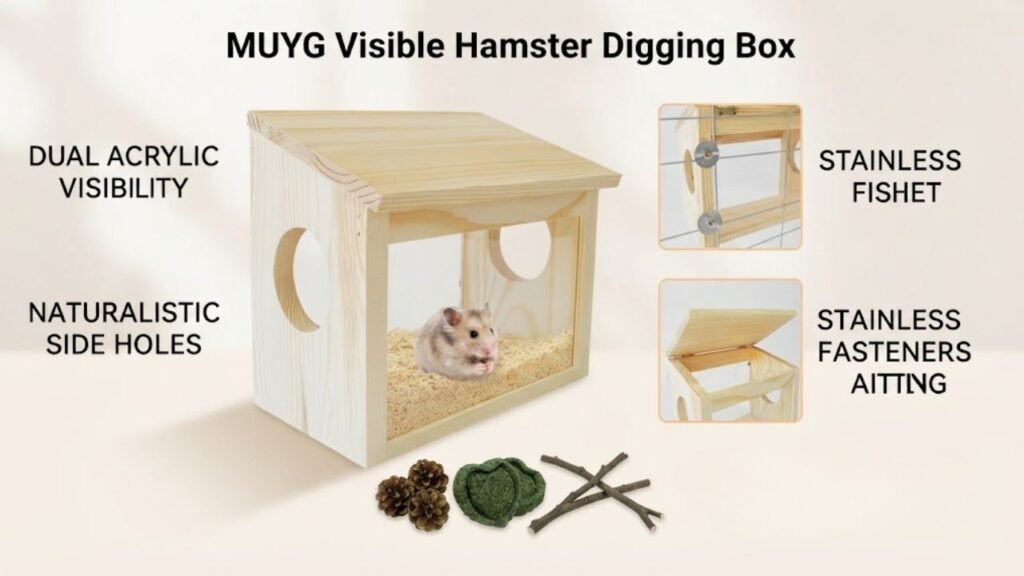
The MUYG dig box for rats distinguishes itself from front-panel-only alternatives through dual acrylic transparency — both the front and back panels are transparent acrylic, providing observation from two sides rather than one. This is a practical advantage in cage configurations where the dig box for rats is positioned centrally or away from the primary viewing position — rats inside can be monitored from either side without repositioning the structure.
The 2.3-inch circular side holes (rather than a top exit only) create a more naturalistic tunnel-entrance experience for rats, who in wild settings enter burrows through side openings at ground level rather than dropping through a top hole. Stainless steel fasteners are specified — a specific detail that prevents the fastener corrosion and degradation that basic metal screws develop in the humid substrate environment of an active dig box for rats.
Key Features
- Dimensions: 7.8″L x 4.7″W x 7.2″H
- Material: Pine + acrylic panels + stainless steel fasteners
- Visibility: Front and back transparent acrylic — dual-side observation
- Side Holes: 2.3″ diameter circular holes on both sides — natural tunnel entrance style
- Top: Openable lid for cleaning access
- Trapezoidal Shape: Top width 5.5″ — slightly wider at top than base
- Included: Chew toys included
- Fasteners: Stainless steel — corrosion-resistant in humid environments
Pros
- Dual-panel transparency (front and back) provides observation from two directions — more monitoring flexibility
- Side entry holes create a naturalistic ground-level tunnel entry experience
- Stainless steel fasteners resist corrosion in the humid substrate environment of an active dig box
- 7.2″ internal height allows 5–6 inches of substrate with adequate clearance
- Chew toys included — immediate enrichment addition without additional purchase
- Amazon’s Choice designation — positive per-review reception
Cons
- 4.7″ width is narrow for adult female rats of standard size — turning inside the box will feel restricted
- Pine wood absorbs urine significantly — requires more aggressive cleaning protocol than acrylic-only alternatives
- Trapezoidal shape reduces effective interior floor space below the stated 7.8″ x 4.7″ dimensions
- Cage mounting with fasteners means relocation requires unscrewing and reattachment
Best For: Owners of juvenile or smaller adult female rats who want a dig box for rats with dual acrylic transparency and naturalistic side entry holes — accepting the narrower interior width
3. NitePookie Fully Detachable Hamster Digging Box — Large Acrylic Panoramic (11.42″ x 8.07″ x 7.68″)
Best For: Rat owners who want the most premium, panoramic dig box for rats with 360-degree acrylic visibility, full panel disassembly for zero-dead-end cleaning, and dual-side DIY habitat openings

Why We Recommend It
The NitePookie dig box is the most functionally advanced dig box for rats in this review — and the 4.7-star rating, while from only 8 reviews, reflects a product that has impressed every owner who has used it. The critical design advantage over every other dig box for rats reviewed here is full disassembly: not just a removable lid, but complete panel separation that eliminates the dead cleaning corners where waste compacts and bacterial biofilm develops.
In a standard enclosed dig box for rats, the junction between floor and walls collects urine-saturated substrate that lid-removal and reach-in scooping cannot fully access. Full panel separation eliminates this entirely — every surface becomes reachable and rinseable. The 360-degree acrylic transparency on four sides and base provides behavioral observation that no other dig box for rats in this review can match.
Key Features
- Dimensions: 11.42″L x 8.07″W x 7.68″H (Large)
- Material: High-transparent smooth acrylic (4 sides + base) + removable wooden top lid
- Visibility: 360-degree panoramic — four-side and base transparency
- Disassembly: Fully detachable — complete panel separation for cleaning
- DIY Openings: Dual-side open gaps — fill with moss, dried flowers, safe branches
- Substrate Capacity: 7.68″ internal height allows 6–7 inches of substrate
- Lid Function: Flat top stably holds water bottles and feeding bowls
- Size Options: Standard (8.7″L x 6.1″W x 6.3″H) or Large
Pros
- Full panel disassembly eliminates dead cleaning corners — the most hygienic dig box for rats in this review
- 360-degree acrylic transparency provides behavioral observation from all four sides and base
- 11.42″ x 8.07″ floor area is the largest in this review — adequate for adult male rats
- 7.68″ internal height allows 6–7 inches of substrate — deepest possible fill of any product reviewed
- Dual-side DIY openings allow habitat decoration and moss/botanical additions for naturalistic setup
- Burr-free premium material finish — smooth acrylic edges eliminate scratch risk throughout
Cons
- Full acrylic construction with wooden lid means the lid is the only non-acrylic component — lid durability under rat chewing is unverified at community scale
- DIY side openings require additional botanical materials (not included) to utilize the naturalistic decorating feature
- Premium design carries a higher price than wood-and-acrylic alternatives in this review
- Fully transparent construction provides no visual privacy for rats during sensitive behavioral periods — some rats prefer partial enclosure
Best For: Rat owners who want the most premium dig box for rats available — maximum substrate depth, 360-degree visibility, and zero-dead-end hygienic cleaning through full panel disassembly
4. PETRYTHM Visible Hamster Digging Box — Acrylic with Color Options (8.6″ x 5.7″ x 5.9″)
Best For: Rat owners who want a fully acrylic dig box for rats with multiple color and material options — including a bamboo frame version for a natural aesthetic — at a mid-range price point

Why We Recommend It
The PETRYTHM dig box for rats offers the widest material and color variety of any product in this review — transparent acrylic, bamboo-framed, bamboo-light, red, yellow, and brown versions all within the same product line. For rat owners building a visually cohesive cage aesthetic, the ability to select a dig box for rats frame color that matches existing cage accessories is a practical option that purely natural or purely transparent alternatives cannot provide.
The fully acrylic construction (transparent version) provides easier cleaning than wood-sided alternatives — smooth acrylic releases substrate residue and urine deposits more completely under rinsing than pine or birch wood surfaces that absorb moisture into the grain.
The top exit at 0.2 inches appears to be a measurement error in the listing — likely referring to the top hole width specification that would make the box non-functional for any animal. Verify the actual entry/exit dimensions directly with the seller before purchasing, particularly for adult-sized rats.
Key Features
- Dimensions: 8.6″L x 5.7″W x 5.9″H
- Material: Acrylic (various color frame options + bamboo variant)
- Visibility: Front transparent acrylic panel
- Top Exit: Stated as 0.2″ — requires verification before purchase
- Colors: Transparent, bamboo, bamboo-light, red, yellow, brown
- Cleaning: Smooth acrylic surface — wipe or rinse clean
- Decoration: Side grid panels allow botanical decoration inserts
- Substrate: Sand bath or digging substrate compatible
Pros
- Widest color and material variety of any dig box for rats reviewed — 6 aesthetic options
- Acrylic construction cleans more thoroughly than wood alternatives — no grain absorption
- Side grid panels allow botanical decoration for naturalistic habitat aesthetics
- Bamboo version provides a natural wood-look alternative to all-plastic designs
- Transparent version provides full front-face visibility of digging behavior
- Multiple purchase options for matching with existing cage color schemes
Cons
- 5.9″ internal height limits substrate depth to approximately 4–5 inches — below the recommended 5–6 inches for satisfying rat burrowing
- Top exit specification (0.2″) appears to be a product listing error — requires pre-purchase verification
- 5.7″ width is marginal for adult female rats and inappropriate for adult males
- No community reviews available to assess — zero public feedback for purchase confidence
- Smallest internal dimensions for rat use of any product reviewed here
- Acrylic frame color options (red, yellow) use colorants of unspecified material safety — verify before purchasing
Best For: Rat owners who prioritize color-matched aesthetics and easy-clean acrylic in a dig box for rats — with mandatory pre-purchase verification of the exit hole dimensions and colorant safety
5. Jinzhenhong Hamster Digging Box with Climbing Ladder (8.6″ x 4.8″ x 5.7″)
Best For: Juvenile rat owners or owners of very small adult female rats who want a dig box for rats with an integrated climbing ladder that doubles as a surface enrichment platform
Why We Recommend It
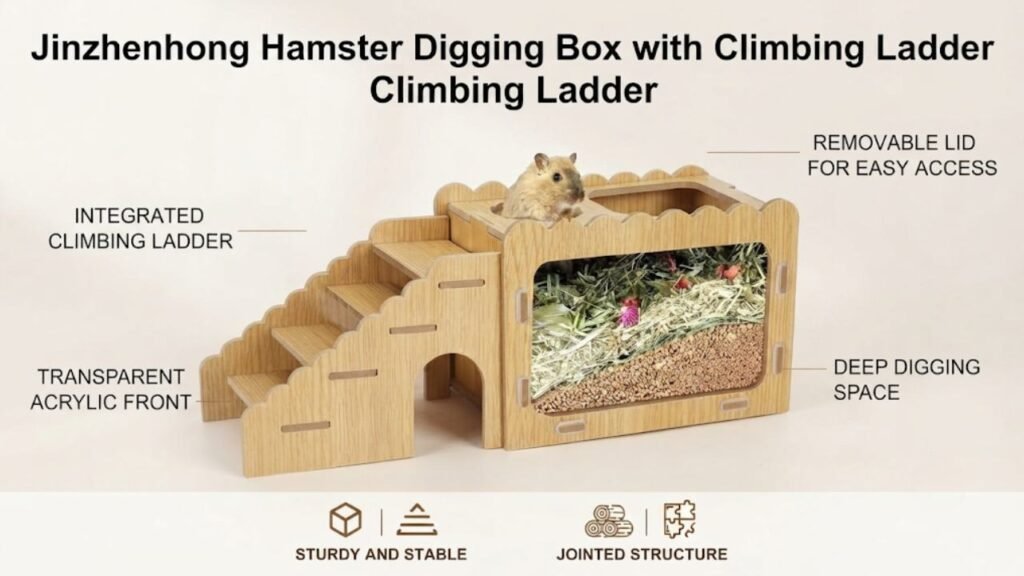
The Jinzhenhong dig box for rats is the only product in this review that integrates a climbing ladder as a structural component — converting the top of the dig box from a simple flat surface into a functional climbing and balance enrichment platform above the burrowing space below. For rats, this vertical stacking of behavioral enrichment (digging below, climbing above) makes effective use of the vertical space that the dig box structure occupies in the cage.
The 2.5-inch top exit provides adequate access for juvenile rats and smaller adult females.
Key Features
- Dimensions: 8.6″L x 4.8″W x 5.7″H
- Material: Acrylic front + wood construction
- Visibility: Transparent acrylic front door
- Top Exit: 2.5″ diameter — suitable for juvenile and small adult rats
- Special Feature: Integrated climbing ladder on top — surface enrichment above digging space
- Lid: Removable top cover for cleaning access
- Use Context: Home, travel, pet shop display
Pros
- Integrated climbing ladder adds physical enrichment above the digging space — stacks two behavioral functions vertically
- 2.5-inch top exit is functional for juvenile rats and smaller adult females
- Transparent acrylic front panel provides forward-facing observation of digging behavior
- Removable top cover allows cleaning access without full disassembly
- Compact dimensions suitable for smaller cage configurations
- Rustic style aesthetic works well in naturalistic cage setups
Cons
- 4.8″ width is the narrowest of any dig box for rats reviewed — adult rats of any size will feel restricted
- 5.7″ internal height limits substrate depth to approximately 4 inches — below optimal for satisfying rat burrowing
- Climbing ladder is part of the lid structure — if the lid is removed for cleaning, the ladder is not accessible during that period
- Wood construction absorbs urine where substrate contacts interior walls
Best For: Juvenile rat owners or owners of very small adult female rats who want a combined digging-and-climbing dig box for rats — with clear expectations that the narrow width limits adult rat use
6. FiboPawer Large Acrylic Hamster Digging Box (9.8″ x 5.9″ x 5.9″)
Best For: Adult female rat owners who want a larger-format, easy-clean acrylic dig box for rats without wood components — the simplest cleaning maintenance of any product reviewed

Why We Recommend It
The FiboPawer acrylic dig box for rats is specifically marketed for its cleaning advantage over wooden alternatives — the all-acrylic construction means no wood grain absorption of urine and no permanent odor development that wooden dig boxes accumulate over months of use.
For owners who maintain high cleaning standards and want a dig box for rats they can simply wipe down or rinse rather than scrub and dry, the all-acrylic format delivers the fastest and most thorough cleaning outcome of any product reviewed here. At 9.8″ x 5.9″ x 5.9″, the floor space is the second-largest in this review and is adequate for adult female rats of standard size.
Key Features
- Dimensions: 9.8″L x 5.9″W x 5.9″H
- Material: Fully acrylic — no wood components
- Visibility: Transparent front panel
- Cleaning: Wipe or rinse clean — no grain absorption
- Assembly: Assembles and disassembles for cleaning
- Use: Digging substrate or sand bath
- Size Advantage: Second-largest floor space in this review
Pros
- All-acrylic construction prevents permanent odor absorption — the cleanest long-term material in this review
- 9.8″ x 5.9″ floor area is adequate for adult female rats and standard-sized rats
- Wipe or rinse cleaning requires less time and effort than wood dig box maintenance
- Smooth acrylic interior releases substrate residue completely under rinsing
- Transparent construction provides full front-face behavioral observation
- Dual-use as sand bath or digging substrate container
Cons
- 5.9″ internal height limits substrate to 4–5 inches — below optimal for meaningful rat tunneling
- All-acrylic construction may develop micro-cracks at panel joints under repeated rat digging pressure against the walls
- Exit size not specified — requires pre-purchase verification for adult rat body size compatibility
- Acrylic panel assembly quality unverified at community scale — connection durability unknown
- Not appropriate for large adult male rats — 5.9″ width limits comfortable movement at larger body sizes
Best For: Adult female rat owners who prioritize the easiest-clean all-acrylic dig box for rats with no permanent odor risk — accepting limited community validation and moderate satisfaction data
What to Put in a Dig Box for Rats
The substrate choice for a dig box for rats determines how satisfying the digging experience is and how structurally stable any tunnels the rat creates will be.
Best Substrates for a Dig Box for Rats
Paper substrate (Carefresh, Kaytee Clean & Cozy): The most commonly recommended primary fill for a dig box for rats. Paper substrate is safe to ingest in small quantities, soft on paws, and holds a light tunnel shape when packed. The limitation is that paper substrate compresses over time and does not hold deep tunnel architecture as well as denser alternatives.
Coco coir (slightly moistened): Provides the best tunnel stability of any substrate for a dig box for rats. When slightly damp (not wet), compressed coco coir holds tunnel structure and chamber shapes that paper alone cannot maintain. Mix with paper substrate at approximately 30% coco coir to 70% paper for a balance of stability and moisture management.
Hemp bedding: Good structural stability, low dust, and safe for ingestion in small quantities. Hemp substrate in a dig box for rats holds tunnel architecture better than pure paper while remaining safer for respiratory health than wood shavings.
Organic soil (pesticide-free): For naturalistic bioactive dig box setups, pesticide-free topsoil mixed with coconut fiber provides the most realistic burrowing substrate. Requires more frequent full replacement to prevent mold development.
Substrates to Avoid in a Dig Box for Rats
- Cedar shavings — phenol content causes respiratory irritation and liver damage
- Pine shavings (untreated) — lower phenol content than cedar but still causes respiratory irritation
- Clumping cat litter — clumping agents create GI obstruction risk if ingested
- Sand alone — collapses immediately during digging, provides no tunnel stability
- Wet substrate — excess moisture promotes bacterial growth and mold in the enclosed dig box environment
How to Introduce a Dig Box to a Rat That Shows No Interest
Not every rat immediately investigates a new dig box for rats — some animals require encouragement before engaging with a new structure in their environment.
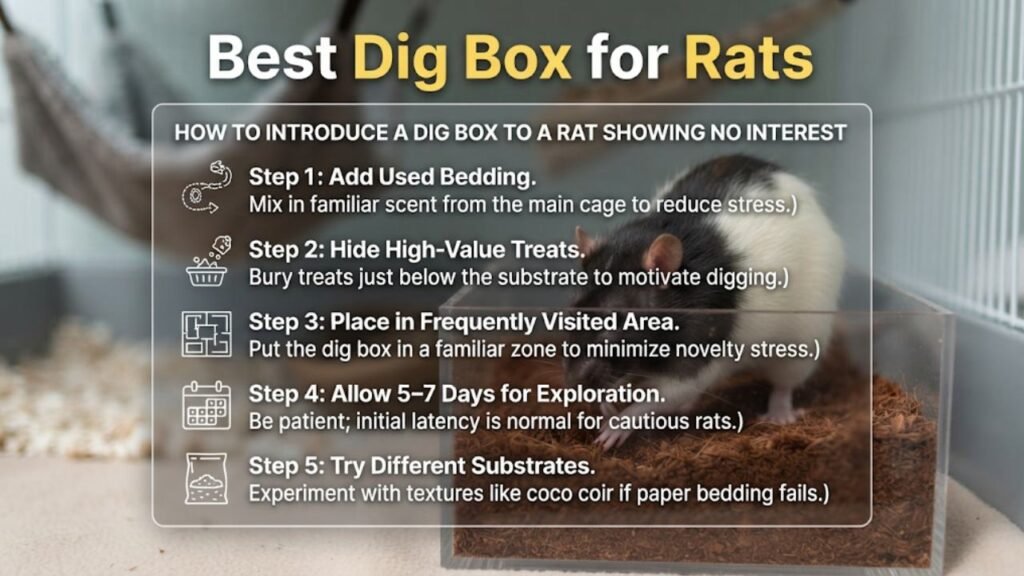
Step 1: Place a small amount of used bedding from the main cage inside the dig box for rats — familiar scent reduces novelty stress and encourages investigation.
Step 2: Hide high-value treats just below the substrate surface inside the dig box — the smell of food motivates initial digging contact.
Step 3: Place the dig box for rats in the area of the cage the rat already visits most frequently — positioning in unfamiliar cage zones adds novelty stress to the new structure stress.
Step 4: Allow at least 5–7 days before concluding the rat is uninterested — initial exploration latency is normal, particularly in cautious individual animals.
Step 5: Try a different substrate type — some rats are highly motivated by the texture and smell of coco coir but show no interest in paper bedding alone as a dig box substrate.
How to Clean a Dig Box for Rats

A dig box for rats requires cleaning on the same schedule as the main cage substrate — typically every 1–2 weeks for a 2-rat household.
Weekly spot maintenance: Remove any visible droppings from the substrate surface and replace the top inch of substrate if visibly soiled. Do not disturb the deeper substrate layers unless soiling is evident — rats that have constructed chambers in the lower layers will use those chambers more consistently if they are not destroyed by unnecessary full cleanings.
Full clean (every 1–2 weeks):
- Remove all substrate — discard completely
- Separate all disassembleable panels (NitePookie full disassembly is fastest for this step)
- Rinse all acrylic components under warm water — no soap required for standard soiling
- For wooden components: wipe with diluted white vinegar solution (1:1 with water), then rinse and allow to dry completely in a ventilated area before reassembling
- Do not return the dig box for rats to the cage until wooden components are fully dry — damp wood in a substrate-filled environment develops mold within 24–48 hours
Acrylic panels: Wipe with a microfiber cloth only — standard cloths and paper towels create micro-scratches that reduce transparency progressively over months.
DIY Dig Box for Rats: When a Commercial Box Is Not the Right Fit
Commercial dig boxes for rats are sized primarily for hamsters and small gerbils. For very large adult male rats who consistently exceed the interior dimensions of available commercial options, a DIY dig box for rats is often the most practical solution.
Suitable DIY dig box containers:
- Large plastic storage tubs with a hole cut in the lid (minimum 3-inch diameter for adult rat entry)
- Glass aquarium tanks repurposed with a mesh lid — provide the deepest substrate capacity of any container format
- Large ceramic mixing bowls with smooth interior surfaces — stable, easy-clean, and cannot be tipped
The key requirements for any DIY dig box for rats are the same as commercial options: sufficient internal depth for 5+ inches of substrate, an exit hole sized for the specific rat using it, smooth interior surfaces with no sharp edges, and a cleaning method that can be consistently maintained.
Frequently Asked Questions About Dig Boxes for Rats
Can I use a dig box for rats that is designed for hamsters?
Yes, with size verification. Check the internal floor dimensions against your rat’s body length — adult female rats need at least 8″ x 6″ internal floor space, and adult males need 10″ x 7″ or larger. Most hamster-sized dig boxes are too small for adult male rats.
How deep should the substrate be in a dig box for rats?
A minimum of 4 inches for basic digging satisfaction, and 5–6 inches for meaningful tunnel construction. Calculate usable depth by subtracting the exit hole height from the total internal height.
How often should I clean the dig box for rats?
Full substrate replacement every 1–2 weeks, with weekly spot removal of visible droppings from the substrate surface. More frequent full cleaning destroys tunnel structures rats have constructed and causes stress.
What is the best substrate for a dig box for rats?
A mix of paper bedding (70%) and slightly moistened coco coir (30%) provides the best balance of safety, tunnel stability, and ease of cleaning. Pure paper is the simplest option. Avoid cedar, pine, and clumping cat litter entirely.
Final Thoughts on Choosing the Best Dig Box for Rats
The dig box for rats that best serves burrowing behavior starts with one calculation: is the internal depth sufficient to hold 5–6 inches of substrate? If the answer is no, the box will provide a shallow contact with digging substrate that fails to engage the burrowing instinct meaningfully regardless of how well the rest of the design performs.
For most adult female rat owners, the Niteangel dig box for rats provides the strongest combination of verified community confidence, appropriate floor dimensions, and usable internal depth in the standard wood-acrylic format. For owners who want the premium experience with 360-degree visibility and zero-dead-end cleaning capability, the NitePookie full-acrylic panoramic dig box for rats delivers the most functionally advanced design in this review — with the honest caveat that only 8 reviews currently exist to validate it.
For owners of very large adult male rats, the honest recommendation is to supplement any commercial dig box for rats with a deep-substrate cage section or repurposed storage container that provides the larger floor dimensions that commercially available products in this category cannot yet match. What every dig box for rats in this guide shares is the fundamental purpose of giving a burrowing-driven animal a space where that drive can be fully expressed — and that behavioral outlet, provided consistently, is one of the most impactful welfare investments a rat owner can make.
