

A gerbil tank setup is not simply an enclosure — it is the entire behavioral environment that determines whether a gerbil thrives or merely survives in captivity. Mongolian gerbils in the wild construct elaborate underground tunnel systems reaching several feet in depth, with separate chambers for sleeping, food storage, and waste. These tunnel systems are not luxury behavior — they are a fundamental biological drive that does not disappear in captivity regardless of how enriched the surface environment is. A gerbil without the ability to dig, burrow, and create underground passages experiences a form of chronic behavioral frustration that manifests as bar chewing, excessive grooming, hyperactivity, and stress-related aggression between colony members.
The gerbil tank setup you build needs to address burrowing depth first and surface enrichment second. Most commercially available gerbil cages fail at this basic requirement — they provide surface-level platforms, wheels, and tubes while offering only 2–3 inches of substrate depth, which is functionally insufficient for actual tunnel construction. A genuine gerbil tank setup starts with a minimum of 6 inches of suitable substrate in a glass or acrylic enclosure that holds the substrate depth stable without collapsing at the walls. Wire-bar cage floors prevent burrowing entirely, making them unsuitable as the primary gerbil tank setup for burrowing-focused welfare.
This guide covers what a proper gerbil tank setup requires, reviews the best tunneling and digging enrichment accessories currently available, and provides the setup guidance that converts a basic enclosure into a genuinely functional gerbil tank setup built around the behavioral needs of active, burrowing gerbils.

- What Makes a Safe and Functional Gerbil Tank Setup for Digging?
- Substrate Depth — The Foundation of Every Gerbil Tank Setup
- Enclosure Type for Substrate Depth
- Escape Prevention in a Deep-Substrate Gerbil Tank Setup
- Temperature Management in Glass Tank Gerbil Setups
- Ventilation in a Gerbil Tank Setup
- Product Reviews: Best Gerbil Tank Setup Tunneling Accessories
- 1. Niteangel Creative & Composable Hamster Tunnel — Seagrass
- 2. Hamiledyi Wooden 2-Chamber Hideout-Tunnel
- 3. Niteangel Hamster House with Climbing Ladder — Secret Peep Tunnel Hut
- 4. Cyirexylcc Multi-Chamber Wooden Hamster Hideout & Tunnel
- 5. Hamiledyi 8-Piece Plastic Hamster Tunnel Tube Set
- 6. AccEncyc Hamster Tunnel Hideout with Climbing Ladder
- 7. Niteangel Ceramic Hamster Tunnel & Tubes Hideout
- 8. MUYG Natural Birch Tree Trunk Tunnel
- Comparison Table: Best Gerbil Tank Setup Tunneling Accessories
- How to Build a Complete Gerbil Tank Setup for Digging and Tunneling
- Step 1 — Select the Right Enclosure
- Step 2 — Layer the Substrate for Maximum Burrow Stability
- Step 3 — Install Tunnel Accessories Before Adding Top Substrate
- Step 4 — Add Surface Enrichment Above the Substrate Layer
- Step 5 — Secure the Enclosure Top
- Wooden vs. Ceramic vs. Natural Fiber Tunnels in a Gerbil Tank Setup
- Wood Tunnels in a Gerbil Tank Setup
- Ceramic Tunnels in a Gerbil Tank Setup
- Natural Fiber Tunnels (Seagrass) in a Gerbil Tank Setup
- Plastic Tunnels in a Gerbil Tank Setup
- How to Maintain a Deep-Substrate Gerbil Tank Setup
- Daily
- Weekly
- Monthly
- Frequently Asked Questions About Gerbil Tank Setups
- Final Thoughts on Building the Best Gerbil Tank Setup for Digging
What Makes a Safe and Functional Gerbil Tank Setup for Digging?
Understanding the specific requirements of a burrowing-focused gerbil tank setup prevents the most common setup mistakes that owners encounter after purchasing an enclosure and accessories.
Substrate Depth — The Foundation of Every Gerbil Tank Setup
No other element of a gerbil tank setup matters as much as substrate depth. The minimum depth recommendation from small animal welfare organizations for a gerbil tank setup is 6 inches of suitable substrate.
This allows gerbils to create basic U-shaped tunnels with a buried entrance, a horizontal run, and a sleeping chamber. For owners committed to providing a naturalistic gerbil tank setup, 8–10 inches of substrate is significantly better — enabling multi-chamber tunnel systems that provide genuine behavioral expression.
Substrates suitable for burrowing in a gerbil tank setup:
- Compressed paper substrate (Carefresh, Kaytee Clean & Cozy): High absorbency, good tunnel stability, low dust — the most practical choice for most gerbil tank setups
- Hemp bedding: Excellent tunnel stability, low dust, natural material — a strong choice for burrowing-focused setups
- Coco coir (slightly moistened): Outstanding tunnel stability when mixed with paper substrate — mimics desert soil moisture content that gerbils experience naturally
- Peat moss and soil mix: Best tunnel stability of any substrate — appropriate for naturalistic bioactive gerbil tank setups but requires more maintenance
- Avoid: Cedar and pine shavings (aromatic oils cause respiratory irritation), sand alone (collapses without structural stability), cat litter (compacts into hard masses that injure paws)
Enclosure Type for Substrate Depth
A glass aquarium tank is the most practical enclosure for a deep-substrate gerbil tank setup. Glass walls hold substrate stable at depth without the wall-collapse that occurs when deep bedding is added to wire-bar cage floors. A 40-gallon breeder aquarium (36″ x 18″ x 16″) provides adequate floor space for a gerbil pair with 8+ inches of substrate depth. The tank top should be a mesh or wire lid that locks securely — gerbils are capable climbers and will investigate every gap in an enclosure top.
Glass tanks also solve the ventilation challenge of deep-substrate gerbil tank setups: a mesh lid provides full cross-ventilation from the top while the glass walls retain substrate humidity at burrowing level — where gerbils actually spend most of their time.
Escape Prevention in a Deep-Substrate Gerbil Tank Setup
A gerbil tank setup with deep substrate creates a specific escape risk that shallow setups do not: gerbils can construct tunnels that emerge above the substrate level at the enclosure walls, reaching heights that allow cage-top access.
In a glass aquarium gerbil tank setup, the smooth glass walls prevent climbing — but the burrowed height plus the gerbil’s standing reach can approach the top of an 16-inch deep tank when 8 inches of substrate is used. A securely locked mesh lid with no gaps larger than 1/2 inch is essential.
Temperature Management in Glass Tank Gerbil Setups
Glass tank gerbil setups are more temperature-sensitive than wire cage alternatives because they trap heat more effectively. Gerbils are comfortable between 65–75°F (18–24°C) and experience heat stress above 80°F (27°C). A glass gerbil tank setup in direct sunlight or near a heating vent will overheat much faster than a wire cage in the same location — the glass retains radiant heat while the substrate insulates from below, creating a temperature gradient that rises faster than owners typically anticipate.
Position your gerbil tank setup away from direct sunlight, heating vents, and radiators. Monitor with a thermometer placed at substrate surface level — the temperature at the mesh lid top and at the substrate surface can differ by 5–8°F in a poorly positioned gerbil tank setup.
Ventilation in a Gerbil Tank Setup
The common concern about glass tank gerbil setups is that they restrict airflow. This is a real consideration — solid glass walls on five sides with only a mesh top means all ventilation comes through a single surface. For a standard-depth gerbil tank setup (under 6 inches of substrate with normal gerbil population), this provides adequate airflow for a pair of gerbils. For deeper substrate setups or larger groups, ensure:
- The mesh lid covers the full top surface — not just a partial section
- The room where the gerbil tank setup is located has adequate ambient ventilation
- The substrate is not so damp that anaerobic decomposition begins — which produces ammonia at substrate level even in an otherwise well-ventilated gerbil tank setup
- Spot-clean the top substrate layer weekly to prevent ammonia accumulation from urine-concentrated areas
Product Reviews: Best Gerbil Tank Setup Tunneling Accessories
1. Niteangel Creative & Composable Hamster Tunnel — Seagrass
Best For: Gerbil tank setup owners who want a buriable, naturally chew-safe seagrass tunnel that integrates with a full modular Niteangel tunnel system
Why We Recommend It
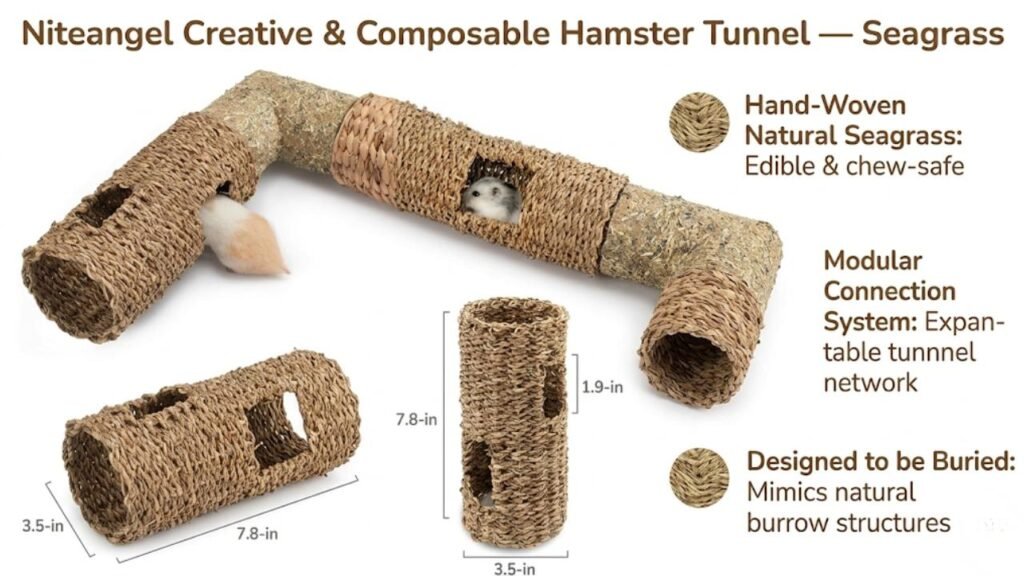
The Niteangel seagrass tunnel earns its place as a gerbil tank setup foundation because it is the only modular tunnel system in this review made from a material that is both buriable in deep substrate and genuinely safe to ingest when chewed. Hand-woven seagrass can be buried completely in a gerbil tank setup’s substrate layer — gerbils will naturally burrow around and beneath it, incorporating the tunnel into their constructed tunnel network.
When the seagrass is chewed (which is inevitable and appropriate), the ingested fiber poses no toxicity risk, unlike plastic tubes or treated wood that shed fragments of concern. The modular connection system — with at least 2 holes per piece and multiple style options (HC, corner, T-shape, tunnel with hole, burrow piece) — allows owners to create custom tunnel configurations that can be adjusted as gerbils modify their own burrowing patterns around the installed pieces.
Key Features
- Material: Hand-woven natural seagrass — edible and chew-safe
- Diameter: 3.5″ tunnel diameter — accommodates Syrian-sized gerbils
- Entrances: HC style has 4 entrances for multi-directional access
- Modular: Compatible with all Niteangel seagrass tunnel pieces
- Buriable: Designed to be buried in gerbil tank setup substrate
- Size: 7.8″L x 3.5″W x 3.5″H
- Side Entrance: 1.9″ wide
- Enrichment Purpose: Mimics underground burrow system structure
Pros
- Natural seagrass is safe to ingest — eliminates the fragment-ingestion concern of plastic tunnels
- Designed to be buried — functions as a genuine underground tunnel in a gerbil tank setup
- 3.5″ diameter accommodates adult gerbils of all standard sizes
- Modular — expandable into a full tunnel network as gerbil tank setup grows
- 4 entrances allow multiple approach and exit directions — naturalistic burrow access
- Hand-woven natural material satisfies the texture-exploration instinct alongside burrowing
Cons
- Seagrass degrades through chewing and burrowing — requires periodic replacement
- Cannot be machine washed or rinsed — wipe cleaning only before degradation necessitates replacement
- 1.9″ side entrance may restrict entry for larger adult gerbils in paired setups
- Natural material absorbs moisture — in very damp substrate setups, can develop mold faster than ceramic or plastic alternatives
Best For: Gerbil tank setup owners using deep natural substrate who want a buriable, chew-safe, modular seagrass tunnel system as the burrowing structure foundation
2. Hamiledyi Wooden 2-Chamber Hideout-Tunnel
Best For: Gerbil tank setup owners who want a surface-level wooden 2-chamber exploration structure with a bottomless design that integrates with existing substrate

Why We Recommend It
The Hamiledyi 2-chamber wooden hideout earns its Amazon’s Choice status through a combination of genuine functional design and strong review validation that budget-competing products cannot match. The bottomless design is the most practically important feature for a gerbil tank setup: without a base, gerbils can dig directly through the hideout into the substrate below, naturally incorporating the wooden structure into their self-constructed burrow system.
A gerbil that digs into a baseboards hideout experiences a genuine burrowing reward that solid-base alternatives cannot provide. The 2-chamber design creates decision-point exploration — gerbils must navigate between rooms, which is a cognitively enriching activity that reduces boredom-driven bar chewing.
Key Features
- Material: Natural wood — no glue, no nails, sandpaper-finished edges
- Chambers: 2 interconnected chambers for multi-room exploration
- Base: Bottomless — gerbils can burrow directly through into substrate
- Size: 8.3″ x 4.3″ x 3.2″ (Medium)
- Entrance: Mouse-shaped door opening
- Sizes Available: M, M+M, L, L+L, XL
- Cleaning: Wipe clean — bottomless design prevents urine floor absorption
- Species: Dwarf hamsters, Syrian hamsters, gerbils
Pros
- Bottomless design allows direct substrate burrowing through the hideout — genuine integration with gerbil tank setup substrate layer
- No glue or nails — natural material safety throughout
- 2-chamber navigation provides cognitive enrichment beyond single-room alternatives
- Sandpaper-finished edges eliminate sharp contact points
- Available in multiple size combinations — scalable to different gerbil tank setup dimensions
Cons
- Wood absorbs urine where substrate contact occurs — requires periodic deep cleaning or replacement
- Not buriable — surface placement only, unlike seagrass or ceramic tunnel alternatives
- Mouse-shaped entrance door may restrict larger adult Mongolian gerbils depending on individual body size
- No modular connection system — cannot be expanded or linked to other tunnel pieces
- Natural wood will show significant chewing damage over time — monitor for splinter development at chewed edges
Best For: Gerbil tank setup owners who want a bottomless wooden 2-chamber exploration structure that allows direct substrate burrowing through the base
3. Niteangel Hamster House with Climbing Ladder — Secret Peep Tunnel Hut
Best For: Gerbil tank setup owners who want a surface-level tunnel hut with an integrated climbing ladder roof for multi-level enrichment above the substrate
Why We Recommend It
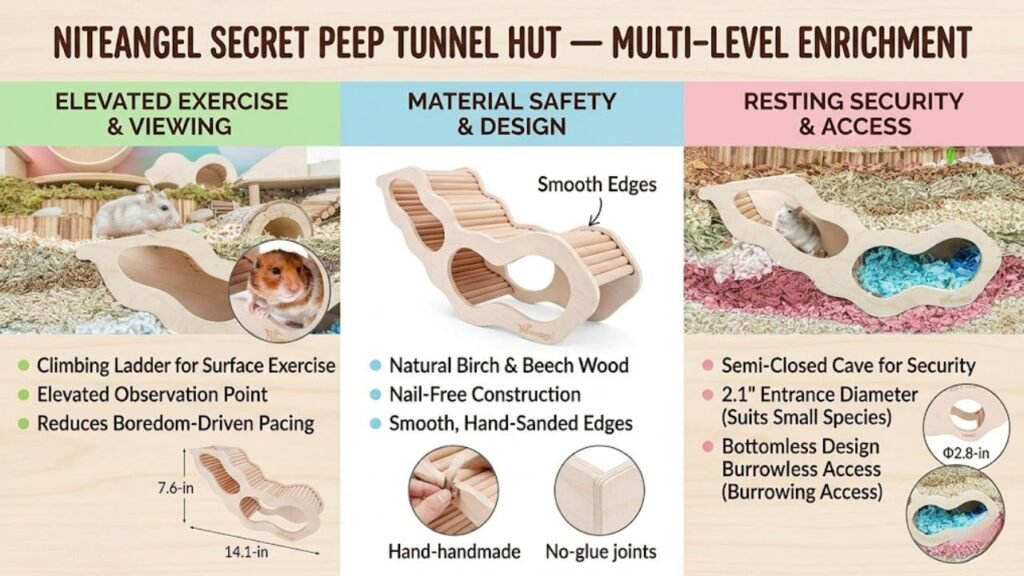
The Niteangel Secret Peep Tunnel Hut occupies a specific role in a gerbil tank setup that pure burrowing accessories cannot fill: it provides the elevated surface structure that gerbils use when emerging from burrows to feed, explore, and exercise.
The exercise ladder roof is the distinguishing feature — gerbils that would otherwise pace on a flat cage floor have an elevated climbing surface that serves both as a physical outlet and a higher observation point. The semi-closed internal cave with a 2.1-inch entrance provides the enclosed security feeling that reduces stress during resting without the complete enclosure that prevents airflow in warmer environments.
Key Features
- Material: Selected birch plywood + beech sticks — nail-free construction
- Dimensions: 14.1″L x 3.3″W x 7.6″H
- Entrance Diameter: 2.1″ — suited for dwarf and smaller gerbil species
- Roof: Exercise climbing ladder — balance and agility enrichment
- Base: Bottomless — substrate burrowing access from inside hut
- Cleaning: Bottomless design simplifies interior cleaning
- Construction: Hand-made, sanded smooth at all corners
Pros
- Integrated climbing ladder provides surface exercise above the burrowing substrate — addresses both needs in one structure
- Birch plywood and beech construction with no nails — genuine material safety standard
- Semi-closed cave entrance provides security without full enclosure heat trapping
- 14.1-inch length provides meaningful tunnel length for gerbils running through
- Bottomless design allows substrate integration at the base
Cons
- 2.1-inch entrance is appropriate for dwarf species and smaller gerbils — may feel tight for larger adult Mongolian gerbils
- 3.3-inch width is narrow — gerbils turning inside the tunnel may feel restricted
- Surface placement only — not designed to be buried in gerbil tank setup substrate
- No modular connection system — standalone piece only
- Higher price than comparable hideout-only structures without the ladder component
Best For: Gerbil tank setup owners who want a surface-level tunnel hut with an integrated climbing ladder that addresses exercise, exploration, and resting in one multi-function structure
4. Cyirexylcc Multi-Chamber Wooden Hamster Hideout & Tunnel
Best For: Gerbil tank setup owners who want a modular, multi-chamber wooden tunnel system with waterproof coating and zero-formaldehyde plant-based adhesive
Why We Recommend It
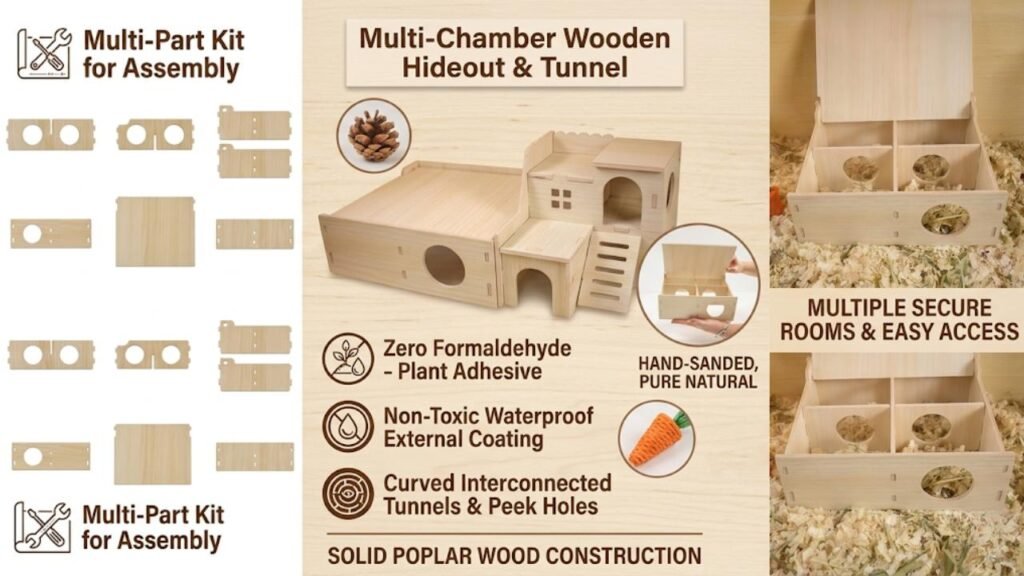
The Cyirexylcc multi-chamber wooden hideout addresses a specific quality concern that natural wood tunnels frequently face: moisture absorption leading to warping, mold, and structural degradation in the humid substrate layer of a gerbil tank setup.
The non-toxic waterproof external coating maintains moisture resistance while keeping all internal surfaces genuinely safe for gerbil contact — an important distinction, since internal coatings that contact gerbil mouths and paws require a different safety standard than exterior coatings.
The plant-based adhesive and zero-formaldehyde construction addresses the chemical safety concern that cheap bonded wood products present when gerbils chew at bonded joints.
Key Features
- Material: Solid poplar wood — sanded smooth edges
- Adhesive: Plant-based — zero formaldehyde stated
- Coating: Non-toxic waterproof external coating — moisture resistant
- Design: Multi-chamber with interconnected tunnels + peek holes
- Modular: Compatible with 1.5–2 inch diameter tubes and platforms
- Mounting: Floor mount
- Safety: No harmful chemicals stated — pure natural construction
Pros
- Waterproof external coating extends lifespan in humid substrate environments
- Zero-formaldehyde plant-based adhesive eliminates chemical ingestion risk at chewed joints
- Multi-chamber design with curved tunnels provides complex exploration paths
- Modular compatibility with standard tube diameters allows integration into existing gerbil tank setup
- Peek holes provide observation points without disturbing gerbils inside
- Poplar wood with sanded edges — smooth contact at all surfaces
Cons
- Waterproof coating effectiveness over extended gerbil use and chewing is unverified at community scale
- Gerbil Cage dimension requirement (at least twice the hideout size) limits placement in smaller gerbil tank setups
- Internal dimensions not specified — difficult to pre-assess suitability for different gerbil body sizes
Best For: Gerbil tank setup owners who prioritize chemical material safety (zero formaldehyde, plant adhesive, waterproof coating) in a modular multi-chamber wooden tunnel system
5. Hamiledyi 8-Piece Plastic Hamster Tunnel Tube Set
Best For: Gerbil tank setup owners who want an expandable, transparent, easy-to-clean plastic tube system for surface-level tunnel exploration

Why We Recommend It
The Hamiledyi 8-piece plastic tube set addresses a different gerbil tank setup need than natural material tunnels: it provides an expandable, transparent, and fully cleanable above-ground tunnel network that allows owners to observe gerbil movement through the tube system in real time.
This behavioral monitoring value is unique — no other tunnel system reviewed here allows full visibility of the gerbil while inside the tunnel. The 2.1-inch diameter is sized for dwarf gerbil species and standard Mongolian gerbils up to average adult size.
The gap-free connection design prevents paw catching at joints — the most common injury point in poorly designed plastic tube systems.
Key Features
- Material: Sturdy transparent plastic
- Diameter: 2.1 inches — dwarf and standard gerbil sizes
- Pieces: 8-piece set with multiple configuration options
- Transparency: Full visibility through tube walls
- Connection: Gap-free joints — no paw-catching risk
- Expandable: Connects to other habitats and tube systems
- Cleaning: Disassemble and rinse — fastest cleaning of any tunnel reviewed
- Installation: Hot air or warm water softens connector rings for easier assembly
- Colors: Blue, pink, purple
Pros
- Full transparency allows behavioral observation inside tunnel system — unique welfare monitoring capability
- Gap-free connection joints eliminate the paw-catching injury risk that older tube systems create
- Easiest cleaning of any tunnel in this review — rinse under running water after disassembly
- Expandable — connects to additional tube sets or other habitat extensions
- 8-piece set provides enough configuration variety for complex surface tunnel networks
- Colors available provide aesthetic variety for different gerbil tank setup themes
Cons
- 3.9-star rating — the lowest of any tunnel product reviewed here, with some durability and connection concerns
- Plastic is not chew-safe for gerbils — ingested plastic fragments create genuine GI risk
- 2.1″ diameter may feel tight for larger adult Mongolian gerbils — particularly for turning within the tube
- Cannot be buried in gerbil tank setup substrate — surface placement only
- Hot water installation requirement indicates the connection mechanism is not reliably user-friendly
Best For: Gerbil tank setup owners who want transparent plastic tube enrichment for surface-level tunnel observation — with full understanding that chewed plastic poses safety risks and tubes require daily inspection
6. AccEncyc Hamster Tunnel Hideout with Climbing Ladder
Best For: Gerbil tank setup owners who want a large buriable wooden ladder-tunnel that can be partially submerged in substrate to create an artificial underground cave entrance
Why We Recommend It
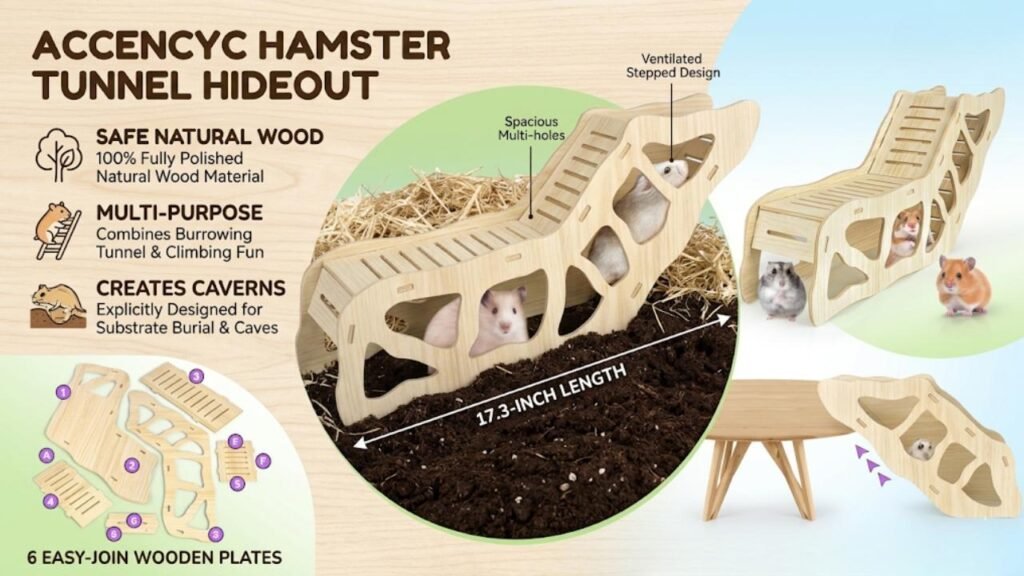
The AccEncyc hideout ladder is the largest single piece reviewed here at 17.3″ x 7.7″ x 3.8″ — a dimension that allows it to span the full depth of a glass aquarium gerbil tank setup’s substrate layer when partially buried. The design intent is explicitly stated: “place the hamster bridge into the hamster bedding and an artificial underground cave is set up to shelter.”
This burial functionality makes it the most substrate-integrated wooden tunnel option reviewed here. Gerbils that encounter the buried ladder structure will naturally incorporate it into their tunnel network — the wood provides structural support that prevents tunnel collapse in areas where the gerbil has excavated around the buried component.
Key Features
- Material: Natural wood — fully polished, smooth-processed corners
- Dimensions: 17.3″L x 7.7″W x 3.8″H — largest piece in this review
- Function: Partially buriable in gerbil tank setup substrate
- Purpose: Creates artificial underground cave when buried in bedding
- Connection: Compatible with hamster huts, platforms, and houses
- Cleaning: Natural wood — wipe clean
- Species: Syrian hamsters, dwarf hamsters, gerbils, small guinea pigs
Pros
- Largest tunnel piece reviewed — spans significant depth of a glass tank gerbil setup’s substrate
- Explicitly designed for substrate burial — creates genuine artificial underground cave structure
- Fully polished corners throughout — no sharp contact points
- Compatible with other cage accessories as a connecting tunnel component
- 17.3-inch length creates the longest continuous underground tunnel run of any piece reviewed
- Natural wood — chew-safe material appropriate for gerbil gnawing behavior
Cons
- Natural wood absorbs urine significantly when buried in substrate — requires frequent inspection for ammonia buildup
- Assembly required — “follow instruction step by step” guidance suggests some complexity
- Wood joints can crack under excessive force during assembly — manufacturer cautions against pushing joints too hard
- 3.8-inch height limits burial depth to a specific substrate range — too shallow to bury fully in 8+ inch setups without emerging at surface
- Larger size requires significant gerbil tank setup floor area planning
Best For: Gerbil tank setup owners using 4–6 inch substrate depth who want the longest buriable wooden tunnel piece available for creating a large-footprint artificial underground cave
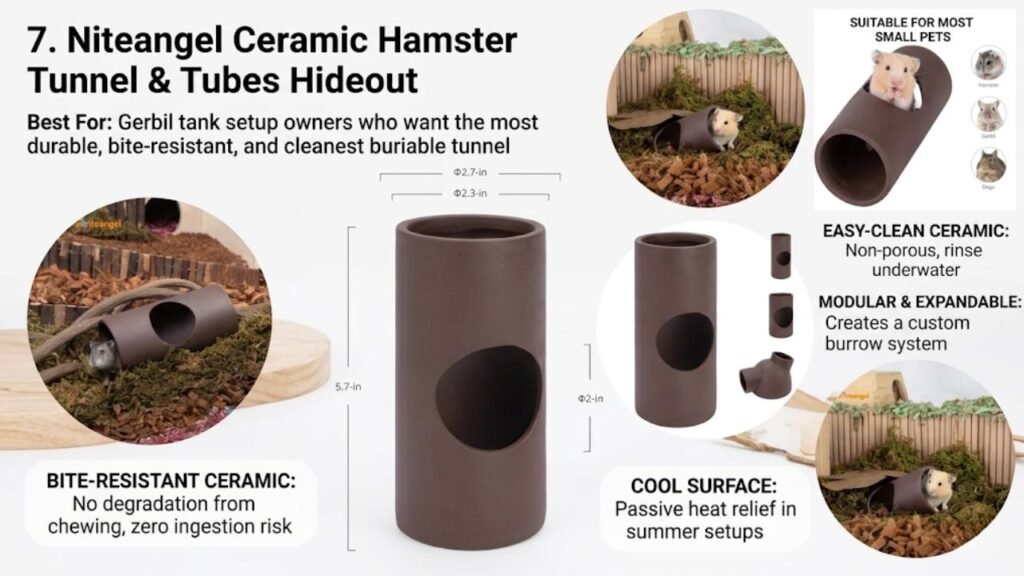
7. Niteangel Ceramic Hamster Tunnel & Tubes Hideout
Best For: Gerbil tank setup owners who want the most durable, bite-resistant, and cleanest buriable tunnel that maintains structural integrity regardless of gerbil chewing — the premium long-term gerbil tank setup investment
Why We Recommend It
The Niteangel ceramic tunnel is the most functionally superior tunnel accessory for a permanent gerbil tank setup — and the 4.8-star rating across 374 reviews validates this claim at community scale. Ceramic provides three advantages that no other material in this review matches simultaneously: it is bite-resistant (no degradation from chewing), rinseable under water without warping or mold risk, and actively cooling in summer environments — ceramic surface temperature stays lower than ambient air temperature, providing a passive cooling effect in warmer gerbil tank setups that wood and plastic cannot replicate.
The 2.3-inch inner diameter fits standard gerbil species comfortably, and the side entrances are compatible with other Niteangel ceramic components — creating a fully expandable ceramic burrow system that maintains structural integrity indefinitely.
Key Features
- Material: Quality ceramic — bite-resistant, cool surface, non-porous
- Inner Diameter: 2.3″ — accommodates standard gerbil sizes
- Length: 5.7″ (small version)
- Side Entrances: 2 side openings compatible with Niteangel ceramic system
- Buriable: Designed to be covered by bedding in gerbil tank setup
- Cleaning: Rinse underwater — no drying time issues unlike wood
- Temperature: Cooler than ambient in summer — passive heat relief
- Modular: Expandable with Niteangel ceramic hideout pieces
Pros
- Bite-resistant ceramic — no degradation or fragment ingestion risk from chewing
- Rinse-clean under water in seconds — the easiest-cleaning tunnel in this review by a significant margin
- Passive cooling surface — meaningful temperature benefit in warm gerbil tank setups
- Designed to be buried and hold shape — does not collapse when gerbils burrow around it
- Modular with Niteangel ceramic system — expandable into a full ceramic burrow network
Cons
- 5.7-inch length is shorter than wood alternatives — requires multiple pieces for longer tunnel runs
- Higher price per piece than wood or seagrass alternatives
- Ceramic weight is significant — repositioning within a gerbil tank setup requires more effort than lightweight wood pieces
- Ceramic can crack if dropped during cleaning — handle with care outside the tank
- Small version’s 2.3-inch diameter may feel slightly narrow for the largest adult Mongolian gerbil body sizes
Best For: Gerbil tank setup owners who want a permanent, bite-resistant, rinse-clean, buriable ceramic tunnel system that provides passive cooling and indefinite structural integrity
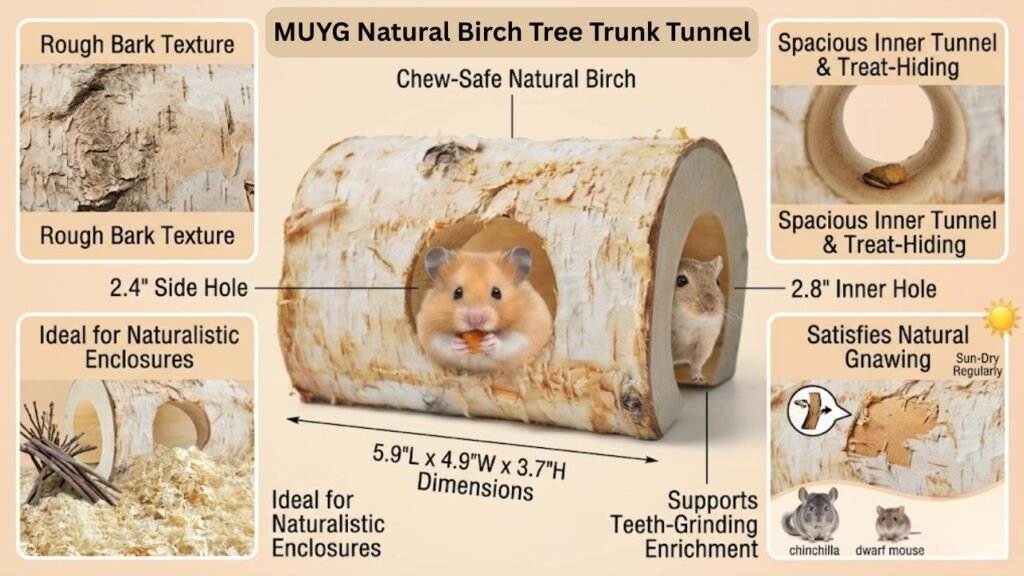
8. MUYG Natural Birch Tree Trunk Tunnel
Best For: Gerbil tank setup owners who want a naturalistic birch tree trunk hollow that provides rough-surface chewing enrichment alongside tunnel hiding in one piece
Why We Recommend It
The MUYG birch tree trunk tunnel offers a genuinely different aesthetic and functional experience within a gerbil tank setup than machined wooden tunnels. The rough natural birch surface actively satisfies gnawing behavior through its uneven texture — gerbils that chew at the outer surface are engaging in natural bark-stripping behavior that also serves as teeth-grinding enrichment.
The 2.8-inch inner hole and 2.4-inch side hole dimensions accommodate standard gerbil sizes comfortably for resting and hiding, while the hollow trunk format allows substrate to be mounded around the base for a partially-buried, semi-natural appearance in a naturalistic gerbil tank setup.
The manufacturer’s honest disclosure that natural birch develops surface cracks and requires regular sun exposure to prevent mold during use reflects genuine product transparency.
Key Features
- Material: Natural birch wood — rough natural surface texture
- Inner Hole: 2.8″ diameter
- Side Hole: 2.4″ diameter
- Dimensions: 5.9″L x 4.9″W x 3.7″H
- Function: Hiding, climbing, chewing, resting, treat-hiding
- Surface: Rough natural bark texture — teeth-grinding enrichment
- Maintenance: Sun-dry regularly to prevent mold — manufacturer stated
- Species: Hamsters, guinea pigs, chinchillas, gerbils, dwarf mice, rats
Pros
- Natural birch rough surface provides teeth-grinding enrichment alongside tunnel hiding
- 2.8-inch inner diameter is the most spacious single-tunnel entrance in this review
- Treat-hiding functionality converts the tunnel into a foraging enrichment item
- Naturalistic tree trunk aesthetic integrates with natural-theme gerbil tank setups
- Multiple functions in one piece — hiding, climbing, grinding, resting
- Natural birch is chew-safe — no toxic materials
Cons
- Surface cracks on natural birch are normal but can develop sharp edges if chewing concentrates at a crack point — monitor regularly
- Requires regular sun exposure to prevent mold — more active maintenance than ceramic alternatives
- Cannot be rinsed under water — moisture management requires sun-drying rather than washing
- No modular connection — standalone piece only
- Natural material variation means individual pieces will differ in appearance from product images
Best For: Gerbil tank setup owners building a naturalistic theme enclosure who want a rough-surface birch tunnel that provides teeth-grinding enrichment alongside burrowing and hiding
Comparison Table: Best Gerbil Tank Setup Tunneling Accessories
| Product | Material | Buriable | Chew-Safe | Diameter | Best Gerbil Size | Multi-Connect | Cleaning |
|---|---|---|---|---|---|---|---|
| Niteangel Seagrass Tunnel | Seagrass (natural) | Yes | Yes (edible) | 3.5″ | All sizes | Yes (modular) | Wipe/replace |
| Hamiledyi 2-Chamber Wood | Natural wood | Partial | Yes (chewable) | Multiple entries | Dwarf + Syrian | No | Wipe clean |
| Niteangel Secret Peep Hut | Birch plywood + beech | No (surface) | Yes | 2.1″ entrance | Dwarf + small | No | Wipe clean |
| Cyirexylcc Multi-Chamber Wood | Poplar + plant adhesive | Partial | Yes | Not specified | Dwarf + Syrian | Yes (modular) | Wipe clean |
| Hamiledyi 8pc Plastic Tube | Plastic | No | No | 2.1″ | Dwarf + gerbil | Yes (expandable) | Rinse clean |
| AccEncyc Hideout Ladder | Natural wood | Yes (design intent) | Yes | Multiple | Syrian + medium | Partial | Wipe clean |
| Niteangel Ceramic Tunnel | Ceramic | Yes (designed for) | Bite-resistant | 2.3″ inner | All sizes | Yes (Niteangel system) | Rinse clean |
| MUYG Birch Tree Trunk | Natural birch | No | Yes (rough surface) | 2.8″ inner, 2.4″ side | All sizes | No | Sun-dry regularly |
How to Build a Complete Gerbil Tank Setup for Digging and Tunneling
A genuine burrowing-focused gerbil tank setup requires more than individual tunnel accessories placed on a shallow substrate layer. Here is the complete setup process that converts an enclosure into a functional underground gerbil habitat.
Step 1 — Select the Right Enclosure
A glass aquarium tank is the most practical gerbil tank setup enclosure for deep substrate. Minimum recommended sizes:
| Colony Size | Minimum Tank Size | Substrate Depth |
|---|---|---|
| 1 gerbil | 20 gallon (24″ x 12″ x 16″) | 6″ minimum |
| 2 gerbils | 40 gallon breeder (36″ x 18″ x 16″) | 8″ recommended |
| 3–4 gerbils | 55+ gallon (48″ x 13″ x 20″) | 8–10″ recommended |
The 40-gallon breeder is the most commonly recommended gerbil tank setup for a pair — wide floor dimensions provide both burrowing depth and surface territory without the height-to-width ratio imbalance of standard aquariums.
Step 2 — Layer the Substrate for Maximum Burrow Stability
The most stable gerbil tank setup substrate is not a single material but a combination:
Bottom layer (2–3 inches): Coco coir slightly moistened — provides the damp-soil foundation that anchors deeper tunnels
Middle layer (3–4 inches): Paper substrate (Carefresh or hemp bedding) — primary burrowing material with excellent tunnel stability
Top layer (1–2 inches): Dry paper substrate or meadow hay — the surface layer where gerbils forage and bring nesting materials
This layered approach creates a moisture gradient that mimics natural desert soil profiles — damp at depth for structural stability, dry at the surface for hygiene and respiratory health.
Step 3 — Install Tunnel Accessories Before Adding Top Substrate
Place ceramic tunnels (Niteangel), seagrass tunnels (Niteangel modular), or the AccEncyc buried ladder at the bottom of the middle substrate layer before adding the remaining substrate on top.
Gerbils will burrow to discover these pre-installed structures, incorporate them into their self-designed tunnel network, and use them as structural supports that prevent tunnel collapse in heavily burrowed areas.
Step 4 — Add Surface Enrichment Above the Substrate Layer
Once the substrate layers are complete, position surface-level accessories:
- Wooden hideout structures at the substrate surface
- Exercise wheel positioned on a stable wooden platform above the substrate to prevent sinking
- Sand bath container in one corner — gerbils designate one enclosure area as their toilet, and sand baths placed in this naturally chosen corner reduce cleanup effort
- Foraging scatter in the top substrate layer — mixing seeds and food pieces into the top inch encourages natural foraging behavior that reduces stress
Step 5 — Secure the Enclosure Top
Any gerbil tank setup using a glass aquarium requires a mesh lid that:
- Covers the full tank opening with no gaps
- Locks or clips securely — gerbils push at lid edges consistently
- Has mesh spacing of 1/2 inch or smaller — standard window screen mesh is appropriate
- Allows water bottle attachment without creating escape gaps
Wooden vs. Ceramic vs. Natural Fiber Tunnels in a Gerbil Tank Setup
The material choice for gerbil tank setup tunnels has more practical impact than most product descriptions acknowledge.
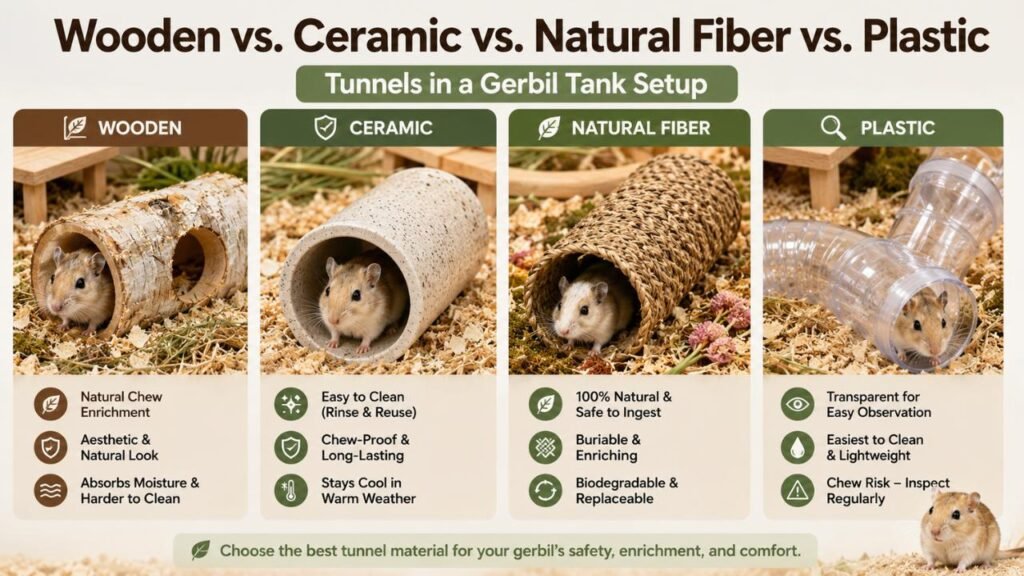
Wood Tunnels in a Gerbil Tank Setup
Wood tunnels provide natural chew enrichment, integrate well aesthetically with naturalistic setups, and allow gerbils to gnaw at the tunnel structure in ways that satisfy teeth-grinding behavior.
The limitations are moisture absorption (urine and humid substrate degrade wood faster than ceramic or plastic), surface degradation through chewing (wood splinters at chewed edges over time), and cleaning difficulty (cannot be rinsed under water without warping risk).
Ceramic Tunnels in a Gerbil Tank Setup
Ceramic is the most practical long-term tunnel material for a gerbil tank setup. It maintains its shape when buried, cleans in seconds under running water, resists all chewing without degrading, and provides a passive cooling surface in warm environments.
The limitations are higher cost per piece and weight. For owners building a permanent gerbil tank setup rather than a temporary arrangement, ceramic represents the best long-term value.
Natural Fiber Tunnels (Seagrass) in a Gerbil Tank Setup
Natural seagrass tunnels are the most appropriate choice for owners prioritizing 100% natural material contact. The chewing safety advantage is significant — seagrass ingestion is benign, while wood splinter and plastic fragment ingestion carries GI risk.
The limitation is degradation rate — seagrass tunnels need replacement as chewing progresses, creating an ongoing cost that ceramic eliminates.
Plastic Tunnels in a Gerbil Tank Setup
Plastic tube systems provide unique transparency for behavioral observation and the easiest cleaning of any tunnel material. The safety limitation is plastic fragment ingestion when gerbils chew through tube walls — plastic tube systems require daily inspection in gerbil tank setups and immediate removal at the first sign of wall penetration.
How to Maintain a Deep-Substrate Gerbil Tank Setup
A deep-substrate gerbil tank setup requires a different cleaning approach than shallow-bedding wire cage setups.
Daily
Spot-remove any visible soiled surface substrate near food and water areas. Check that water bottle sipper is functional and clean. Ensure tunnel entrances are not blocked by collapsed substrate.
Weekly
Remove and replace the top 1–2 inch surface substrate layer. This addresses the urine-concentrated surface zone where ammonia develops fastest without disturbing the stable middle-layer tunnels that gerbils have constructed. Remove and clean surface-level wooden accessories — wipe with diluted white vinegar solution (1:1 with water), rinse, and dry fully before returning to the gerbil tank setup.
Monthly
Full substrate change — remove all substrate, disassemble and clean all tunnel accessories, clean the glass tank interior with pet-safe cleaner, rinse thoroughly, and rebuild the substrate layers from the bottom up. This is the most disruptive cleaning for gerbils — existing tunnels are destroyed and must be reconstructed — so monthly frequency is typically the minimum that does not cause excessive gerbil distress through over-frequent full cleans.
Ceramic tunnel cleaning: Rinse under warm water during every cleaning session. No brush or soap required under normal use — ceramic surface releases biological material cleanly under running water.
Wood tunnel cleaning: Wipe with damp cloth, allow to air dry fully before returning to the gerbil tank setup. Do not soak wooden accessories — moisture absorption leads to warping and accelerated mold growth.
Frequently Asked Questions About Gerbil Tank Setups
How deep does the substrate need to be in a gerbil tank setup?
A minimum of 6 inches for basic burrowing. Eight to ten inches allows multi-chamber tunnel construction that more fully satisfies gerbil burrowing instincts. Anything under 4 inches prevents genuine tunneling.
What is the best enclosure for a deep-substrate gerbil tank setup?
A glass aquarium tank. Glass walls hold substrate stable at depth without collapse, prevent escape, and allow full observation of burrowing behavior. A 40-gallon breeder is the most commonly recommended starting point for a gerbil pair.
Can I use sand as the main substrate in a gerbil tank setup?
Sand alone does not hold tunnel structure — it collapses immediately upon gerbil excavation. Fine sand can be mixed with peat or coco coir (up to 30% of the substrate mix) to improve stability while maintaining a natural texture.
How often should I clean a deep-substrate gerbil tank setup?
Surface spot-clean daily, top-layer substrate replace weekly, and full substrate change monthly. Full cleans more frequently than monthly stress gerbils unnecessarily by destroying their constructed tunnel systems.
Do gerbils need tunnel accessories if the substrate is deep enough?
Pre-installed ceramic or seagrass tunnels improve tunnel stability and prevent collapse in heavily burrowed zones. They also provide structural complexity that self-constructed tunnels in substrate alone cannot create. Tunnel accessories complement rather than replace adequate substrate depth in a gerbil tank setup.
What temperature should a glass-tank gerbil tank setup stay at?
Between 65–75°F (18–24°C) at substrate surface level. Glass tanks heat faster than wire cages in sunlight or near heat sources — monitor with a thermometer placed at substrate level and never position a gerbil tank setup in direct sunlight.
Final Thoughts on Building the Best Gerbil Tank Setup for Digging
The gerbil tank setup that genuinely serves burrowing-focused welfare starts with two commitments: adequate substrate depth (8 inches minimum) in an appropriate glass enclosure, and tunnel accessories chosen for material safety, burial compatibility, and long-term durability rather than visual appeal alone.
For long-term ceramic tunnel infrastructure, the Niteangel ceramic tunnel system is the clear choice — the highest-rated product reviewed here, with cleaning, durability, and burial compatibility that no other material can match at comparable community validation. For natural fiber enrichment that supplements ceramic infrastructure, the Niteangel seagrass modular system adds chew-safe, edible tunnel pieces that satisfy gnawing instinct without fragment ingestion risk. For surface-level exploration above the substrate, the Hamiledyi 2-chamber bottomless hideout with its direct burrowing access through the base is the most behaviorally appropriate wooden structure reviewed.
What every gerbil tank setup in this guide shares — and what no accessory choice can compensate for if it is absent — is the fundamental requirement of sufficient substrate depth for genuine tunnel construction. Build the substrate layer first, install the tunnel structures within it, and add surface accessories second. In that order, a gerbil tank setup becomes the underground habitat your gerbil is biologically built to need.
