

Hamster cage accessories for enrichment are the difference between a hamster that simply survives in captivity and one that genuinely thrives. A cage with adequate floor space, appropriate bedding, and a properly sized wheel covers the basics — but enrichment accessories are what transform that space into an environment that meets your hamster’s behavioral and psychological needs day after day.
Hamsters are naturally driven by instinct. They burrow, forage, explore, nest, climb, and chew — behaviors that are as essential to their wellbeing as food and water. When a captive hamster can’t express these behaviors, stress compounds quietly over time. It shows up as bar chewing, repetitive pacing, excessive sleeping during active hours, and a generally flat or anxious demeanor. The right hamster cage accessories for enrichment give these instincts somewhere to go.
Syrian hamsters need larger accessories — wider tunnels, bigger hides, deeper bedding areas — because their body size demands it. Dwarf hamsters can use smaller, more compact enrichment setups, but their need for behavioral stimulation is just as real. Whether you’re setting up a new cage from scratch or improving an existing one, this guide covers the most impactful accessories, which ones genuinely serve your hamster’s needs, and which products are worth including in your setup.

- Why Enrichment Accessories Matter for Hamster Health
- The Burrowing Imperative
- Foraging Behavior and Mental Stimulation
- Chewing as a Dental and Behavioral Need
- Stress Reduction Through Environmental Complexity
- What Makes Genuinely Good Hamster Cage Accessories for Enrichment?
- Natural Materials Where Possible
- Appropriate Sizing
- Safety of Materials
- Cleaning Practicality
- Best Hamster Cage Accessories for Enrichment — Top 12 Picks
- 1. Niteangel Aspen Shaving Hamster Bedding — White Paper Bedding
- 2. Zoo Med Natural Cork Bark — Pack of 2
- 3. Hamiledyi Hamster Grass Tunnel — Natural Woven Straw House
- 4. PINVNBY Foldable Hamster Fun Tunnels — 2-Pack Plastic Expandable Tubes
- 5. Zoo Med Sand Blasted Grapevine — Medium 12″ Terrarium Decoration
- 6. Niteangel Hamster House with Climbing Ladder — Secret Peep Tunnel Hut
- 7. Niteangel Natural Cork and Coco Hamster Bedding — Oak Granule and Coco Options
- 8. Eaton Pet and Pasture Naturally Grown Hemp Bedding — 28L (8 Pound)
- 9. Tafit Dust-Free Natural Paper Hamster Bedding — 80 Liters
- 10. Living World Millet Spray for Birds — 5 Pounds (Foraging Enrichment)
- 11. Pet Greens Self-Grow Cat Grass Garden — Wheatgrass and Medley 4-Pack
- 12. BUCATSTATE Hamster Bedding — 70L Paper Bedding with Odor Control
- Quick Comparison: Hamster Cage Accessories for Enrichment
- How to Build a Complete Enrichment Setup Using These Accessories
- The Layered Substrate Approach
- Natural Material Foundation
- Tunnel and Hide Network
- Foraging Enrichment Integration
- Enrichment Rotation: Why Changing Accessories Matters
- Common Mistakes with Hamster Cage Accessories for Enrichment
- Frequently Asked Questions
- Final Thoughts
Why Enrichment Accessories Matter for Hamster Health
Enrichment isn’t a luxury addition to a hamster’s cage. It’s a welfare necessity that directly affects physical health, stress hormone levels, and behavioral wellbeing.
The Burrowing Imperative
In the wild, Syrian hamsters excavate burrow systems that can extend several feet underground. These systems include dedicated sleeping chambers, food storage rooms, and escape routes. When a hamster can burrow — really burrow, not just scratch at the surface of 2 inches of substrate — their stress response decreases, sleep quality improves, and they show markedly calmer, more contented behavior.
Deep, loose bedding is the most important hamster cage accessory for enrichment you can provide. Everything else builds on top of it.
Foraging Behavior and Mental Stimulation
Hamsters in the wild spend a significant portion of their active hours searching for and carrying food. In captivity, a full food bowl eliminates that search — which sounds convenient but actually removes a primary source of mental stimulation. Scattering dry food through bedding, hiding small portions in tunnels and hideout rooms, and providing natural materials to explore all reactivate foraging behavior that keeps hamsters mentally engaged.
Chewing as a Dental and Behavioral Need
Hamster teeth grow continuously throughout their lives. Regular chewing on appropriate materials keeps teeth worn to the correct length and prevents the dental overgrowth that causes eating difficulties and health complications. Natural wood hides, cork bark, grass tunnels, and wooden enrichment pieces all provide appropriate chewing material while simultaneously serving as environmental enrichment.
Stress Reduction Through Environmental Complexity
A bare cage with minimal accessories is genuinely stressful for hamsters. They have nowhere to feel hidden and secure, no foraging paths to follow, and no physical enrichment to interact with. Adding tunnels, hides, climbing opportunities, and varied substrates creates a more complex environment that gives your hamster’s brain something to engage with during their active hours.
What Makes Genuinely Good Hamster Cage Accessories for Enrichment?
Not every product marketed as hamster enrichment actually delivers on that promise. Here’s what separates effective accessories from decorative items that gather dust.
Natural Materials Where Possible
Hamsters interact with their environment through chewing, digging, and nesting. Accessories made from natural materials — wood, cork, grass, paper — are safe to chew, smell natural, and integrate with substrate in ways that plastic alternatives don’t. Plastic tunnels and toys have their place, but natural materials should form the foundation of most enrichment setups.
Appropriate Sizing
A tunnel your hamster can barely squeeze through isn’t enriching — it’s stressful. Syrian hamsters need accessories that accommodate their full body length and width comfortably. Any tunnel or hideout opening should be at least 2.5–3 inches in diameter for adult Syrians. Dwarf hamsters can use smaller openings but still need enough interior space to turn and nest.
Safety of Materials
- No aromatic softwoods (cedar, pine) — the oils cause respiratory irritation
- No painted or varnished surfaces — hamsters will chew accessories, and chemical coatings are ingested in the process
- No treated or chemically processed materials — natural and untreated is the standard
- No small detachable components — anything small enough to be swallowed is a choking hazard
Cleaning Practicality
Accessories that can’t be cleaned properly accumulate bacteria, ammonia, and mold. Smooth surfaces, simple designs without deep crevices, and materials that tolerate periodic cleaning without degrading all contribute to accessories that remain hygienic over months of use.
This YouTube video below explains basic hamster cage accessories, highlighting essentials like wheels, hideouts, bedding, and water bottles. It shows how to prepare a comfortable hamster cage. Understanding this helps create a healthy habitat for your hamster.
Best Hamster Cage Accessories for Enrichment — Top 12 Picks
1. Niteangel Aspen Shaving Hamster Bedding — White Paper Bedding

Best for: The foundational hamster cage accessory for enrichment — deep substrate for burrowing, nesting, and foraging
Why We Recommend It:
Before any other enrichment accessory, bedding is the most critical hamster cage accessory for enrichment in any setup. Niteangel’s paper bedding earns its place at the top of this list because it directly supports the burrowing and nesting behavior that is most essential to hamster wellbeing — and it does so without the dust and respiratory concerns that affect many competing bedding products.
The soft, fluffy paper texture holds tunnels reasonably well when packed firmly, allowing Syrian hamsters to construct and maintain burrow systems that don’t collapse immediately. The dust-free formulation is specifically meaningful for hamsters, whose sensitive respiratory tracts are disproportionately affected by airborne particles in their immediate living environment.
Key Features:
- Soft paper fiber construction — appropriate texture for burrowing and nesting
- Dust-free formulation — safe for hamsters with sensitive respiratory tracts
- Strong moisture and odor absorption without chemical additives
- No added fragrances — scent-neutral, safe for chewing
- Available in multiple sizes from 36L to 65L
- Suitable for Syrian hamsters, dwarf hamsters, gerbils, chinchillas, and other small animals
Pros:
- Dust-free design reduces respiratory irritation risk — a genuine health benefit for daily-use substrate
- Soft texture encourages natural burrowing and nest-building behavior
- Strong odor absorption reduces ammonia buildup between cleaning cycles
- No chemical additives make it safe even when ingested during normal chewing and burrowing
Cons:
- Paper bedding collapses more quickly than cork or eco-earth mixes when used alone — mixing with coconut fiber improves tunnel stability
- 36L fills a large enclosure but may require more frequent replenishment than denser substrate options
Best For Hamster Type: All species — Syrian hamsters, all dwarf varieties, gerbils
2. Zoo Med Natural Cork Bark — Pack of 2

Best for: Natural hide and climbing surface that doubles as a chew-safe enrichment accessory
Why We Recommend It:
Cork bark is one of the most versatile hamster cage accessories for enrichment you can add to any enclosure. A curved piece of cork bark placed against the substrate serves as a natural-looking hide. Partially buried, it creates an entrance to a substrate tunnel. Used as a climbing platform, it adds texture and elevation to an otherwise flat cage floor. And when your hamster chews on it — which they will — it’s completely safe and provides genuine dental enrichment.
The Zoo Med cork bark is natural, untreated, and appropriately sized for hamster enclosures. The curved shape creates enclosed shelter underneath, and the textured surface provides grip for climbing. The variation in size means each piece has slightly different utility, which adds visual interest to the cage and different physical interactions for your hamster.
Key Features:
- Natural cork bark — untreated, chew-safe
- Curved shape creates natural hide underneath
- Textured surface provides grip and climbing opportunities
- Creates humidity gradients when partially embedded in substrate
- Pack of 2 allows varied placement throughout the enclosure
- Compatible with bioactive and naturalistic enclosure setups
Pros:
- Chew-safe natural material — safe when gnawed without chemical exposure risk
- Multi-functional — hide, climbing surface, chew item, and substrate anchor simultaneously
- Natural appearance integrates beautifully with naturalistic cage setups
- Durable — cork resists moisture better than most wood alternatives and lasts longer in enclosure conditions
Cons:
- Sizes vary between pieces — exact dimensions cannot be guaranteed
- Not a cleaning-intensive accessory but should be spot-cleaned when soiled
Best For Hamster Type: Syrian hamsters (larger pieces), all dwarf varieties
3. Hamiledyi Hamster Grass Tunnel — Natural Woven Straw House

Best for: Natural burrowing instinct enrichment using edible, chew-safe grass materials
Why We Recommend It:
The Hamiledyi grass tunnel addresses two enrichment needs simultaneously: the hamster’s drive to explore and navigate tunnels, and their need to chew safe, natural materials throughout the day. Made from natural alfa grass using hand-weaving construction without nails or adhesives, the entire structure is edible — your hamster can chew it freely without ingesting anything harmful.
The three-tunnel design provides multiple entry and exit points, which is behaviorally more interesting than a single straight tube. Syrian hamsters can move through the 4-inch channel diameter comfortably. The structure sits in the enclosure like a natural grass mound, which integrates well with naturalistic substrate setups.
Key Features:
- Hand-woven natural alfa grass — entirely edible and chew-safe
- Three interconnected tunnels with 4-inch channel diameter
- Multiple entry and exit points for exploratory behavior
- 12.5″×8.6″×4.7″ overall dimensions — substantial enrichment structure
- No nails, staples, or adhesives — construction is fully natural
- Provides a natural sweet grass fragrance that attracts hamster interest
Pros:
- Fully edible construction means no toxic exposure risk regardless of how much your hamster chews
- Multi-tunnel design provides more exploration opportunities than single-tube alternatives
- Natural materials biodegrade safely when replaced — environmentally responsible
- The grass fragrance naturally attracts hamster interest, encouraging immediate use
Cons:
- Natural grass degrades with use — this accessory has a finite lifespan and will need replacement as it’s chewed down
- Currently listed as unavailable — check current stock status before relying on this option
- May absorb moisture more readily than cork or wood alternatives in very humid environments
Best For Hamster Type: Syrian hamsters and larger dwarf species — verify channel diameter compatibility for very small Roborovski
4. PINVNBY Foldable Hamster Fun Tunnels — 2-Pack Plastic Expandable Tubes

Best for: Expandable, reusable plastic tunnels for DIY tunnel systems in hamster enclosures
Why We Recommend It:
The PINVNBY foldable tunnels solve a practical problem that natural material tunnels don’t address: adjustability. These plastic tunnels expand from 8.26 inches collapsed to up to 35 inches stretched, allowing you to create curved, angled, or straight tunnel routes that fit differently sized enclosures without modification.
For owners who want to create a dynamic tunnel network that can be reconfigured periodically — which provides ongoing novelty and exploration enrichment for hamsters — the foldable plastic design is genuinely more flexible than fixed natural alternatives. The 3.93-inch diameter is adequate for dwarf hamsters and smaller Syrians; larger adult Syrians may find this tight.
Key Features:
- Expands from 8.26 inches to 35 inches — highly adaptable for different cage configurations
- 3.93-inch diameter — appropriate for dwarf hamsters and smaller Syrians
- Durable, stain-resistant plastic — easy to clean between uses
- 2-pack provides enough for basic tunnel system creation
- Available with optional 19-piece toy bundle
- Multiple color options available
Pros:
- Expandable design allows creative DIY tunnel configuration within the cage
- Plastic construction is washable — more durable than natural grass alternatives for long-term use
- Foldable for compact storage between cage configurations
- Multiple color options for owners who enjoy cage aesthetics
Cons:
- 3.93-inch diameter is too tight for large adult Syrian hamsters — they cannot use this comfortably
- Plastic material doesn’t provide the chewing enrichment that natural alternatives offer
- Some hamsters prefer natural materials and may show less interest in plastic tunnels
Best For Hamster Type: Dwarf hamsters (all species), smaller Syrian hamsters only
5. Zoo Med Sand Blasted Grapevine — Medium 12″ Terrarium Decoration

Best for: Climbing, chewing, and three-dimensional enrichment in naturalistic hamster setups
Why We Recommend It:
Grapevine wood is a trusted enrichment material across multiple small animal and reptile communities, and its application in hamster enclosures makes practical sense. The irregular, branched structure of a grapevine piece creates vertical and horizontal surfaces that a hamster can climb over, chew on, and use as a perching or resting spot — all forms of physical enrichment that flat cage floors don’t provide.
The Zoo Med sand-blasted grapevine is cleaned and prepared specifically for use in animal enclosures. The 12-inch medium size provides enough structural interest for a meaningful cage addition without overwhelming smaller setups. Natural wood texture provides good grip for hamster feet during climbing and foraging behavior.
Key Features:
- Natural grapevine wood — sand-blasted for animal enclosure safety
- Irregular branching structure creates varied climbing surfaces
- Medium 12″ size — appropriate for most hamster enclosure setups
- Chew-safe natural material
- Adds vertical dimension to otherwise flat enclosure floors
- Compatible with naturalistic and bioactive setup themes
Pros:
- Natural irregular shape creates more varied enrichment than uniform commercial accessories
- Grapevine wood is a recognized safe material for small animal enrichment
- Adds genuine three-dimensional complexity to cage layout
- Chewing the wood provides dental enrichment alongside physical exploration
Cons:
- Sizes and shapes vary — you won’t receive an identical piece to what’s shown in images
- Heavier hamsters may dislodge pieces not secured in substrate — anchor partially in bedding for stability
Best For Hamster Type: Syrian hamsters, all dwarf varieties
6. Niteangel Hamster House with Climbing Ladder — Secret Peep Tunnel Hut
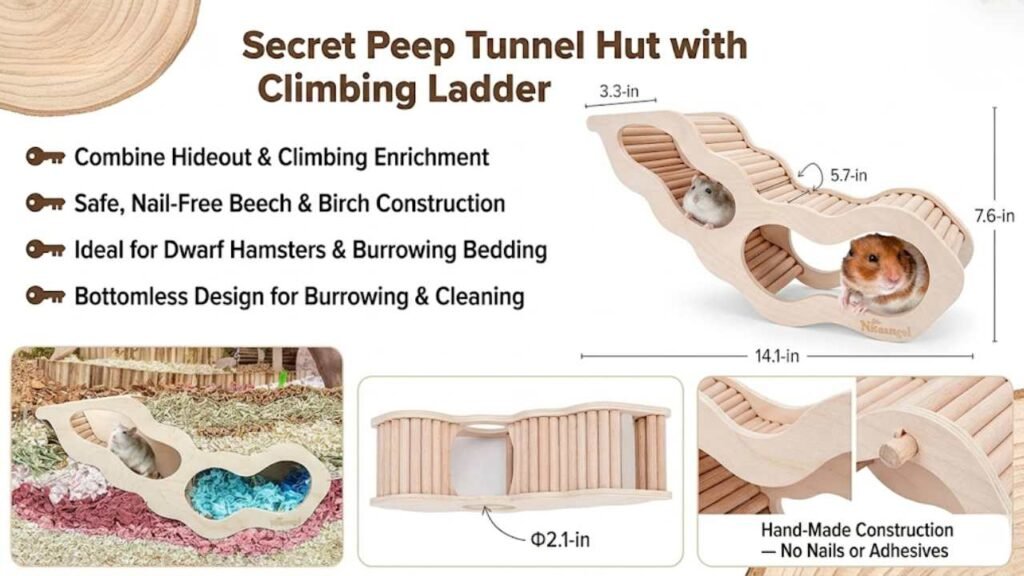
Best for: Combined hideout and climbing enrichment as a central hamster cage accessory for enrichment
Why We Recommend It:
The Niteangel Secret Peep Tunnel hut combines two enrichment functions in one structure — a secure, enclosed resting space and a climbing ladder roof that gives hamsters an elevated platform to reach, balance on, and use as a staging point for exploring other cage areas. For enrichment density per cage footprint, this design is efficient.
The birch plywood and beech stick construction is hand-made, nail-free, and sanded smooth at all corners — the construction quality standard that makes the difference between a safe chewable wooden accessory and one with sharp edges or adhesive risks. The semi-closed design with a 2.1-inch entrance provides the enclosed security that hamsters seek in their primary shelter.
Key Features:
- Birch plywood body with beech stick climbing ladder roof
- 2.1-inch entrance diameter — appropriate for dwarf hamsters and smaller animals
- Semi-enclosed design creates a secure, breathable shelter space
- Hand-made construction — no nails, no adhesives, corners sanded smooth
- Ladder provides balance practice and platform access
- Bottomless design allows easy interior cleaning and bedding interaction
- 14.1″L×3.3″W×7.6″H dimensions
Pros:
- Combined hide and climbing structure reduces cage footprint per enrichment function
- Natural birch construction is safe for sustained chewing — provides dental enrichment
- Bottomless design allows hamster to burrow bedding into the interior, creating a customized nest
- 4.7 stars from 1,335 reviews — one of the most validated enrichment hides on this list
Cons:
- 2.1-inch entrance is appropriate for dwarf hamsters but too small for adult Syrian hamsters — Syrians cannot use this product
- Wooden construction requires monitoring for moisture damage in humid environments
Best For Hamster Type: Dwarf hamsters, gerbils, mice — not appropriate for adult Syrian hamsters due to entrance size
7. Niteangel Natural Cork and Coco Hamster Bedding — Oak Granule and Coco Options

Best for: Natural substrate that improves tunnel stability when mixed with paper bedding
Why We Recommend It:
Cork and coconut-based substrates serve a specific and valuable function in hamster enrichment setups: they add structural stability to burrowing substrate that paper bedding alone doesn’t provide. When mixed into a paper bedding base, cork granules or coco peat allow hamsters to construct tunnels that hold their shape for longer — making the burrowing experience more rewarding and more closely mimicking the firm-earth tunnels hamsters build in the wild.
Niteangel offers this in multiple formats — oak granules (2-3mm and 8-10mm sizes), coco chips, and coco peat — allowing you to customize the texture and structural contribution based on your hamster’s preferences and your setup’s depth.
Key Features:
- Natural cork material — low dust, no additives
- Multiple format options: oak granule, coco chips, coco peat
- Strong odor absorption — effective ammonia control between cleaning cycles
- Safe for chewing — no chemical processing
- Encourages natural digging and burrowing behavior
- Mixes well with paper bedding for improved tunnel stability
Pros:
- Cork and coco substrates improve tunnel integrity when mixed with softer paper bedding
- Natural odor control without added fragrances — appropriate for hamsters’ sensitive noses
- Low-dust formulation protects respiratory health during digging and burrowing activity
- Versatile — can be used as the primary substrate layer beneath a paper bedding top layer
Cons:
- 4L and 5L sizes are relatively small — require frequent repurchasing for large enclosures
- Cork granules alone are firmer than paper — not comfortable as the only surface substrate layer
Best For Hamster Type: All species — mix with paper bedding for best results
8. Eaton Pet and Pasture Naturally Grown Hemp Bedding — 28L (8 Pound)
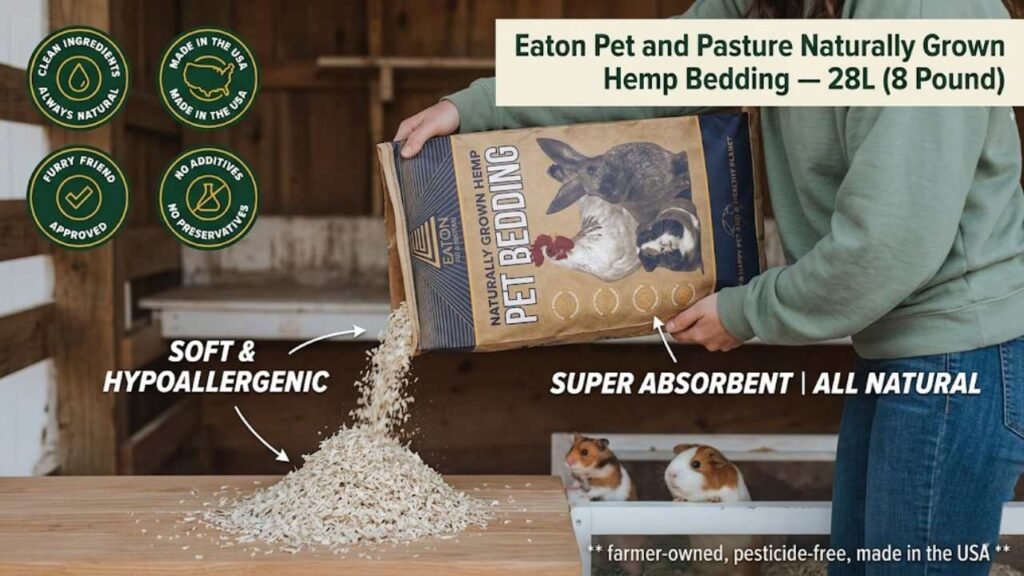
Best for: Owners who prioritize natural, sustainable bedding with exceptional absorbency as a hamster cage accessory for enrichment
Why We Recommend It:
Hemp bedding occupies an interesting position in the small animal substrate market — it’s natural, it’s highly absorbent, and it’s produced without pesticides or herbicides, which matters for animals that spend their entire lives in contact with their substrate. The Eaton Pet and Pasture hemp bedding is farmer-owned and made in the USA, with a production focus on clean, pure materials without the chemical processing that affects many wood-based alternatives.
The absorbency claim (2× more than traditional bedding) translates practically into longer periods between spot-cleaning requirements and better moisture management in areas of the cage where hamsters habitually urinate. The low-to-no dust formulation is appropriate for hamsters’ sensitive respiratory systems.
Key Features:
- 100% naturally grown hemp — no pesticides or herbicides in production
- 2× absorbency compared to traditional wood-based bedding
- Low-to-no dust — appropriate for sensitive respiratory tracts
- Biodegradable and compostable — environmentally responsible disposal
- Soft fiber texture compatible with burrowing behavior
- Made in the USA by farmer-owned operation
Pros:
- Exceptional absorbency reduces moisture-related odor and bedding degradation
- Chemical-free production is appropriate for animals in constant substrate contact
- Biodegradable disposal option makes it the most environmentally responsible bedding option on this list
- Soft texture encourages natural nesting and burrowing behavior
Cons:
- Higher price per liter than paper bedding alternatives — factor into ongoing supply cost
- Hemp bedding is less universally available than paper alternatives for subscription or bulk purchasing
- Some hamsters take time to acclimate to the different texture and scent of hemp compared to familiar paper bedding
Best For Hamster Type: All species — well-suited to Syrian hamsters who produce more waste volume
9. Tafit Dust-Free Natural Paper Hamster Bedding — 80 Liters
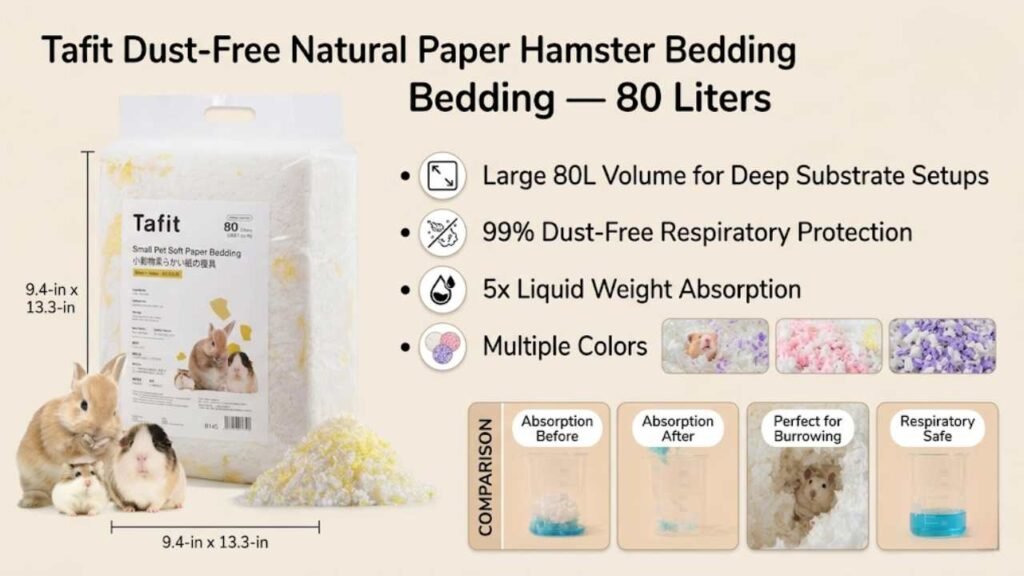
Best for: Large-volume paper bedding at accessible cost for owners maintaining deep substrate setups
Why We Recommend It:
The tafit 80-liter paper bedding addresses a practical reality of quality hamster care: maintaining 6–10 inches of deep substrate in a large enclosure requires substantial bedding volume, and purchasing it repeatedly in small quantities becomes expensive and inconvenient. The 80-liter size with up to 3× expansion ratio provides genuine value for owners committed to maintaining proper substrate depth as a core hamster cage accessory for enrichment.
The 99% dust-free specification across multiple dust-removal processing steps is the most important performance claim — paper bedding that generates dust defeats its purpose for hamsters with sensitive respiratory systems. The 5× liquid absorption capacity keeps substrate dry and reduces ammonia accumulation between cleaning cycles.
Key Features:
- 80-liter volume with up to 3× expansion ratio
- 99% dust-free through multiple dust-removal processing steps
- 5× liquid weight absorption capacity
- 100% natural wood pulp without chemical additives
- Odor control through porous fiber structure — no added fragrances
- Available in multiple colors (white, mixed colors, white+pink, white+purple, etc.)
- Hypoallergenic formulation
Pros:
- 80-liter volume provides substantial supply for deep substrate maintenance
- 3× expansion means even more usable bedding than the listed volume
- Color options allow owners to coordinate cage aesthetics if desired
- 5× liquid absorption is among the strongest absorbency claims in paper bedding category
Cons:
- 4.3 stars from 162 reviews — solid but smaller validation sample than top-tier bedding options
- Color variations are decorative rather than functional — verify colors are non-toxic dyes safe for hamster contact
- Paper bedding alone still collapses faster than substrate mixes including cork or coco components
Best For Hamster Type: All species — 80L volume particularly practical for large Syrian hamster enclosures
10. Living World Millet Spray for Birds — 5 Pounds (Foraging Enrichment)

Best for: Natural foraging enrichment for hamsters who enjoy millet as an occasional treat woven through substrate
Why We Recommend It:
Millet spray is one of those enrichment tools that doesn’t come from the hamster product aisle but belongs in the hamster cage nonetheless. Hamsters are natural foragers — they search for food as a primary activity during their active hours. Tucking a small piece of millet spray into substrate, partially hidden in a tunnel, or woven into a grass hide activates foraging behavior that keeps hamsters mentally engaged in ways that a full food bowl simply doesn’t.
The Living World millet spray is vacuum-packed for freshness and free from artificial additives. A single large strand can be broken into multiple small pieces and distributed throughout the enclosure across several weeks, providing ongoing foraging enrichment from a single purchase.
Key Features:
- Natural spray millet — vacuum-packed for freshness
- No artificial additives or preservatives
- Rich in vitamins and minerals — appropriate as an occasional hamster treat
- 5-pound bulk size provides extended supply for ongoing foraging enrichment use
- Multiple size options available for owners who prefer smaller quantities
Pros:
- Activates natural foraging behavior when hidden in substrate or tucked into tunnels
- Natural, additive-free composition safe for occasional hamster consumption
- 5-pound value size provides extended supply at reasonable cost per gram
- Vacuum packaging maintains freshness throughout the supply period
Cons:
- Marketed primarily for birds — confirm appropriate portion sizing for hamsters before use (small pieces only, as an occasional treat)
- 5-pound quantity is significantly more than most hamster owners need — consider the 7-ounce size for single-hamster setups
- High in carbohydrates — use as enrichment treat in small amounts, not as a regular food component
Best For Hamster Type: All species — portion size appropriately for hamster body weight
11. Pet Greens Self-Grow Cat Grass Garden — Wheatgrass and Medley 4-Pack

Best for: Growing fresh grass for hamster foraging enrichment and environmental novelty
Why We Recommend It:
Fresh growing grass in or near a hamster’s enclosure provides a genuinely different type of enrichment — novel scent, fresh texture, and natural foraging material that processed cage accessories can’t replicate. Hamsters in naturalistic setups benefit from exposure to real plant material, and small amounts of fresh wheatgrass provide fiber, chlorophyll, and an enriching sensory experience.
The Pet Greens self-grow kit includes both wheatgrass and a medley of oat, rye, and barley — different textures and flavors that add variety. Grow a small pot, allow your hamster supervised access to graze or nibble at the edges, or clip small amounts and scatter them through the enclosure substrate for a foraging experience.
Key Features:
- Self-grow kit — wheatgrass and oat/rye/barley medley
- 4-pack provides four growing cycles of fresh grass
- Rich in chlorophyll, vitamins, and minerals — nutritionally beneficial in small amounts
- No pesticides or harmful chemicals in organic seed and soil
- Can be used in-enclosure or as cut foraging material scattered through substrate
- Provides digestive fiber as a dietary supplement
Pros:
- Fresh, living plant material provides sensory enrichment that processed accessories cannot replicate
- Organic seed and soil formulation — no pesticide exposure risk
- Multiple growing cycles from a single 4-pack purchase
- Provides genuine nutritional value alongside enrichment function
Cons:
- Requires active growing — not immediately ready to use like other accessories
- 4.1 stars from 70 reviews — smaller validation sample
- Marketed for cats — verify grow medium components are appropriate for hamster contact before placing directly in enclosure
Best For Hamster Type: All species — offer small amounts as foraging enrichment
12. BUCATSTATE Hamster Bedding — 70L Paper Bedding with Odor Control
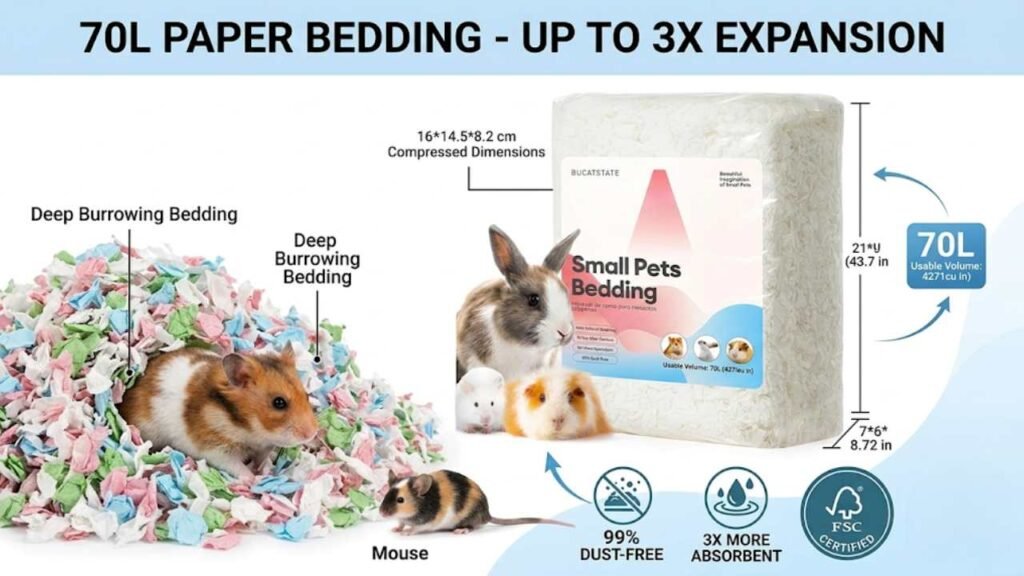
Best for: Budget-conscious owners who want a large volume, FSC-certified paper bedding for Syrian hamster enclosures
Why We Recommend It:
The BUCATSTATE 70L paper bedding is one of the more practically designed options in the large-volume paper bedding category. The compact packaging with 3× expansion means the compressed package expands significantly when fluffed — more usable bedding from a smaller shipping and storage footprint. The FSC certification confirms the wood pulp sourcing meets responsible forestry standards, which matters for environmentally conscious owners.
The color options — white, blossom, blue, green, lavender, ocean blue, rosy, confetti — are more extensive than most bedding products, allowing owners who care about cage aesthetics to coordinate their substrate color with other cage elements. The functional performance (99% dust-free, no additives, strong absorbency) is consistent with the tafit option but comes in from a brand with stronger established review volume (521 reviews at 4.2 stars).
Key Features:
- 70L volume with up to 3× expansion ratio
- 99% dust-free through dedicated dust-removal processing
- FSC certified wood pulp — responsible sourcing verification
- No artificial additives or chemical treatments
- 3× more absorbent than standard paper alternatives
- Multiple color options for aesthetic coordination
- Hypoallergenic formulation
Pros:
- FSC certification adds verified responsible sourcing beyond standard “natural” claims
- Compact packaging reduces storage space and shipping impact
- Extensive color options for owners who prioritize cage aesthetics
- 3× expansion ratio means significant usable volume from a compressed package
Cons:
- 4.2 stars with 521 reviews — solid validation but some variance in buyer experience worth reviewing
- Color dyes should be verified as non-toxic and pet-safe — check current product information for dye specifics
- 70L is slightly less volume than the tafit 80L option at comparable sizing
Best For Hamster Type: All species — 70L particularly useful for large Syrian hamster enclosures needing regular deep substrate maintenance
Quick Comparison: Hamster Cage Accessories for Enrichment
| Accessory | Type | Best Enrichment Function | Syrian Compatible | Natural Material | Chew Safe |
|---|---|---|---|---|---|
| Niteangel Paper Bedding (36L) | Substrate | Deep burrowing + nesting | ✅ Yes | ✅ Yes | ✅ Yes |
| Zoo Med Cork Bark | Hide + Chew | Shelter + dental enrichment | ✅ Yes | ✅ Yes | ✅ Yes |
| Hamiledyi Grass Tunnel | Tunnel + Chew | Exploration + foraging | ✅ Yes (check size) | ✅ Yes | ✅ Yes |
| PINVNBY Plastic Tunnels | Tunnel | Exploration + exercise | ⚠️ Smaller Syrians only | ❌ Plastic | ⚠️ Monitor |
| Zoo Med Grapevine | Climbing + Chew | Physical enrichment + dental | ✅ Yes | ✅ Yes | ✅ Yes |
| Niteangel Hut with Ladder | Hide + Climb | Shelter + balance enrichment | ❌ Entrance too small | ✅ Yes | ✅ Yes |
| Niteangel Cork/Coco Bedding | Substrate mix | Tunnel stability + burrowing | ✅ Yes | ✅ Yes | ✅ Yes |
| Eaton Hemp Bedding | Substrate | Deep burrowing + absorbency | ✅ Yes | ✅ Yes | ✅ Yes |
| Tafit Paper Bedding (80L) | Substrate | Large volume deep substrate | ✅ Yes | ✅ Yes | ✅ Yes |
| Living World Millet Spray | Foraging treat | Mental stimulation + foraging | ✅ Yes (small amounts) | ✅ Yes | ✅ Yes |
| Pet Greens Grass Kit | Foraging material | Sensory + foraging enrichment | ✅ Yes | ✅ Yes | ✅ Yes |
| BUCATSTATE Paper Bedding 70L | Substrate | Large volume deep substrate | ✅ Yes | ✅ Yes | ✅ Yes |
How to Build a Complete Enrichment Setup Using These Accessories
The most effective hamster cage accessories for enrichment aren’t placed randomly. Thoughtful arrangement creates a cage layout that naturally encourages the behavioral patterns hamsters are driven to express.
The Layered Substrate Approach
Start with a base layer of cork granules or coco peat (Niteangel Cork/Coco Bedding) approximately 2–3 inches deep for structural stability. Layer paper bedding (Niteangel, tafit, or BUCATSTATE) on top to 6–10 inches total depth. The cork base holds tunnel structure; the paper top provides softness for nesting. This combination outperforms either substrate used alone for supporting genuine burrowing behavior.
Natural Material Foundation
Place cork bark pieces (Zoo Med) at the substrate surface — partially buried at different angles to create natural-looking sheltered spaces. A grapevine piece (Zoo Med) across one section of the enclosure adds a climbing surface above substrate level. These natural materials create the three-dimensional complexity that makes a cage feel like an environment rather than a box.
Tunnel and Hide Network
Position the grass tunnel (Hamiledyi) in one area of the enclosure as a central exploration structure. Run a foldable plastic tunnel (PINVNBY — sized appropriately for your hamster species) from one side of the cage toward a hideout or sand bath area. The combination of natural grass and plastic tunnels provides both chewable and permanent tunnel options.
Foraging Enrichment Integration
Scatter dry food and small pieces of millet spray (Living World) through the substrate layer rather than placing all food in a bowl. Cut small amounts of fresh grass from the Pet Greens kit and distribute throughout the enclosure. These foraging elements activate your hamster’s search behavior during their active hours in ways that a static food bowl cannot.
Enrichment Rotation: Why Changing Accessories Matters
One of the most impactful — and most overlooked — aspects of hamster cage accessories for enrichment is rotation. Hamsters habituate to familiar environments over time. An accessory that generated intense exploratory behavior when first introduced may be largely ignored after two weeks of continuous presence.
Rotating accessories in and out of the cage every 2–4 weeks reintroduces novelty that reactivates exploration behavior. This doesn’t require purchasing new accessories constantly — simply:
- Remove two or three accessories during a cage clean
- Reintroduce previously used accessories in different positions or combinations
- Occasionally add a genuinely new item to maintain novelty across the rotation
This approach extends the enrichment value of each accessory and reduces the habituation that leads to behavioral flat-lining in captive hamsters.
Common Mistakes with Hamster Cage Accessories for Enrichment
Using cedar or pine wood accessories. Aromatic softwoods release volatile oils that irritate hamster respiratory tracts. Always verify wood species in any wooden accessory before purchasing. Birch, beech, poplar, cork, and grapevine are all safe alternatives.
Choosing accessories sized for dwarf hamsters and placing a Syrian inside. A 2.1-inch tunnel entrance is genuinely too small for a full-grown Syrian hamster. Always verify opening dimensions against your specific hamster’s body size before purchasing any hide or tunnel accessory.
Removing all familiar scent during cage cleaning. The enrichment value of a natural substrate partially depends on your hamster’s established scent markers within it. During full cage cleans, preserve a small handful of used substrate to reintroduce alongside the fresh bedding. This maintains a familiar scent environment that reduces post-clean stress.
Providing no variation in substrate texture. Single-substrate setups — all paper or all coco peat — miss the enrichment opportunity that varied textures provide. Mixing substrates creates a more complex sensory environment that more closely mimics natural habitat variation.
Placing all enrichment accessories at surface level. Partially burying cork pieces, grapevine sections, and tunnel entrances in substrate creates a more naturalistic environment and encourages digging behavior as your hamster uncovers and interacts with partially buried items.
Frequently Asked Questions
What enrichment do hamsters need most?
Deep burrowing substrate is the most critical enrichment requirement. After that, a properly sized exercise wheel, a multi-chamber hideout, and tunnel options address the most essential behavioral needs.
How often should I change hamster cage accessories?
Spot-clean soiled areas every 2–3 days. Rotate accessory placement every 2–4 weeks for novelty. Replace natural material accessories (grass tunnels, cork bark) as they degrade through use. Full substrate replacement every 3–4 weeks.
Are plastic tunnels safe for hamsters?
Plastic tunnels are safe when appropriately sized and monitored for chewing damage. Hamsters that chew plastic consistently should be transitioned to natural alternatives to avoid plastic ingestion risk.
Can hamsters eat millet spray?
Yes, in small amounts as an occasional treat. Millet is high in carbohydrates, so it should be used as enrichment foraging material in small portions rather than as a regular food component.
What wood is safe for hamster accessories?
Birch, beech, poplar, balsa, cork, apple, and pear wood are all considered safe. Avoid cedar, pine (especially aromatic varieties), and any painted, varnished, or treated wood.
How deep should hamster substrate be?
Minimum 6 inches throughout the enclosure, with 8–10 inches in at least one burrowing area. Deeper is always better for Syrian hamsters specifically.
Can I use cat grass for my hamster?
Small amounts of fresh, organic wheatgrass or oat grass are safe for hamsters as occasional foraging enrichment. Verify the growing medium contains no pesticides before offering clipped grass to your hamster.
Final Thoughts
Hamster cage accessories for enrichment aren’t optional extras — they’re the functional elements that transform an adequately sized cage into a genuinely enriching habitat where a hamster can express natural behavior and maintain psychological wellbeing.
The most impactful starting point is always bedding depth. Whether you choose the Niteangel paper bedding, tafit’s 80L option, BUCATSTATE’s color-varied paper bedding, or Eaton’s hemp alternative, getting substrate depth to 6–10 inches is the single biggest enrichment upgrade most hamster enclosures need. Add natural materials — cork bark, grapevine, grass tunnels — for chewing, climbing, and shelter enrichment. Integrate foraging elements through millet spray and fresh grass to activate mental engagement during active hours.
Build the environment around what your hamster is naturally driven to do, rotate accessories periodically for novelty, and the right hamster cage accessories for enrichment will produce a visibly happier, more active, and more behaviorally fulfilled hamster — which is the entire goal.
