

A glass tank for gerbils is not simply a different style of enclosure from a wire cage — it is a fundamentally different welfare commitment that changes what behavioral needs you can meet. Mongolian gerbils are burrowing animals first. In their natural Central Asian steppe habitat, they construct underground tunnel systems with distinct chambers for sleeping, food storage, and waste — tunnel networks that can extend several feet below the surface. This burrowing drive does not diminish in captivity. A gerbil without the ability to dig and construct tunnels experiences chronic behavioral frustration that manifests as repetitive bar chewing, excessive sand bathing, displacement grooming, and hyperactivity that has nowhere to go.
Wire-bar cages cannot support deep bedding — substrate falls through the bar floor gaps, and even with a solid base tray, the shallow depth possible in most wire cage formats (2–3 inches) prevents genuine tunnel construction. A glass tank for gerbils, by contrast, holds substrate at full depth across the entire enclosure floor, with glass or acrylic walls that maintain the substrate column stable against lateral pressure at burrowing depth. The result is an enclosure where gerbils can actually construct the underground environment their biology demands.
Choosing the right glass tank for gerbils requires understanding ventilation, escape prevention, internal dimensions for deep substrate, and cleaning accessibility — because glass tanks create a distinct set of trade-offs compared to wire alternatives that affect daily management as much as initial setup. This guide covers every consideration and reviews eight of the best glass tank options for gerbils currently available, from premium all-glass enclosures to practical wood-and-acrylic hybrids.

- What Makes a Good Glass Tank for Gerbils?
- Internal Height for Deep Bedding
- Ventilation Design in Glass Tanks for Gerbils
- Floor Space Requirements
- Escape Prevention in a Glass Tank for Gerbils
- Cleaning Accessibility
- Product Reviews: Best Glass Tanks for Gerbils
- 1. Niteangel Stacker Series Hamster Cage
- 2. VEVOR Hamster Cage — 360 Viewing Transparent
- 3. Oiibo 3-Tier Large Hamster Cage with Glass Base and Wire Topper
- 4. REPTI ZOO 10-Gallon Glass Terrarium with Sliding Screen Top
- 5. BitMit Wooden Hamster Cage — Chewproof Pine Acrylic
- 6. PIDINUK Acrylic Cage — Foldable Transparent Habitat
- 7. PawHut Hamster Cage with Glass Basin
- 8. BingoPaw Wooden Hamster Cage with Tempered Glass and LED Light
- Glass vs. Acrylic vs. Wood-Frame Hybrid: Which Material Is Best for a Gerbil Tank?
- Pure Glass (Aquarium-Style)
- Acrylic Panels with Metal or Wood Frame
- Wood-Frame Acrylic Hybrid
- How to Set Up a Glass Tank for Gerbils with Deep Bedding
- Step 1 — Choose the Right Tank Height First
- Step 2 — Install a Secure Mesh Lid Before Adding Substrate
- Step 3 — Layer Substrate for Tunnel Stability
- Step 4 — Position Accessories at Substrate Surface Level
- Step 5 — Temperature and Ventilation Monitoring
- Cleaning a Glass Tank for Gerbils with Deep Bedding
- Weekly Surface Cleaning
- Monthly Full Clean
- Cleaning the Detachable Basin (PawHut)
- Frequently Asked Questions About Glass Tanks for Gerbils
- Final Thoughts on Choosing the Best Glass Tank for Gerbils
What Makes a Good Glass Tank for Gerbils?
Understanding what separates a genuinely appropriate glass tank for gerbils from an aesthetically appealing but functionally limited enclosure shapes every purchase decision in this category.
Internal Height for Deep Bedding
The single most important dimension in a glass tank for gerbils is internal height — because height determines how deep the substrate can be before it approaches the ventilation and lid level. For a glass tank for gerbils to support genuine burrowing behavior:
- Minimum internal height for basic burrowing: 16 inches total, supporting 6 inches of substrate
- Recommended for pair burrowing: 18–20 inches internal height, supporting 8–10 inches of substrate
- Ideal for colony burrowing: 20+ inches internal height, supporting 10–12 inches of substrate
A glass tank for gerbils marketed at 16 inches total height with 6 inches of required ventilation space above substrate effectively supports only 10 inches of bedding — which limits tunnel depth significantly. Always calculate usable substrate depth by subtracting the required clear air space above the bedding (typically 6–8 inches for ventilation and gerbil movement) from the total enclosure height.
Ventilation Design in Glass Tanks for Gerbils
Ventilation is the most commonly misunderstood aspect of a glass tank for gerbils. Glass on five sides with only a mesh or wire top means all air exchange happens through a single surface. This is functionally adequate for a pair of gerbils in a properly sized glass tank with a full-width mesh lid — gerbils are desert animals adapted to environments with lower ambient humidity and less ventilation than many other small animal species.
The risk comes from three specific conditions:
- Partial lid coverage — if the mesh covers only part of the top, effective ventilation area is reduced proportionally
- Warm room placement — glass tanks placed near heat sources or in direct sunlight trap heat significantly faster than wire cages in identical conditions
- Deep damp substrate — overly moist substrate at depth begins anaerobic decomposition, producing ammonia at a level that top-only ventilation cannot dilute adequately
A good glass tank for gerbils has a full-width mesh top covering the entire opening, positioned in a room maintained between 65–75°F (18–24°C), and uses substrate that is slightly damp at depth but dry at the surface.
Floor Space Requirements
Gerbils need floor space for territory, surface enrichment, food stations, sand baths, and exercise wheels — all of which must fit above the substrate layer while still leaving navigable space. Floor space requirements for a glass tank for gerbils:
| Colony Size | Minimum Floor Space | Recommended Glass Tank |
|---|---|---|
| Single gerbil | 360 sq in (20″x18″) | 20-gallon aquarium |
| Pair of gerbils | 648 sq in (36″x18″) | 40-gallon breeder |
| Group of 3–4 | 864+ sq in (48″x18″) | 55+ gallon or equivalent |
The 40-gallon breeder aquarium (36″ x 18″ x 16″) is the most commonly recommended glass tank for gerbils in welfare-focused communities — it provides adequate floor space for a pair with 8 inches of substrate while the glass walls hold the substrate column stable.
Escape Prevention in a Glass Tank for Gerbils
Gerbils are capable climbers when substrate is piled near tank walls. In a glass tank for gerbils with 8 inches of substrate, a gerbil standing on the substrate surface has an effective starting height of 8 inches — meaning in a 16-inch tank, they are already halfway to the top before climbing begins.
A securely fitted, locked mesh lid with gaps smaller than 0.6 inches (15mm) is essential. Button-style locks, clip fasteners, and weighted lid designs each provide different levels of escape resistance — reviewed for each product below.
Cleaning Accessibility
A glass tank for gerbils requires full substrate replacement monthly, with weekly surface-layer spot cleaning. Cleaning accessibility matters differently than in wire cages:
- Front-opening designs allow substrate scooping without lifting the entire tank top, which is the heaviest cleaning motion in a glass tank for gerbils loaded with 8+ inches of deep bedding
- Removable front panels allow the deepest and most comfortable cleaning access
- Top-only access in a full glass aquarium requires reaching down 8+ inches of substrate depth during cleaning — manageable but more physically demanding
Product Reviews: Best Glass Tanks for Gerbils
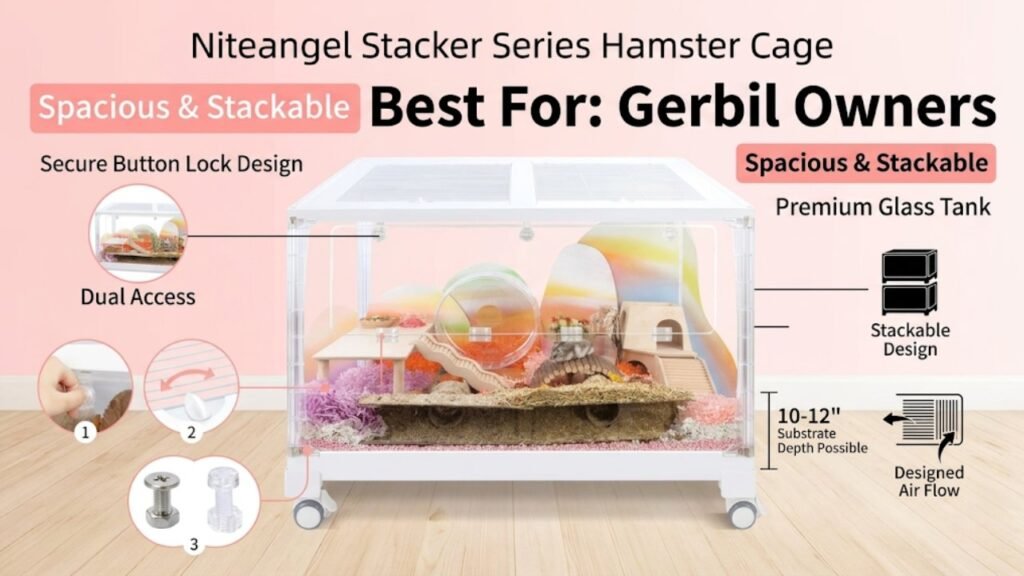
1. Niteangel Stacker Series Hamster Cage
Best For: Gerbil owners who want a premium stackable glass tank for gerbils with front door access and the largest internal volume of any purpose-built enclosure reviewed here
Why We Recommend It
The Niteangel Stacker is the most comprehensively designed purpose-built glass tank for gerbils in this review — the front acrylic door opening allows feeding, enrichment adjustment, and interaction without disturbing the entire substrate layer from above, which is the most meaningful practical advantage in daily care of a deep-bedding setup.
At 33.2″L x 19.4″W x 21.5″H, the internal volume provides approximately 10–12 inches of usable substrate depth while maintaining the 8–10 inches of clear air space above that adequate ventilation requires. The button lock system on the top and door openings addresses the escape risk that standard clip lids create when gerbils push at the ceiling during climbing exploration at substrate height.
Key Features
- Dimensions: 33.2″L x 19.4″W x 21.5″H (front door version)
- Material: High-quality glass panels + acrylic front door
- Ventilation: Curved slits in cage top — designed air flow pattern
- Access: Front acrylic door + top opening — dual access
- Locking: Button lock design on all openings
- Substrate Depth Possible: 10–12 inches with adequate clearance above
- Stackable: Yes — stackable accessories available separately
- Gap Size: 1.6cm ventilation gap
Pros
- Largest internal volume of any purpose-built glass tank for gerbils reviewed — genuine colony space
- Front door access enables daily care without full top removal — practical for deep bedding setups
- Button lock system on all openings — active escape prevention beyond simple clip designs
- Stackable design — second unit adds colony separation or species-specific territory without new floor space
- Four viewing angles including front panel — full behavioral observation
- Niteangel brand recognition in small animal welfare — established design expertise
Cons
- Higher price than all other glass tank for gerbils options reviewed here
- Curved top ventilation slits provide less total airflow area than full-width mesh alternatives — monitor room temperature carefully
- Large footprint (33.2″ x 19.4″) requires significant dedicated shelf or surface space
- Stackable accessories sold separately — full stacking setup costs more than listed base price
Best For: Gerbil owners investing in a permanent, premium glass tank for gerbils that supports 10+ inch deep burrowing with front door daily access and long-term expandability through stacking
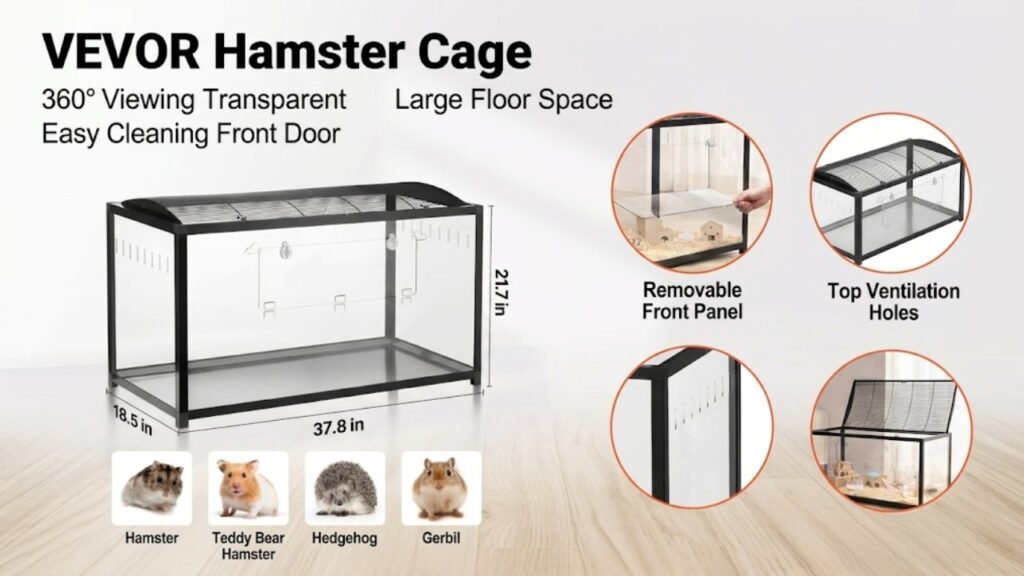
2. VEVOR Hamster Cage — 360 Viewing Transparent
Best For: Gerbil owners who want the widest floor-space glass tank for gerbils in this review with 360-degree visibility and removable front acrylic panel
Why We Recommend It
The VEVOR transparent cage provides the largest single-unit floor footprint reviewed here at 37.8″ x 18.5″ — equivalent in floor space to a standard 40-gallon breeder aquarium — while the 21.7-inch height allows 10+ inches of substrate with adequate clearance above.
The removable front acrylic panel is the critical cleaning feature: the entire front face of the glass tank for gerbils opens outward, converting the cleaning process from a top-reach-down operation into a front-access scoop-out — significantly more ergonomic when managing 8–10 inches of deep, compacted burrowing substrate monthly.
The metal frame construction resists the chewing pressure that acrylic-only enclosures face at frame joints over extended use.
Key Features
- Dimensions: 37.8″L x 18.5″W x 21.7″H (largest size)
- Material: Metal frame + transparent acrylic panels
- Ventilation: Top ventilation holes — full top coverage stated
- Access: Removable front acrylic panel + top ventilation opening
- Visibility: 360-degree panoramic viewing
- Assembly: Easy assembly with detailed instructions
- Additional Sizes: 22.8″L x 15″W x 21.3″H; 29.5″L x 17.3″W x 24″H
Pros
- Largest floor space of any product reviewed — 37.8″ x 18.5″ matches 40-gallon breeder aquarium dimensions
- Removable front panel provides the most ergonomic cleaning access of any glass tank for gerbils reviewed
- 21.7-inch height allows the deepest substrate possible in this review
- Metal frame resists chewing at junction points better than wood-only alternatives
- 360-degree viewing allows behavioral observation from all angles
- Multiple size options allow matching to available space and colony size
Cons
- Top ventilation holes — total ventilation area not specified, requires owner monitoring in warm rooms
- Acrylic panels are vulnerable to scratching over time, reducing clarity of viewing
- Metal frame adds significant weight — repositioning for cleaning behind enclosure is difficult
- Front panel removal during cleaning means the enclosure is open without a door — temporary containment of gerbils needed
Best For: Gerbil owners who want the maximum floor space glass tank for gerbils with the most ergonomic front-access cleaning design and 360-degree visibility
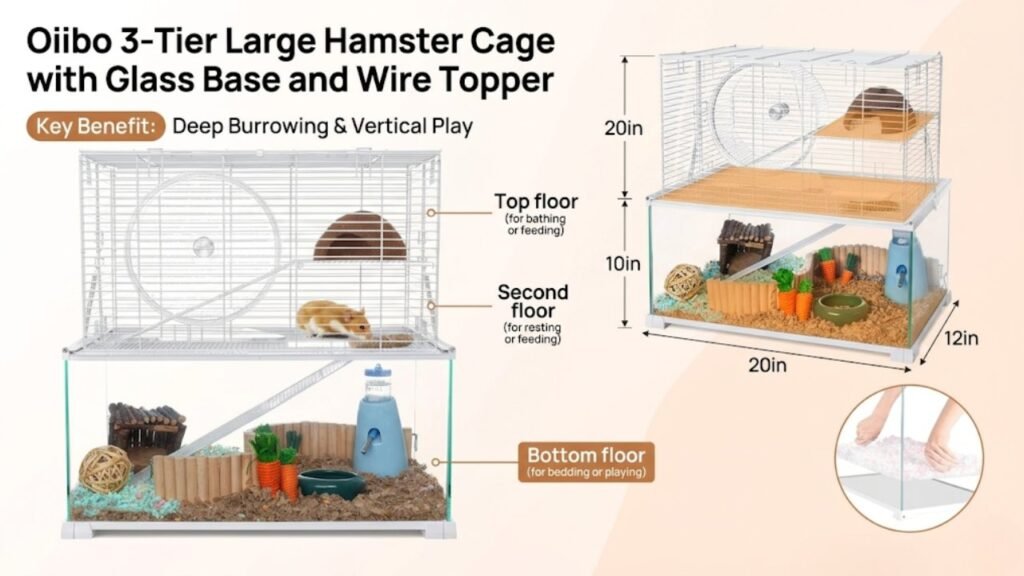
3. Oiibo 3-Tier Large Hamster Cage with Glass Base and Wire Topper
Best For: Gerbil owners who want a hybrid glass-base wire-topper glass tank for gerbils with a genuine 10-inch deep burrowing base and multi-tier enrichment above — combining deep substrate and vertical climbing in one unit
Why We Recommend It
The Oiibo 3-tier cage takes the same hybrid design philosophy as the PawHut glass basin but improves on one critical dimension: the glass base is 10 inches deep — the deepest dedicated burrowing zone of any product in this review. For gerbil owners who want genuine deep-substrate tunneling capability without purchasing a separate aquarium, this 10-inch glass base provides the foundation for real multi-chamber tunnel construction while the heightened wire topper above delivers the multi-side ventilation that glass-only enclosures cannot match.
The waterproof PVC tray at the glass base bottom addresses the most physically demanding cleaning task in any deep-substrate glass tank for gerbils: removing a glass basin loaded with 8–10 inches of compacted, urine-saturated substrate. The removable PVC tray slides out independently, allowing the top substrate layers to be scooped before the tray itself is pulled for cleaning — a more ergonomic sequence than lifting a full glass basin.
Key Features
- Dimensions: 20″L x 12″W x 20″H (small) / 30″L x 12″W x 24″H (large)
- Material: HD glass base + wear-resistant metal wire topper
- Glass Base Depth: 10 inches — deepest dedicated glass burrowing zone reviewed
- Bar Spacing: 0.4 inches — safe for juvenile and adult gerbils
- Ventilation: Heightened wire topper — full multi-side airflow above glass base
- Access: Openable top
- Cleaning: Removable waterproof PVC tray at base
- Included: 2 platforms, 2 ramp ladders, 2 fastening clips, PVC tray
- Tiers: 3 levels of surface enrichment above burrowing base
Pros
- 10-inch glass base depth is the deepest dedicated burrowing zone of any glass tank for gerbils reviewed — genuine multi-chamber tunneling possible
- 0.4-inch wire spacing on topper is juvenile-safe — no supplemental mesh required for young gerbils
- Wire topper provides genuine multi-side ventilation above the glass base — the best ventilation design in the hybrid glass-wire category
- Removable PVC tray simplifies cleaning without lifting the full glass base loaded with substrate
- Chew-proof glass base eliminates the plastic and wood degradation concerns that acrylic and wooden alternatives face
- Transparent 360-degree view through the glass base allows full burrowing behavior observation
- HD glass resists scratching better than acrylic alternatives — maintains optical clarity over long-term use
Cons
- 20″ x 12″ floor footprint of the small version is narrow — 12-inch width is below the minimum recommended for a gerbil pair by welfare space standards
- 30″L x 12″W large version maintains the narrow 12-inch width — floor space remains limiting despite the longer length
- 10-inch glass base loaded with deep substrate becomes very heavy — two-person cleaning operation strongly recommended
- Wire ramp and platform surfaces in the upper section require cover additions to prevent bumblefoot
- Only top opening access — no front door for daily substrate interaction at depth
Best For: Gerbil owners who want the deepest purpose-built glass burrowing base available in a hybrid glass tank for gerbils, with tight 0.4-inch wire spacing above for complete juvenile-safe ventilation — accepting the narrow 12-inch width limitation
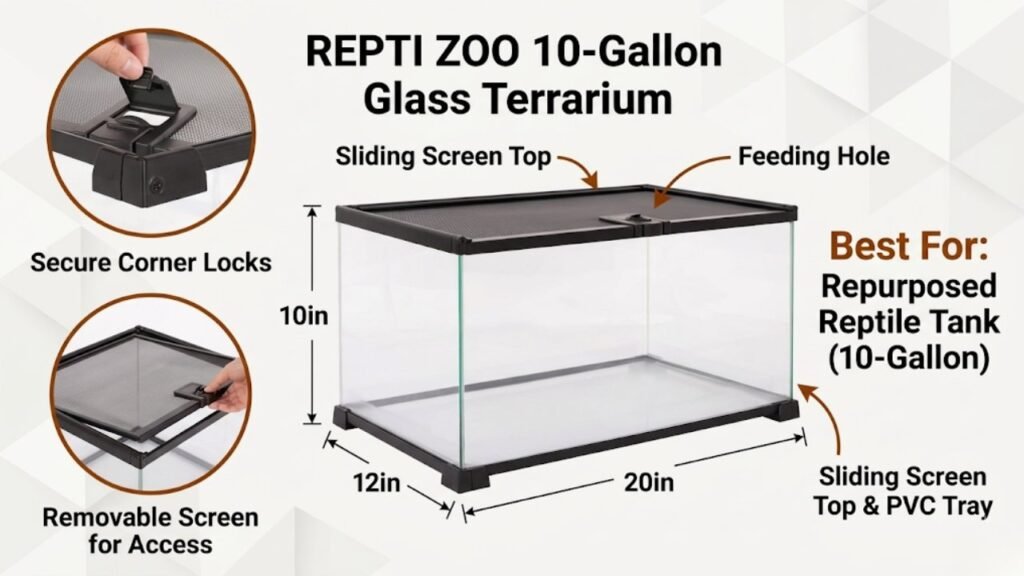
4. REPTI ZOO 10-Gallon Glass Terrarium with Sliding Screen Top
Best For: Gerbil owners who want a purpose-made pure glass tank for gerbils repurposed from reptile use — with a sliding screen top, feeding hole, and PVC substrate tray at the most accessible entry price in this review
Why We Recommend It
The REPTI ZOO 10-gallon glass terrarium is the only true all-glass enclosure in this review — no acrylic panels, no wood frame, no metal mesh walls — and its reptile terrarium origin means it was engineered to hold substrate, manage humidity at depth, and seal against escape with the precision that purpose-built reptile housing demands.
For gerbil owners who understand that a glass aquarium-style enclosure is the foundational gold standard for deep-substrate setups, the REPTI ZOO terrarium provides that format with practical improvements over standard aquariums: the sliding screen top with a dedicated feeding hole allows targeted food placement without fully opening the enclosure, and the 2-minute assembly reflects a design built for repeated setup and breakdown rather than permanent installation.
The honest limitation is the 10-inch total height — at 10 inches, with the 6–8 inches of clear air space required above the substrate surface, usable substrate depth is only 2–4 inches. This is below the 6-inch minimum for genuine gerbil burrowing. The REPTI ZOO is best understood as a starter glass tank for gerbils, a secondary quarantine enclosure, or a juvenile housing solution — not as the primary long-term glass tank for gerbils for an adult pair committed to deep-substrate welfare.
Key Features
- Dimensions: 20″L x 12″W x 10″H
- Volume: 10 gallons
- Material: Pure glass construction — no acrylic components
- Top: Sliding screen top with feeding hole — “Lift and Pull” mechanism
- Ventilation: Full screen top — maximum ventilation area from top surface
- PVC Tray: Transparent PVC base tray for substrate and water holding
- Weight: 13 pounds — lightest glass enclosure in this review
- Assembly: 2-minute setup — tool-free
- Designed For: Reptiles primarily — adapted for small animals
Pros
- Pure glass construction — no scratching concern, no acrylic clarity loss, no wood moisture absorption
- Sliding screen top with feeding hole allows targeted interaction without full enclosure opening
- Full screen top provides maximum top-surface ventilation area of any glass tank for gerbils reviewed
- 13-pound unfilled weight is the lightest glass tank for gerbils reviewed — genuinely portable for cleaning and repositioning
- 2-minute tool-free assembly and disassembly — practical for owners who move or reorganize enclosures regularly
- Transparent PVC base tray is removable — simplifies substrate removal during cleaning
Cons
- 10-inch total height limits usable substrate to 2–4 inches — insufficient for genuine gerbil tunneling behavior
- Not appropriate as a primary long-term glass tank for gerbils for adult animals requiring deep burrowing substrate
- 20″ x 12″ floor space is below the minimum recommended for a gerbil pair — single animal only at this size
- Reptile-focused design means no front access door — top-only entry for all cage maintenance
- Feeding hole in the sliding screen top creates a potential escape point if not properly secured during unsupervised periods
- 10-gallon volume places this as an introductory or temporary glass tank for gerbils rather than a permanent welfare enclosure
Best For: First-time gerbil owners starting with a single juvenile gerbil, owners needing a secondary quarantine glass tank for gerbils, or as a temporary housing solution during primary enclosure cleaning — with a clear upgrade path to a deeper tank as the gerbil matures
5. BitMit Wooden Hamster Cage — Chewproof Pine Acrylic
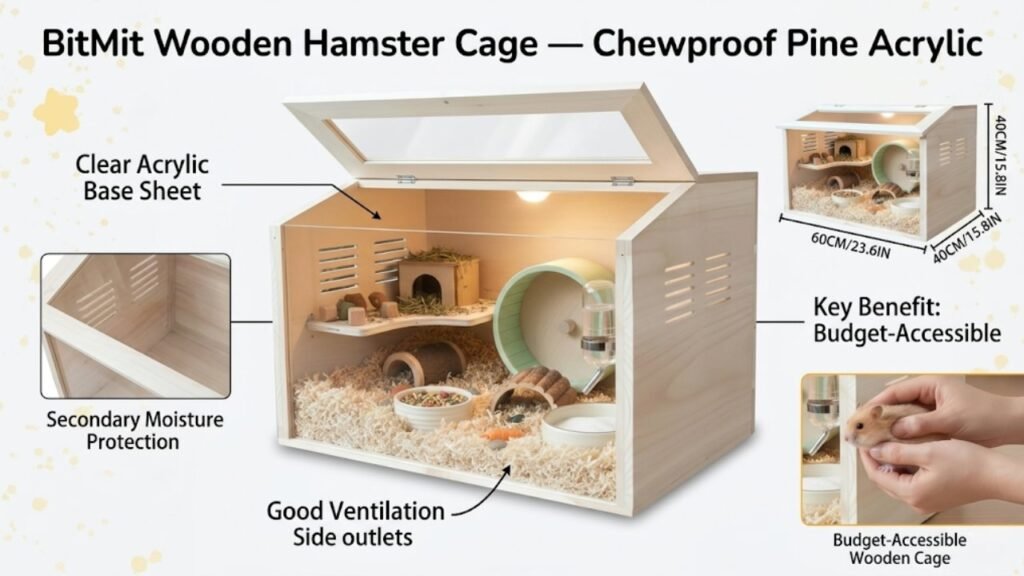
Best For: Gerbil owners seeking a budget-accessible wooden glass tank for gerbils with waterproof coating and clear acrylic base sheet for moisture protection
Why We Recommend It
The BitMit cage distinguishing practical feature within the wooden acrylic glass tank for gerbils category is the included clear acrylic sheet for the base interior — placed on the enclosure floor before substrate is added, it creates a moisture barrier between the pine base and the deep bedding layer that prevents urine absorption into the wood.
This directly addresses the most common long-term maintenance failure of wood-frame glass tanks for gerbils: the base absorbing urine over months until odor becomes impossible to eliminate without replacing the enclosure. The waterproof external coating on the pine structure provides secondary moisture resistance at the outer walls.
Key Features
- Dimensions: 24″L x 16″W x 16″H
- Material: Top pine + thickened acrylic panels
- Special Feature: Clear acrylic base sheet included — moisture barrier for substrate
- Coating: Waterproof external coating on pine structure
- Ventilation: Side air outlets (2) + liftable roof viewing window
- Access: Openable acrylic panels + liftable roof
- Assembly: Step-by-step detailed instructions included
Pros
- Acrylic base sheet prevents urine absorption into pine base — the most practical long-term maintenance feature in this category
- Waterproof external coating on pine structure — secondary moisture protection
- Side air outlets provide meaningful cross-ventilation beyond top-only designs
- Clear acrylic viewing through multiple panels — good behavioral observation
- Liftable roof viewing window adds a third access point for monitoring without full opening
- Budget-accessible price within the wooden glass tank for gerbils category
Cons
- 16-inch total height limits usable substrate to approximately 5–7 inches
- 24″ x 16″ floor space is adequate for one gerbil but limiting for a standard pair by welfare space standards
- Pine internal surfaces accessible to gerbils will develop chewing damage over time despite external waterproof coating
Best For: Budget-conscious single-gerbil owners who want a pine-frame glass tank for gerbils with a practical acrylic base sheet moisture barrier — with full understanding of the limited community validation
6. PIDINUK Acrylic Cage — Foldable Transparent Habitat
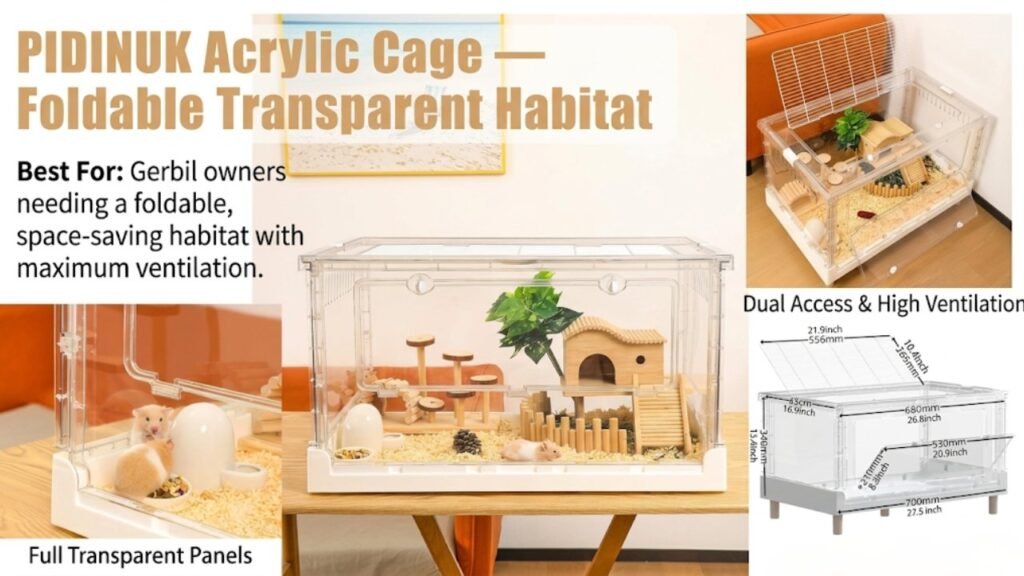
Best For: Gerbil owners who need a foldable, space-saving glass tank for gerbils with full-width wire mesh top for maximum ventilation and compact storage capability
Why We Recommend It
The PIDINUK acrylic cage occupies a practical niche that no other product reviewed here covers: it folds flat for storage when not in use. For owners who maintain a secondary enclosure for quarantine periods, veterinary separation, or temporary colony restructuring, the ability to store the glass tank for gerbils flat rather than occupying permanent floor or shelf space has genuine practical value.
The reinforced wire mesh top provides more total ventilation area than curved slit or hole-pattern alternatives, making this the best-ventilated glass tank for gerbils reviewed here at the trade-off of less substrate depth from the lower total height.
Key Features
- Dimensions: 27.5″L x 17″W x 13.4″H (standard) — 16″H version also available
- Material: Transparent acrylic panels + reinforced wire mesh top
- Ventilation: Full wire mesh top — maximum ventilation area
- Access: Front door + full top opening (wire mesh removal)
- Special Feature: Foldable — flat storage when not in use
- Base: Deep base to contain bedding and debris
- Eco-Friendly: Stated sustainable material
Pros
- Foldable design — flat storage is unique in this review, valuable for secondary enclosure use
- Full wire mesh top provides the most ventilation area of any glass tank for gerbils reviewed
- Dual access — front door and full top opening for complete cleaning access
- Deep base design contains substrate and debris better than shallow-rim alternatives
- Transparent acrylic panels on all sides — full behavioral observation
Cons
- 13.4-inch height is the lowest in this review — limits usable substrate to approximately 4–6 inches
- 4–6 inches of substrate depth is marginal for genuine gerbil tunneling behavior
- Acrylic panels are vulnerable to scratching and impact damage over extended daily use
- Foldable panel joints create potential stress fracture points over repeated assembly and disassembly cycles
- No front lock mechanism — wire mesh top security depends on reliable mesh weighting or clipping
Best For: Gerbil owners who need a foldable glass tank for gerbils as a secondary or quarantine enclosure with maximum ventilation — accepting the shallower substrate depth that the lower height creates
7. PawHut Hamster Cage with Glass Basin
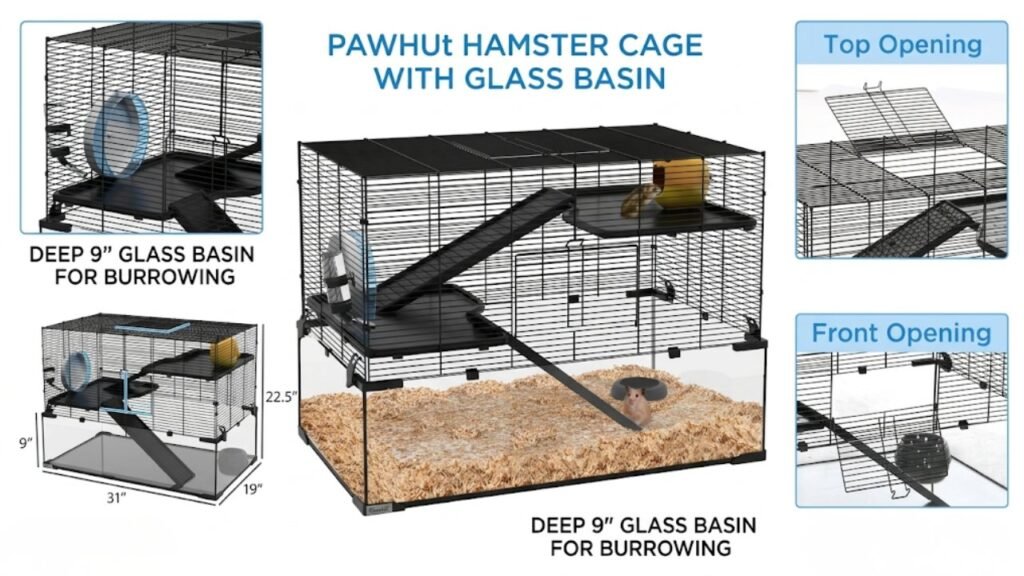
Best For: Gerbil owners who want a hybrid glass-basin wire-top glass tank for gerbils with the deepest dedicated glass burrowing base in this review and multi-tier surface enrichment above
Why We Recommend It
The PawHut glass basin cage takes the most structurally interesting approach to a glass tank for gerbils in this review: a dedicated 9-inch-deep tempered glass basin forms the burrowing substrate zone, topped by a steel wire cage structure that provides multi-level surface enrichment above the burrowing area.
This separation of the burrowing zone (glass basin, substrate-filled) from the surface enrichment zone (wire cage, platforms and wheel) addresses one of the most common gerbil tank setup challenges — maintaining adequate substrate depth in the burrowing area without the surface accessories sinking into deep bedding.
The detachable glass basin is also the most practical cleaning design in this review — detach the basin, carry it to an outdoor hose or bathtub, and empty entirely without dismantling the wire structure above.
Key Features
- Total Dimensions: 31″L x 19″W x 22.5″H
- Glass Basin Dimensions: 31″L x 19″W x 9″H — dedicated burrowing depth
- Wire Top Structure: Multi-level with ramps, platforms, exercise wheel
- Material: Tempered glass basin + steel wire upper structure
- Ventilation: Steel wire cage construction above basin — full multi-side ventilation
- Access: Top door (9.75″W x 8.25″H) + front door (9.75″W x 5.5″H)
- Included: Water bottle, food dish, exercise wheel (6.5″), hut, ramps
- Substrate Depth: Up to 7–8 inches usable in glass basin with 1–2 inch safety margin
Pros
- 9-inch dedicated glass basin provides the deepest purpose-built substrate zone in this review
- Detachable glass basin enables the most practical deep-substrate cleaning — remove and empty rather than scoop from inside
- Steel wire upper section provides full multi-side ventilation above the burrowing zone — the best ventilation of any glass tank for gerbils reviewed
- Multi-level surface enrichment (platforms, ramps, wheel) sits above the substrate, preventing sinking
- Water bottle, food dish, exercise wheel, and hut included — complete out-of-box setup
- Tempered glass is more impact-resistant and heat-stable than standard glass
Cons
- Steel wire ramp surfaces above the burrowing basin require cover additions to prevent bumblefoot
- 6.5-inch exercise wheel included is undersized for adult Mongolian gerbils — requires replacement
- Glass basin is heavy when loaded with 7–8 inches of substrate — two-person cleaning operation recommended
- Front door (5.5″H) is narrow for comfortable daily access to the lower basin area
- Wire cage section above the basin may be climbed by gerbils reaching the wire from substrate height
Best For: Gerbil owners who want the deepest dedicated tempered glass burrowing basin with a separate wire surface enrichment zone — the most functionally specialized glass tank for gerbils for burrowing-focused welfare
8. BingoPaw Wooden Hamster Cage with Tempered Glass and LED Light
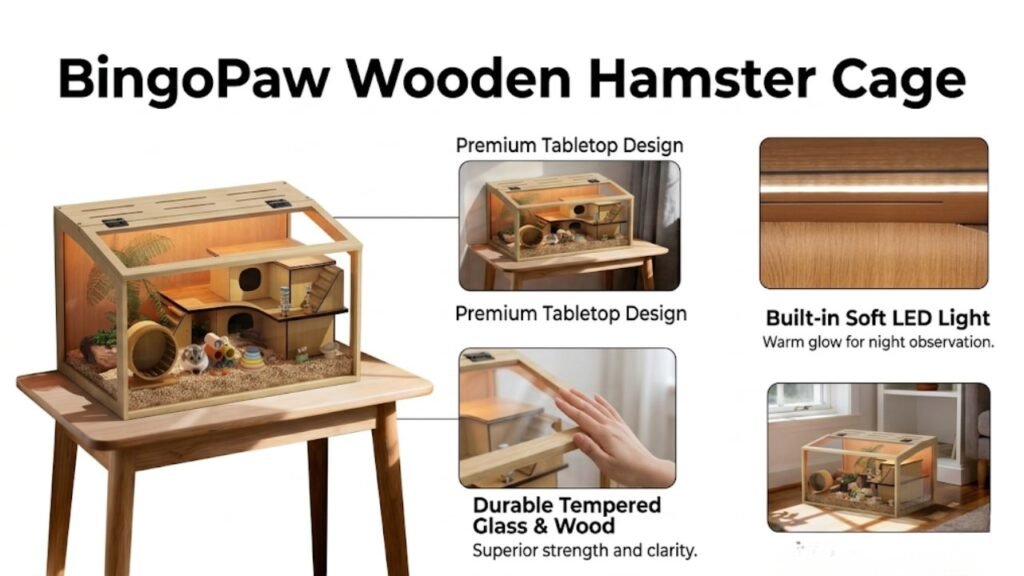
Best For: Gerbil owners who want a tabletop glass tank for gerbils with premium tempered glass, LED lighting for night observation, and a modern wood-glass aesthetic
Why We Recommend It
The BingoPaw wooden glass tank for gerbils occupies the most distinctive design position in this review — it is the only enclosure that integrates LED lighting specifically for low-light observation without disturbing gerbils during their naturally nocturnal active period.
The warm LED strip illuminates the enclosure interior gently enough to allow behavioral monitoring after dark without the stress that bright white lighting creates in small animals. The tempered glass and solid plywood construction combine the highest material quality available in the wooden-frame glass tank for gerbils category — tempered glass resists impact and thermal stress better than standard glass, while solid plywood provides greater structural rigidity and moisture resistance than engineered wood panel alternatives.
Key Features
- Material: Tempered glass panels + solid plywood frame
- Special Feature: Built-in LED light strip — USB powered, warm glow
- Ventilation: Top ventilated holes — promotes airflow stated
- Access: Glass top opening — full top access
- Construction: Chemical-free stated — no harmful materials
- Design: Tabletop suitable — compact footprint
- Placement: Tabletop, flat surface, or corner placement
- Assembly: Hardware and instructions included
Pros
- LED lighting enables nocturnal behavioral monitoring without stress-inducing bright light — unique in this review
- Tempered glass panels provide superior impact resistance and thermal stability versus standard glass
- Solid plywood frame is more moisture-resistant and structurally rigid than engineered wood panel frames
- Chemical-free construction explicitly stated — appropriate for direct gerbil contact throughout
- Tabletop sizing allows placement in living spaces where floor-standing enclosures are impractical
- Modern aesthetic — the most visually distinctive glass tank for gerbils reviewed here
Cons
- Dimensions not fully specified in product listing — substrate depth capacity cannot be calculated accurately without measurement
- Glass top access only — no front door for deep-substrate daily care convenience
- Ventilated top holes provide less total airflow area than full wire mesh alternatives
- LED light requires USB power — permanent cable routing to enclosure location needed
- No specified locking mechanism — escape security depends entirely on glass top weight and fit
Best For: Gerbil owners who prioritize aesthetic design and nocturnal observation with LED lighting in a premium tempered glass and solid plywood glass tank for gerbils — accepting the complete absence of community review data
Glass vs. Acrylic vs. Wood-Frame Hybrid: Which Material Is Best for a Gerbil Tank?
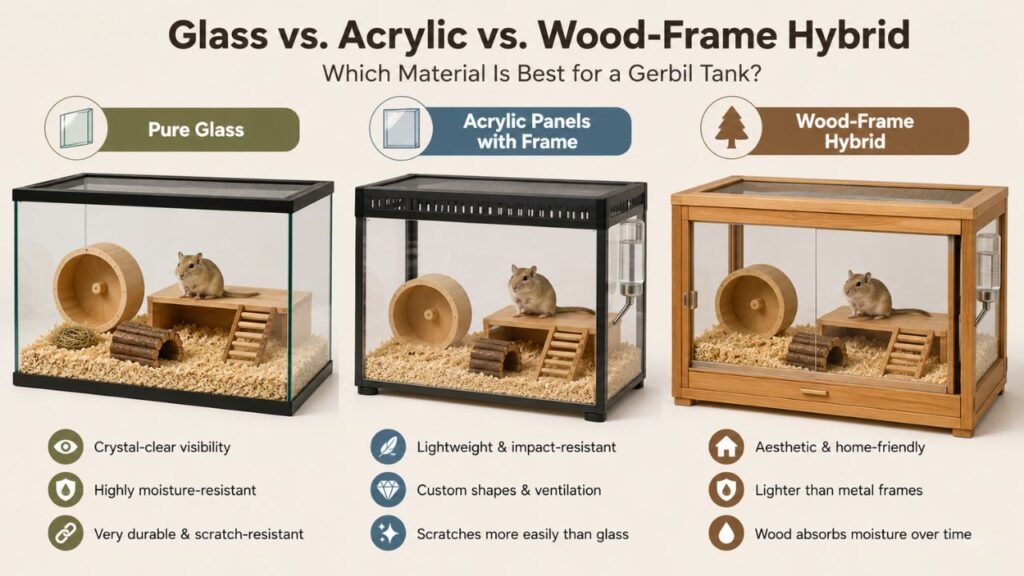
The material decision for a glass tank for gerbils has more long-term impact than most product listings acknowledge.
Pure Glass (Aquarium-Style)
Traditional glass aquariums — not reviewed as specific products here but foundational to the glass tank for gerbils concept — offer the most stable substrate containment, the clearest long-term visibility (glass does not scratch as easily as acrylic), and the most moisture-resistant surface of any material.
The limitations are weight (a 40-gallon aquarium weighs 55+ pounds unfilled), no purpose-built lid for small animal use (requiring a separate mesh lid purchase), and the top-only access that makes deep-substrate cleaning the most physically demanding of any format.
Acrylic Panels with Metal or Wood Frame
Purpose-built glass tanks for gerbils typically use acrylic rather than pure glass for the transparent panels — acrylic is lighter, less likely to shatter if the enclosure is accidentally knocked, and easier to manufacture in enclosure-specific shapes like slanted ventilation slits or curved viewing panels.
The trade-off is that acrylic scratches significantly more easily than glass — standard cleaning cloths leave micro-scratches that accumulate over months, gradually reducing visibility. For a glass tank for gerbils used long-term, this clarity loss is a genuine practical concern. Use only microfiber cloths and enclosure-specific acrylic cleaners.
Wood-Frame Acrylic Hybrid
Wooden frame glass tanks for gerbils integrate aesthetically into home environments, provide a warmer visual presentation than all-metal or all-acrylic designs, and are typically lighter than metal-frame equivalents. The specific limitation is moisture — wood absorbs urine that reaches frame contact points, eventually developing permanent odor that no cleaning can fully resolve.
Using an acrylic base sheet liner (as in the BitMit design) and ensuring the enclosure is positioned so gerbil urine does not reach wood frame joints extends wood-frame glass tank for gerbils lifespan significantly.
How to Set Up a Glass Tank for Gerbils with Deep Bedding
Step 1 — Choose the Right Tank Height First
Before purchasing, calculate your usable substrate depth: total tank internal height minus 8 inches (minimum required clearance for ventilation and gerbil movement above substrate). A glass tank for gerbils with 21-inch internal height supports 13 inches of potential substrate — in practice, 8–10 inches is the functional target.
Step 2 — Install a Secure Mesh Lid Before Adding Substrate
Fit the mesh lid and test all locking or clipping mechanisms before beginning the substrate layer. A glass tank for gerbils that is hard to escape from empty becomes much easier to escape from when substrate provides 8 inches of climbing height advantage.
Step 3 — Layer Substrate for Tunnel Stability
Use the layered approach for maximum tunnel stability in a glass tank for gerbils:
- Bottom 2–3 inches: Slightly moistened coco coir — anchors tunnel structure
- Middle 4–5 inches: Paper substrate (Carefresh, hemp bedding) — primary burrowing material
- Top 1–2 inches: Dry paper substrate or meadow hay — surface forage layer
Step 4 — Position Accessories at Substrate Surface Level
Place exercise wheel on a raised platform or heavy base to prevent sinking into substrate. Position sand bath in the corner gerbils naturally designate as toilet area. Place water bottle sipper at a height accessible from substrate surface — not from the glass bottom. Add wooden hideouts, ceramic tunnels, and foraging enrichment at the surface layer.
Step 5 — Temperature and Ventilation Monitoring
Place a thermometer at substrate surface level — not at the mesh lid where temperature reads several degrees cooler. In a glass tank for gerbils, substrate surface temperature is the relevant reading. Maintain between 65–75°F. If room temperature approaches 78°F, increase room ventilation before relying on the glass tank for gerbils’ own ventilation design.
Cleaning a Glass Tank for Gerbils with Deep Bedding
Weekly Surface Cleaning
Remove and discard the top 1–2 inch surface substrate layer where urine concentrates. This maintains ammonia levels below harmful thresholds without disturbing the gerbil-constructed tunnel network in the lower substrate layers. Wipe visible spots on glass or acrylic walls above substrate level with a damp microfiber cloth.
Monthly Full Clean
Remove all substrate. Clean all glass or acrylic surfaces with pet-safe enclosure cleaner diluted per instructions, or a 1:10 white vinegar and water solution. For acrylic panels in a glass tank for gerbils, use only microfiber cloths — paper towels and standard cloths leave micro-scratches.
For pure glass, a glass cleaner without ammonia (which can linger and irritate gerbil respiratory tissue) is appropriate. Allow complete drying before rebuilding the substrate layers. Gerbils find full cleans stressful because their constructed tunnels are destroyed — minimizing full clean frequency to once monthly by maintaining diligent weekly surface cleaning reduces this stress.
Cleaning the Detachable Basin (PawHut)
The PawHut detachable glass basin is removed entirely and taken to a hose or bathtub for emptying. Scrub with a stiff brush and pet-safe cleaner, rinse thoroughly, and allow to dry standing upright before reattaching to the wire upper structure.
Frequently Asked Questions About Glass Tanks for Gerbils
What is the minimum size glass tank for gerbils?
For a single gerbil, the minimum is 360 square inches of floor space (roughly 20″ x 18″) with 16+ inches of height. For a gerbil pair — and gerbils should always be kept in pairs — a 40-gallon breeder aquarium (36″ x 18″) or equivalent is the widely accepted minimum in welfare-focused communities.
How deep should the substrate be in a glass tank for gerbils?
Six inches is the absolute minimum for basic burrowing. Eight to ten inches allows multi-chamber tunnel construction that more fully satisfies gerbil burrowing instinct. Calculate usable depth by subtracting 8 inches of required clearance from your total tank height.
Do gerbils overheat in glass tanks?
Yes — glass tanks for gerbils trap heat faster than wire cages. Maintain room temperature between 65–75°F, position the glass tank for gerbils away from direct sunlight and heat sources, and monitor with a thermometer at substrate surface level rather than room level.
Can gerbils escape from a glass tank?
Gerbils can escape from glass tanks for gerbils if the lid has gaps larger than 0.6 inches, if the lid is not secured against pushing from below, or if deep substrate provides climbing height close to the lid. Always use a locked or weighted mesh lid with appropriate gap size.
How often should I fully clean a glass tank for gerbils?
Monthly full substrate replacement, with weekly removal of the top 1–2 inch surface layer. Monthly full cleans destroy gerbil-constructed tunnel networks and cause stress — minimizing full clean frequency through diligent weekly surface cleaning improves welfare outcomes.
Is a glass tank or wire cage better for gerbils?
A glass tank for gerbils is significantly better for burrowing welfare — it holds the substrate depth that genuine tunnel construction requires. Wire cages with shallow trays cannot support the 6–10 inch substrate depth that a glass tank for gerbils enables. For gerbils specifically (as opposed to hamsters), a glass tank with deep substrate is the welfare-superior choice.
Final Thoughts on Choosing the Best Glass Tank for Gerbils
The glass tank for gerbils that best serves burrowing-focused welfare starts with height — because height determines substrate depth, and substrate depth determines whether genuine tunneling behavior is possible. The Niteangel Stacker and VEVOR transparent cage provide the most internal height in this review for maximum substrate depth. The PawHut glass basin takes the most specialized approach with a dedicated 9-inch burrowing zone beneath a wire enrichment structure — the most functionally thoughtful design for a burrowing-first glass tank for gerbils.
For secondary or quarantine use, the PIDINUK foldable acrylic cage stores flat and provides maximum top ventilation at the trade-off of shallower substrate depth.
Whatever glass tank for gerbils you choose, the substrate depth, ventilation management, and secure lid are the three factors that determine whether the enclosure actually serves the burrowing welfare needs that make a glass tank for gerbils the right choice in the first place. Get those three elements right, and the specific product matters considerably less than the deep-bedding setup built inside it.
