

Dig boxes for hamsters are one of the most direct ways to address a behavioral need that standard cage setups frequently fail to meet. Hamsters are hardwired to burrow — not occasionally, but as a daily, instinctive drive that shapes their sleep patterns, stress responses, and overall psychological wellbeing. When that drive has nowhere to go, the frustration shows up as bar chewing, repetitive pacing, and an anxious demeanor that no amount of toys or treats can resolve.
The problem with most commercial hamster cages is base depth. A 3–4 inch plastic base simply cannot accommodate the 6–10 inches of loose substrate that genuine burrowing requires. Dig boxes for hamsters fill that gap — they’re dedicated deep containers placed within or alongside the main enclosure that give your hamster the underground experience their instincts are designed to seek.
Syrian hamsters need larger, deeper dig boxes because of their body size — a full-grown Syrian needs enough underground space to turn, chamber, and move comfortably. Dwarf hamsters, despite being smaller, burrow with equal intensity and need appropriately scaled depth for satisfying enrichment. Roborovski hamsters, the smallest dwarf species, are fast and determined diggers that will use even a compact dig box enthusiastically.
This guide covers purpose-built dig boxes for hamsters across a range of designs, what makes each one effective or limited, and how to choose and set up the right option for your specific hamster species and cage configuration.

- Why Dig Boxes for Hamsters Matter Beyond Basic Enrichment
- Burrowing as Stress Regulation
- What Happens When Burrowing Needs Are Met
- What Makes a Good Dig Box for Hamsters?
- Depth Is the Non-Negotiable Factor
- Floor Space Appropriate to Body Size
- Transparent Observation Panel
- Safe Materials
- Cleaning Access
- Substrate Guide for Dig Boxes for Hamsters
- Best Substrates for Tunnel Stability
- What to Avoid in Dig Boxes
- Best Dig Boxes for Hamsters — Top 10 Reviews
- 1. Niteangel Visible Hamster Digging Box
- 2. mini&moe Hamster Sand Bath Container — Triangle Corner Design
- 3. Hamiledyi Natural Wood Sand Bath Container with Climbing Ladder
- 4. QWORK Hamster Sand Bath Box — Clear Acrylic with Wooden Lid
- 5. MUYG Visible Hamster Digging Box — Wood and Acrylic Trapezoid Design
- 6. Chngeary Hamster Adventure Box — Multi-Chamber Viewable House with Tunnel
- 7. Jinzhenhong Hamster Digging Box — Wood and Acrylic with Climbing Ladder
- 8. SQUSIMEI Hamster Sand Bath Container — Large Space Enclosed Design
- 9. mini&moe Hamster Sand Bath Container — Rectangular Design
- 10. BUCATSTATE Hamster Sand Bath Container with Ladder — Rectangle Acrylic
- Quick Comparison: Best Dig Boxes for Hamsters
- Sizing Guide: Dig Boxes for Syrian vs. Dwarf Hamsters
- Syrian Hamsters
- Dwarf Hamsters (Campbell’s, Winter White, Roborovski)
- How to Set Up and Maintain Dig Boxes for Hamsters
- Initial Setup
- Daily Maintenance
- Weekly Spot-Cleaning
- Full Substrate Replacement
- Common Mistakes with Dig Boxes for Hamsters
- Frequently Asked Questions
- Final Thoughts
Why Dig Boxes for Hamsters Matter Beyond Basic Enrichment
Most hamster owners understand that enrichment is important. Fewer understand why burrowing specifically is in a different category from other enrichment types — not optional or supplemental, but fundamental to hamster welfare.
Burrowing as Stress Regulation
Wild Syrian hamsters construct burrow systems that regulate temperature, provide predator protection, and create a psychologically safe sleeping environment. Their nervous systems are wired to experience a sense of safety when physically enclosed underground. In captivity, when hamsters cannot burrow, the absence of that underground security doesn’t register as a minor inconvenience — it registers as a low-level, ongoing stress state that compromises sleep quality, immune function, and behavioral health over time.
Dig boxes for hamsters that are deep enough for genuine underground concealment provide the most direct solution to this welfare concern.
What Happens When Burrowing Needs Are Met
Hamsters with proper burrowing access consistently show:
- Deeper, calmer daytime sleep — they rest more completely in a self-constructed underground chamber
- More confident nighttime exploration — the security of a proper burrow seems to free hamsters to explore their enclosure more actively
- Less stereotypic behavior — bar chewing, repetitive running, and obsessive digging at cage walls all decrease when appropriate burrowing is available
- More natural body language — relaxed posturing, normal whisker activity, and unhurried movement replace the tight, anxious body language of under-stimulated hamsters
What Makes a Good Dig Box for Hamsters?
Understanding the design criteria helps you evaluate any option honestly — including the purpose-built products below.
This YouTube video below explains how to make a hamster dig box, highlighting DIY materials and safe digging substrates. It shows how dig boxes provide enrichment and natural burrowing behavior. Understanding this helps create a more stimulating habitat for your hamster.
Depth Is the Non-Negotiable Factor
The minimum substrate depth for a functional dig box for hamsters is 6 inches. At this depth, a hamster can disappear underground and experience genuine enclosed security. At 3 inches — the depth of most container options marketed casually as dig boxes — a hamster can dig superficially but cannot achieve the subterranean experience that makes burrowing behaviorally satisfying.
For Syrian hamsters, 8–10 inches of depth is the standard to aim for. For dwarf hamsters, 6–8 inches is a solid target.
Floor Space Appropriate to Body Size
A Syrian hamster in a dig box needs enough floor space to navigate underground without constant wall contact. Minimum 8″×8″ floor space for a Syrian dig zone. Dwarf hamsters work well in 6″×6″ or larger. More space always allows more complex tunnel construction.
Transparent Observation Panel
Purpose-built dig boxes for hamsters often include an acrylic or clear panel on at least one face — allowing you to watch your hamster’s underground activity without disturbing them. This is genuinely useful for monitoring health and observing natural behavior, and it makes the dig box significantly more engaging to have in the cage.
Safe Materials
- Wood: Safe when untreated birch, beech, poplar, or pine. Always verify no varnish, paint, or chemical treatment
- Acrylic panels: Safe, chew-resistant for observation windows
- Plastic: Safe when food-grade ABS or PP. No thin, brittle plastic that can shatter into sharp pieces
- No aromatic softwoods: Cedar and aromatic pine release volatile oils harmful to hamster respiratory tracts
Cleaning Access
A dig box that can’t be cleaned properly becomes a hygiene problem. Removable lids, detachable components, and smooth interior surfaces all make substrate replacement and cleaning practical rather than dreaded.
Substrate Guide for Dig Boxes for Hamsters
The container is only half of what makes a dig box functional. The substrate determines whether burrowing is genuinely satisfying or immediately frustrating.
Best Substrates for Tunnel Stability
- Coconut fiber (eco earth): The most widely recommended dig box for hamsters substrate. Holds tunnel shape well, especially when slightly dampened. Safe to ingest. Natural appearance.
- Coconut fiber + paper bedding mix: Coconut fiber base for structural stability, paper bedding top layer for softness and nest-building material. The most effective combination for multi-layered tunnel systems.
- Cork granules mixed with coconut fiber: Adds texture variation and improves tunnel wall integrity.
What to Avoid in Dig Boxes
- Cedar or pine shavings: Aromatic oils cause respiratory irritation — more acute in the enclosed environment of a burrow
- Fluffy cotton wool: Entanglement risk in burrow conditions
- Sand alone: Doesn’t hold tunnel shape — appropriate for sand baths but not burrowing dig boxes
- Scented or chemical-treated bedding: Overwhelming in the enclosed burrow environment
Best Dig Boxes for Hamsters — Top 10 Reviews
1. Niteangel Visible Hamster Digging Box

Best for: The most purpose-designed dig box for hamsters — combines genuine burrowing depth with transparent observation
Why We Recommend It:
The Niteangel Visible Digging Box is the most thoughtfully engineered purpose-built dig box for hamsters available. While many accessories labeled as dig boxes are essentially shallow sand bath containers with a wood frame, the Niteangel is specifically designed around what hamsters actually need from a burrowing enrichment setup — enclosed interior space, a transparent observation panel, and a top opening that allows bedding addition without full disassembly.
The 11.1″×7.36″×7.3″ dimensions provide a meaningful enclosed volume for burrowing substrate. The 2.75-inch top exit allows comfortable entry and exit for Syrian hamsters — this door sizing specifically distinguishes it from dwarf-only options that Syrians can’t use. The five-sided enclosed construction with a single acrylic front panel creates a genuinely enclosed underground experience when filled with substrate, rather than an open-top box that hamsters can see out of in all directions.
The removable lid serves a practical maintenance purpose — you can add fresh substrate, check for cached food, and spot-clean without having to completely dismantle the unit or disturb your hamster’s constructed tunnel system unnecessarily.
Key Features:
- 11.1″L×7.36″W×7.3″H enclosed wooden construction
- Transparent acrylic front panel for observation without disturbance
- 2.75-inch top exit — appropriate for Syrian hamsters
- Removable lid for substrate addition and spot-cleaning
- Five-sided enclosed design creates genuine underground atmosphere when filled
- Smooth-polished corners throughout — no sharp edges
- Compatible with Niteangel bedding substrates
- Can support water bottle or food bowl placement on the top surface
Pros:
- Most purpose-designed dig box for hamsters on this list — dimensions and entry size reflect genuine hamster behavioral needs
- Enclosed five-sided construction creates a genuinely underground atmosphere when filled with substrate
- 2.75-inch entry accommodates Syrian hamsters — the largest commonly kept species
- Acrylic front panel allows observation without disturbing burrowing activity
- Removable lid makes substrate management practical without full disassembly
Cons:
- At 7.3 inches total height, the available substrate depth depends on how full you fill it — leaving room for the hamster to maneuver reduces effective burrowing depth
- Wooden construction requires monitoring for moisture damage in humid environments or from substrate dampening
- Requires adequate enclosure floor space — verify cage dimensions before purchasing
Best For Hamster Type: Syrian hamsters, all dwarf species, Chinese hamsters, gerbils
2. mini&moe Hamster Sand Bath Container — Triangle Corner Design

Best for: A corner-fitting dig and sand bath container for dwarf hamsters with anti-spill design
Why We Recommend It:
The mini&moe triangle design addresses a specific cage layout problem — corner space that’s often wasted in rectangular enclosures. The corner-fitting triangle format tucks into a 90-degree cage corner cleanly, and the 5.3-inch tall enclosed walls contain substrate during active digging without allowing it to scatter across the cage floor.
The frosted semi-transparent walls create a dimly lit interior that mimics the low-light conditions of an underground burrow — a design detail that contributes meaningfully to how comfortable hamsters feel using this space. The spacious 8.1″×6.6″ interior provides adequate floor space for dwarf hamsters as a dig box for hamsters, and the 3.2″×2.3″ entry accommodates most dwarf species comfortably.
The multi-functional top platform — rated to support 2.2 pounds — can hold a small water bottle or food dish, making efficient use of cage vertical space above the dig box footprint.
Key Features:
- Corner-fitting triangle design — efficient use of cage corner space
- 5.3-inch tall walls with full-wrap enclosed design for anti-spill substrate containment
- 8.1″×6.6″ interior floor space
- 3.2″×2.3″ entry opening
- Frosted semi-transparent walls create dim, burrow-like interior lighting
- Multi-functional weighted top platform supports accessories up to 2.2 pounds
- Easy-clean plastic construction
- Includes cleaning scoop
Pros:
- Corner-fitting design saves cage floor space compared to rectangular alternatives
- Frosted walls create a privacy-enhanced, burrow-like interior atmosphere that reduces hesitation in nervous hamsters
- Anti-spill tall walls keep substrate contained during energetic digging — less cage mess
- Top platform adds functional value above the dig box footprint
Cons:
- 5.3-inch total height limits substrate depth capacity — not appropriate as a primary deep burrowing dig box
- Entry opening (3.2″×2.3″) may be tight for chunkier dwarf hamsters or smaller Syrians — verify against your specific animal
- Functions better as a combined sand bath and light digging station than as a deep burrowing dig box
Best For Hamster Type: Dwarf hamsters (all species), small Syrian hamsters — verify entry fit
3. Hamiledyi Natural Wood Sand Bath Container with Climbing Ladder

Best for: A natural wood dig station with integrated climbing enrichment for dwarf hamsters
Why We Recommend It:
The Hamiledyi wooden dig station brings natural material construction to the dig box for hamsters category, which matters for owners building naturalistic enclosures where plastic containers interrupt the aesthetic. The natural wood construction is chew-safe and integrates visually with wood-themed cage setups.
The integrated hideout roof over approximately one-third of the dig area is a thoughtful design detail — it creates a shaded, more enclosed section within the overall dig zone that replicates the covered, protected nature of underground chambers. After digging, hamsters can climb the included ladder to access the roof platform and a small food bowl area, combining burrowing enrichment with climbing activity in a single footprint.
At 11.6″×8.1″×4.9″, the overall dimensions provide adequate floor space, though the 4.9-inch height limits the substrate depth capacity compared to deeper wooden options.
Key Features:
- Natural wood construction — untreated, nail-free, chew-safe
- 11.6″L×8.1″W×4.9″H dimensions
- Partial hideout roof over one-third of the dig zone
- Integrated climbing ladder to roof platform
- Small food bowl area on roof platform
- Private dig area separated from main cage bedding
- No nails — tongue-and-groove construction throughout
Pros:
- Natural wood construction integrates with naturalistic cage aesthetics
- Partial roof section creates a shaded, more enclosed dig zone within the overall structure
- Climbing ladder adds physical enrichment beyond the primary dig box function
- Nail-free construction is safe for hamsters that chew wooden components
Cons:
- 4.9-inch height limits substrate depth to approximately 3–4 inches practically — below the 6-inch minimum for genuine deep burrowing
- Functions better as a surface dig station than a deep burrowing dig box
- Wood absorbs moisture and requires more diligent maintenance than acrylic or plastic alternatives
Best For Hamster Type: Dwarf hamsters, gerbils, mice — not deep enough for primary Syrian burrowing
4. QWORK Hamster Sand Bath Box — Clear Acrylic with Wooden Lid
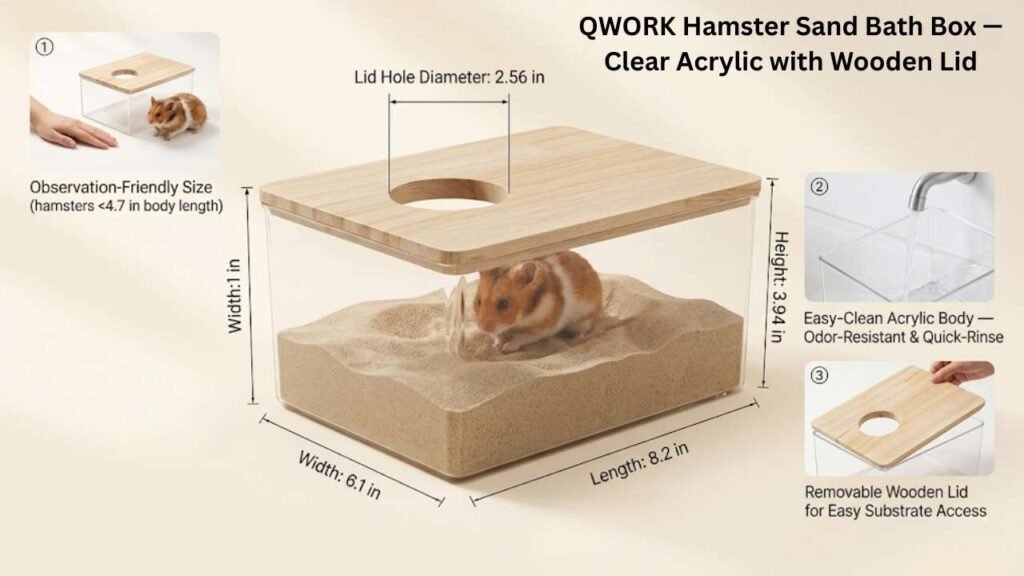
Best for: A transparent, clean-aesthetic acrylic dig station for dwarf hamsters in modern cage setups
Why We Recommend It:
The QWORK acrylic box is the most visually clean option on this list — clear acrylic body with a wooden lid creates a modern, minimal aesthetic that suits contemporary cage setups well. The 8.2″×6.1″×3.94″ internal dimensions provide a functional dig and sand bath station for dwarf hamsters, and the full transparency gives 360-degree observation capability from any viewing angle.
The removable wooden lid makes substrate management straightforward — lift, add or replace substrate, replace. The smooth acrylic interior resists odor absorption and cleans with a quick rinse, which keeps maintenance requirements low for busy owners.
The honest limitation is the 3.94-inch internal height — this provides a surface dig and grooming station rather than a deep burrowing experience. For dwarf hamsters used as a combined sand bath and light digging area, it serves well. As a primary burrowing dig box for any hamster species, deeper options are needed.
Key Features:
- Clear acrylic body — full 360-degree transparency
- Removable wooden lid for easy substrate access
- 8.2″×6.1″×3.94″ internal dimensions
- Smooth acrylic interior — odor-resistant, quick-clean
- Specified for hamsters under 4.7 inches in body length
- Modern, minimal aesthetic for contemporary cage setups
- Amazon Overall Pick designation
Pros:
- Full acrylic transparency provides the best observation capability for watching digging behavior
- Smooth acrylic interior is genuinely odor-neutral — doesn’t retain substrate smells between changes
- Removable wooden lid makes substrate management fast and easy
- Clean modern aesthetic appropriate for display-position enclosures in living spaces
Cons:
- 3.94-inch internal height is below the 6-inch minimum for genuine burrowing depth — functions as a surface dig station
- Specified for hamsters under 4.7 inches — not appropriate for larger Syrian hamsters
- Acrylic can scratch with regular cleaning over time, gradually reducing transparency
Best For Hamster Type: Dwarf hamsters only (all species), gerbils, mice
5. MUYG Visible Hamster Digging Box — Wood and Acrylic Trapezoid Design
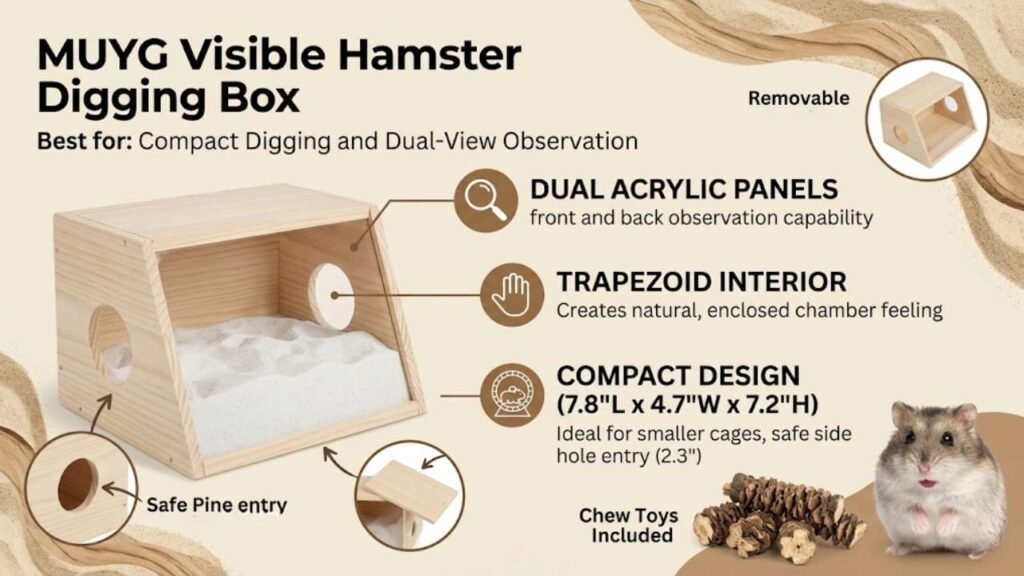
Best for: A compact visible dig box for hamsters in smaller enclosures with dual acrylic observation panels
Why We Recommend It:
The MUYG trapezoid design distinguishes itself by placing transparent acrylic panels on both the front and back of the wooden structure — creating observation capability from two sides rather than the single-face view most similar products provide. The 7.8″L×4.7″W×7.2″H dimensions and 2.3-inch side hole diameters make this accessible for dwarf hamsters and smaller Syrians.
The trapezoid shape is narrower at the top than the bottom, which creates a naturally more enclosed feeling in the substrate interior — replicating the tapered tunnel shape that hamsters construct naturally when burrowing toward a chamber. The included chew toys add dental enrichment value alongside the primary dig box function.
Key Features:
- Trapezoid shape — wider base, narrower top for natural chamber-like interior atmosphere
- Dual acrylic panels — front and back observation capability
- 7.8″L×4.7″W×7.2″H dimensions
- 2.3-inch diameter side holes for entry and exit
- Removable top cover for substrate access and cleaning
- Pine and acrylic construction with stainless steel fasteners
- Includes chew toys
- Can be fastened to cage bars or placed freely inside enclosure
Pros:
- Dual acrylic observation panels provide better visibility than single-face alternatives
- Trapezoid interior shape creates a naturally enclosed, chamber-like atmosphere when filled
- 7.2-inch height provides more potential substrate depth than most compact options
- Cage bar attachment option reduces cage floor footprint
Cons:
- 4.7-inch width is narrow for Syrian hamsters — they can enter but have limited turning room
- 4.1 stars from 33 reviews — moderate validation with some variance in buyer experience
- Pine construction requires verification of treatment-free status and monitoring for moisture absorption
Best For Hamster Type: Dwarf hamsters (primary use), small Syrian hamsters (verify fit)
6. Chngeary Hamster Adventure Box — Multi-Chamber Viewable House with Tunnel

Best for: Owners who want a dig box for hamsters that combines burrowing, exploration, and multi-level enrichment in one structure
Why We Recommend It:
The Chngeary Adventure Box takes a fundamentally different approach to dig boxes for hamsters — rather than a single enclosed substrate container, it provides a nine-room, three-level structure that functions simultaneously as a dig zone, exploration maze, and activity platform. The internal channel design creates a hamster maze within the structure, and the acrylic front wall provides full observation capability throughout.
At 10″L×5.1″W×8.3″H, it has the tallest internal height of any purpose-built wooden option on this list. Each floor is connected by a ladder for vertical movement between levels. This design is behaviorally rich — it allows hamsters to explore, cache food in different rooms, rest in different chambers, and choose their preferred areas for different activities.
Key Features:
- Nine rooms across three levels — multi-chamber exploration structure
- 10″L×5.1″W×8.3″H dimensions — tallest purpose-built wooden option on this list
- Acrylic front panel — full observation across all three levels
- Ladder connections between floors
- High-quality wear-resistant wood construction
- Waterproof and leak-proof construction noted
- Multiple entry and exploration points throughout
Pros:
- Multi-chamber design provides the most behavioral complexity of any option on this list
- 8.3-inch height is the tallest purpose-built dig option — best substrate depth potential among wooden designs
- Nine-room layout allows hamsters to assign different purposes to different chambers naturally
- Acrylic panel provides observation across all levels simultaneously
Cons:
- 4.8 stars from only 5 reviews — very limited validation sample. Promising rating but insufficient for confident recommendation without reading all current buyer feedback
- 5.1-inch width is narrow for Syrian hamsters — better suited to dwarf species
- Complex multi-chamber structure requires more thorough cleaning than simpler single-chamber designs
Best For Hamster Type: Dwarf hamsters (primary), smaller Syrian hamsters — verify width compatibility
7. Jinzhenhong Hamster Digging Box — Wood and Acrylic with Climbing Ladder

Best for: A compact visible dig box for hamsters with climbing ladder in a smaller footprint
Why We Recommend It:
The Jinzhenhong dig box covers the functional essentials of a purpose-built dig box for hamsters — wooden construction, acrylic front panel for observation, removable top lid, and a 2.5-inch top exit opening — in a compact 8.6″×4.8″×5.7″ footprint. For owners with enclosures where floor space is genuinely limited, the smaller dimensions make it possible to include a dedicated burrowing station without significantly reducing the remaining cage area.
The included climbing ladder adds a vertical enrichment element above the primary dig zone. The detachable roof facilitates quick substrate access and cleaning. At the same time, honest assessment requires noting the limitations: the 5.7-inch height and 4.8-inch width constrain the burrowing depth and interior maneuvering space for any hamster larger than a small dwarf.
Key Features:
- 8.6″L×4.8″W×5.7″H compact dimensions
- Acrylic front panel for single-face observation
- 2.5-inch top exit opening
- Detachable roof for substrate access and cleaning
- Climbing ladder for vertical enrichment
- Acrylic and wood construction
- Recommended for Syrian hamsters, dwarf hamsters, chinchillas, lemmings
Pros:
- Compact footprint suits enclosures with limited available floor space
- Detachable roof makes substrate addition and cleaning straightforward
- Climbing ladder adds physical enrichment above the primary burrowing function
- 2.5-inch exit is usable by most hamster species
Cons:
- 3.7 stars from 11 reviews — the lowest average rating on this list. Read all current buyer reviews carefully before purchasing
- 5.7-inch height limits available substrate depth — below the 6-inch minimum for genuine burrowing with any substrate air gap
- 4.8-inch width is very tight for Syrian hamsters despite the listing recommending them
Best For Hamster Type: Small to medium dwarf hamsters — approach Syrian hamster compatibility with caution given width limitations
8. SQUSIMEI Hamster Sand Bath Container — Large Space Enclosed Design

Best for: A budget-accessible enclosed dig and sand bath container for dwarf hamsters with frosted privacy walls
Why We Recommend It:
The SQUSIMEI container provides a practical, affordable entry point into the dig boxes for hamsters category for budget-conscious owners. The 6.8″×7.3″×6.9″ dimensions and frosted semi-transparent top cover create an enclosed, dimly lit interior space that functions well as a combined sand bath and light digging station.
The 2.6″×2.4″ opening accommodates most dwarf hamster species and smaller Syrians. The ABS plastic construction is described as bite-resistant, addressing the chewing durability concern that affects many plastic enclosures. The frosted design provides the semi-private, low-light interior that makes hamsters feel more comfortable using the space — a similar design philosophy to the mini&moe options.
Key Features:
- 6.8″×7.3″×6.9″ enclosed dimensions
- Frosted semi-transparent top cover — dimly lit, burrow-like interior
- 2.6″×2.4″ entry opening — accessible for dwarf hamsters and smaller Syrians
- ABS plastic construction — bite-resistant
- 2.7-inch base height for substrate containment
- Food-grade material — safe for hamster contact
- Multiple color options (green, pink, white, yellow)
Pros:
- Frosted walls create a genuinely private, low-light interior appropriate for stress-free use
- ABS plastic bite resistance addresses the durability concern of thinner plastic containers
- Adequate floor space (6.8″×7.3″) for dwarf hamster digging and sand bathing
- Budget-accessible without significant functional compromise for dwarf hamsters
Cons:
- Total height of 6.9 inches limits practical substrate depth — the base height and hamster maneuvering space reduce actual substrate fill to approximately 3–4 inches
- Functions better as a sand bath and light dig station than a deep burrowing container
- Amazon’s Choice designation but from a newer product listing — verify current buyer feedback
Best For Hamster Type: Dwarf hamsters (all species), smaller Syrian hamsters
9. mini&moe Hamster Sand Bath Container — Rectangular Design

Best for: A rectangular enclosed dig station with anti-spill walls and top platform utility for dwarf hamsters
Why We Recommend It:
The mini&moe rectangular variant provides the same core design principles as the triangle corner version — full-wrap 5.3-inch high walls, frosted semi-transparent construction, spacious 8.1″×6.6″ interior, and weighted top platform — in a rectangular format that suits straight-wall cage placement rather than corner positioning.
For owners whose cage layout doesn’t have accessible corners for a triangle design, the rectangular version provides equivalent functionality in a standard footprint. The 3.2″×2.3″ entry width is identical between the two versions, as is the platform capacity and wall height.
Key Features:
- Rectangular format — straight-wall cage placement compatible
- 5.3-inch tall enclosed walls — anti-spill substrate containment
- 8.1″×6.6″ interior floor space
- 3.2″×2.3″ entry opening
- Frosted semi-transparent walls for dim interior lighting
- Weighted top platform (2.2-pound capacity) for accessory placement
- Easy-clean plastic construction
- Includes cleaning scoop
Pros:
- Rectangular format provides placement flexibility across different cage configurations
- Same proven anti-spill and frosted privacy design as the triangle version
- Weighted top platform makes efficient use of vertical cage space above the dig box
- Cleaning scoop included — practical for daily spot-cleaning without full substrate replacement
Cons:
- Same depth limitation as the triangle version — 5.3-inch walls don’t support 6-inch minimum substrate depth for genuine burrowing
- Entry dimensions may require verification against individual hamster proportions
- Best as a sand bath and light dig station rather than a primary deep burrowing container
Best For Hamster Type: Dwarf hamsters (all species), small Syrian hamsters
10. BUCATSTATE Hamster Sand Bath Container with Ladder — Rectangle Acrylic

Best for: A clean-look acrylic dig station with depth markers and climbing ladder for hamsters
Why We Recommend It:
The BUCATSTATE rectangle acrylic container is one of the most practically designed options in this category — the exterior tick marks at 1.5cm and 3cm guide appropriate substrate depth rather than leaving owners to guess how much to fill. The 8.3″×5.7″×3.2″ dimensions and acrylic construction provide excellent observation and easy cleaning in a format suited to both sand bathing and surface-level digging enrichment.
The wooden ladder included with the half-lid serves as a climbing enrichment accessory above the dig zone, and the poplar wood lid is water-resistant on the surface — more durable than standard untreated wood alternatives. The acrylic body is notably odor-resistant, addressing the persistent smell issue that affects wooden dig boxes over extended use.
Key Features:
- 8.3″×5.7″×3.2″ acrylic construction — clear, scratch-resistant, odor-resistant
- Exterior tick marks at 1.5cm and 3cm for substrate depth guidance
- Half-lid design with climbing wooden ladder
- Poplar wood water-resistant lid surface
- 3.2-inch total height — heightened design reduces substrate scatter
- Chew-resistant acrylic body
- Easy to clean — no odor retention
- 4.6 stars from 278 reviews — the most validated purpose-built option on this list
Pros:
- Exterior depth markers eliminate substrate fill guesswork — a genuinely practical design detail
- Acrylic construction is the most odor-resistant option on this list — cleans completely without residual smell
- 4.6 stars from 278 reviews — the strongest validation of any purpose-built option reviewed
- Wooden ladder adds climbing enrichment beyond the primary dig box function
Cons:
- 3.2-inch total height is the shallowest on this list — functions as a surface dig and sand bath station, not a deep burrowing container
- Better positioned as a secondary surface dig zone within a larger deep substrate setup than as a standalone primary burrowing station
- Half-lid design leaves the top partially open — more substrate scatter than fully enclosed alternatives
Best For Hamster Type: Dwarf hamsters, smaller Syrian hamsters as a secondary dig station
Quick Comparison: Best Dig Boxes for Hamsters
| Product | Material | Internal Height | Entry Size | Syrian Compatible | Best Function |
|---|---|---|---|---|---|
| Niteangel Visible Digging Box | Wood + Acrylic | 7.3″ | 2.75″ | ✅ Yes | Deep burrowing + observation |
| mini&moe Triangle | Plastic (frosted) | 5.3″ walls | 3.2″×2.3″ | ⚠️ Small Syrians | Surface dig + sand bath |
| Hamiledyi Wood Box | Natural Wood | 4.9″ | Open top | ❌ Too shallow | Surface dig station |
| QWORK Acrylic Box | Clear Acrylic | 3.94″ | Open top | ❌ Dwarf only | Sand bath + light dig |
| MUYG Trapezoid | Wood + Acrylic | 7.2″ | 2.3″ holes | ⚠️ Narrow | Compact deep dig |
| Chngeary Adventure Box | Wood + Acrylic | 8.3″ | Multi-entry | ⚠️ Width limited | Multi-chamber exploration |
| Jinzhenhong Dig Box | Wood + Acrylic | 5.7″ | 2.5″ top | ⚠️ Verify fit | Compact dig station |
| SQUSIMEI Bath Container | ABS Plastic | 6.9″ | 2.6″×2.4″ | ⚠️ Small Syrians | Enclosed sand bath + dig |
| mini&moe Rectangular | Plastic (frosted) | 5.3″ walls | 3.2″×2.3″ | ⚠️ Small Syrians | Surface dig + sand bath |
| BUCATSTATE Acrylic | Acrylic + Wood | 3.2″ | Open top | ⚠️ Secondary use | Surface dig station |
Sizing Guide: Dig Boxes for Syrian vs. Dwarf Hamsters

Syrian Hamsters
Adult Syrians reach 5–7 inches in body length and are the most physically demanding species for dig box sizing.
Requirements for Syrian dig boxes:
- Entry opening: Minimum 2.5 inches in diameter — the Niteangel’s 2.75-inch exit is the clearest fit
- Internal height: 7+ inches to allow meaningful substrate depth after accounting for maneuvering space
- Floor space: Minimum 8″×8″ for comfortable underground navigation
- Best option from this list: Niteangel Visible Digging Box — only purpose-built option that genuinely meets Syrian sizing requirements
Dwarf Hamsters (Campbell’s, Winter White, Roborovski)
Dwarf hamsters range from 2–4 inches in body length. Most options on this list are appropriately sized for dwarf species, though Roborovski hamsters — the smallest and fastest — require attention to wall height in external enrichment sessions to prevent climbing escape.
Requirements for dwarf dig boxes:
- Entry opening: 1.5–2.5 inches is adequate for all dwarf species
- Internal height: 5+ inches for functional burrowing
- Floor space: 6″×6″ minimum
- Best options from this list: Niteangel, mini&moe, SQUSIMEI, BUCATSTATE all serve dwarf hamsters well
How to Set Up and Maintain Dig Boxes for Hamsters
Initial Setup
- Choose appropriate substrate — coconut fiber base layer with paper bedding top layer is the most effective combination
- Fill to appropriate depth — minimum 6 inches for genuine burrowing; use depth markers where available (BUCATSTATE’s tick marks are helpful here)
- Position against a cage wall or corner — hamsters feel more secure burrowing in a wall-adjacent location
- Allow voluntary introduction — place your hamster near the dig box and let them investigate at their own pace. Don’t place them inside it.
Daily Maintenance
- Check for obvious soiled patches visible through acrylic or transparent walls
- Remove any perishable cached food discovered during visual checks
Weekly Spot-Cleaning
- Use the included scoop (where provided) to remove soiled substrate
- Preserve the majority of substrate — your hamster’s scent markers in the dig box are part of what makes it feel safe
Full Substrate Replacement
- Every 3–4 weeks for complete substrate change
- Save a small handful of used substrate to reintroduce alongside fresh material
- Wash the container with diluted white vinegar (1:1 with water), rinse thoroughly, air dry completely before refilling
Common Mistakes with Dig Boxes for Hamsters
Choosing a container that’s too shallow and calling it a dig box. A 3-inch substrate layer isn’t burrowing enrichment. It’s a glorified substrate tray. If the container can’t hold 6+ inches of loose substrate with room for the hamster above the substrate surface, it doesn’t function as a genuine dig box.
Using substrate that collapses immediately. Paper bedding alone collapses quickly under active digging. Mix with coconut fiber for tunnel stability that lasts more than a few minutes.
Placing the dig box in the center of the cage. Hamsters instinctively burrow toward enclosed, corner-adjacent spaces. A dig box positioned in the open center of a cage floor gets used less than one positioned against a wall.
Over-cleaning and eliminating scent markers. Your hamster’s scent marks within the dig box substrate are a signal that this is their safe territory. Full substrate replacement every week removes those markers and can cause your hamster to treat the dig box as a new, unfamiliar object requiring re-investigation from scratch.
Assuming the dig box replaces adequate cage bedding depth. A dig box for hamsters supplements a cage setup — it doesn’t replace the need for appropriate substrate depth in the main enclosure. Both are important.
Frequently Asked Questions
What is a dig box for a hamster?
A dig box for hamsters is a deep container filled with loose substrate that provides dedicated space for burrowing behavior — particularly important in cages with limited base depth that can’t accommodate the 6–10 inches of substrate hamsters need for genuine underground tunneling.
How deep should a hamster dig box be?
Minimum 6 inches of loose substrate. For Syrian hamsters, 8–10 inches provides the most satisfying burrowing experience. Most purpose-built options on this list provide less — supplementing with a deep storage container is often necessary for Syrian hamsters.
What substrate is best for a hamster dig box?
Coconut fiber (eco earth) as the base layer, with paper bedding on top for softness. This combination holds tunnel shape while providing comfortable nesting material.
Can a sand bath container work as a dig box?
Sand bath containers and dig boxes serve different behavioral functions. A sand bath is for grooming; a dig box is for burrowing. Some containers on this list serve both functions in one footprint, but they compromise on depth for genuine burrowing compared to dedicated deep dig containers.
Do all hamster species need dig boxes?
Yes. Syrian hamsters, dwarf hamsters, gerbils, and mice all have burrowing instincts that benefit from appropriate substrate depth. The container size and depth requirements scale with body size.
How often do I need to replace dig box substrate?
Spot-clean every few days by removing soiled areas. Full substrate replacement every 3–4 weeks. Always preserve a small amount of used substrate when replacing to maintain familiar scent continuity.
Can I use a fish tank as a dig box for my hamster?
Yes — glass aquariums are excellent dig boxes. They’re stable, fully transparent, odor-resistant, and available in depths appropriate for genuine Syrian and dwarf hamster burrowing. A 10-gallon aquarium works well for dwarf hamsters; a 20-gallon long provides appropriate space for Syrians.
Final Thoughts
Dig boxes for hamsters aren’t a luxury addition for enthusiast owners — they’re a practical solution to one of the most common welfare gaps in standard hamster care. When a cage base is 3–4 inches deep and your hamster needs 6–10 inches for genuine burrowing, a dedicated dig box bridges that difference in a way that directly, measurably improves your hamster’s behavioral health.
Among the purpose-built options on this list, the Niteangel Visible Digging Box stands clearly above the rest for owners of Syrian hamsters — it’s the only option with dimensions, entry sizing, and enclosed construction that genuinely supports Syrian burrowing behavior. For dwarf hamster owners, the BUCATSTATE Acrylic (most validated reviews), mini&moe (best anti-spill enclosed design), and SQUSIMEI (best frosted privacy design) all serve well as primary surface dig and sand bath stations.
For owners who want genuine deep burrowing capacity for Syrian hamsters beyond what any purpose-built option provides, supplementing with a large clear storage container or glass aquarium filled with 8–10 inches of coconut fiber substrate remains the most effective and space-appropriate solution. The dig box matters — but depth matters more than the label on the container.
