

A rat cage for multiple rats is not simply a larger version of a single-rat enclosure — it is a fundamentally different welfare commitment. Rats are intensely social animals. Housed alone, they develop depression-like behavioral symptoms within weeks: lethargy, repetitive movements, excessive grooming, and increased stress hormone levels that have been documented in small animal research. The solution is cohabitation — but cohabitation creates requirements that a standard small animal cage cannot meet safely.
Ventilation is the first concern that changes with population density. A cage housing four or five rats produces significantly more ammonia from urine than a single-animal setup. Poor airflow in an enclosed or near-enclosed rat cage for multiple rats allows ammonia to concentrate at lower cage levels — directly irritating respiratory tissue in animals that spend time near the floor. The best rat cages for multiple rats use wide bar-spacing wire construction that allows continuous cross-ventilation from all sides, not just through a top panel.
Escape prevention becomes more complex with multiple rats because animals at different sizes — juveniles alongside adults, smaller females with larger males — mean the bar spacing that safely contains one animal may be inadequate for another. A 1-inch bar gap that holds an adult rat will allow a juvenile to push through without effort.
Cleaning frequency also scales with rat population: a rat cage for multiple rats holding four animals produces as much waste as a single cage holding one animal does in four times the time — requiring pull-out trays, accessible doors, and removable platforms that make weekly deep cleaning genuinely manageable rather than an hours-long project.

- What Makes a Safe Rat Cage for Multiple Rats?
- 1. Minimum Floor Space Requirements
- 2. Bar Spacing — The Most Critical Safety Feature
- 3. Ventilation and Airflow
- 4. Secure Door Locking
- 5. Pull-Out Tray and Platform Accessibility
- 6. Ramp and Platform Safety
- Product Reviews: Best Rat Cages for Multiple Rats
- 1. Critter Nation Double Unit by MidWest Homes for Pets
- 2. HABUTWAY 60″ Metal Large Rolling Rat Cage
- 3. Homey Pet 3-Level Small Animal Cage
- 4. Mcage 3-Level Foldable Travel Carrier Cage
- 5. Lovinhut Large Wood Chinchilla Cage Enclosure
- 6. Mcage Large Double Unit 4-Tier Rolling Cage
- 7. PawHut Large Hamster Cage with Tempered Glass Bottom
- 8. Kaytee My First Home Multi-Level Exotics Habitat
- Comparison Table: Best Rat Cages for Multiple Rats
- How Much Space Do Multiple Rats Actually Need?
- The 2 Cubic Feet Rule
- Wire Bar Cages vs. Glass Enclosure Cages for Multiple Rats
- Wire Bar Rat Cages for Multiple Rats
- Glass-Base Hybrid Cages (PawHut Style)
- The Practical Recommendation
- Essential Accessories for a Rat Cage for Multiple Rats
- Hammocks and Fabric Shelving
- Food Stations
- Water Bottles
- Burrowing Substrate
- Enrichment Items
- How to Clean a Rat Cage for Multiple Rats
- Frequently Asked Questions About Rat Cages for Multiple Rats
- Final Thoughts on Choosing the Right Rat Cage for Multiple Rats
What Makes a Safe Rat Cage for Multiple Rats?
Before comparing specific products, understanding the safety and welfare criteria for a rat cage for multiple rats prevents purchases that look adequate on paper but fail in daily use.
1. Minimum Floor Space Requirements
Floor space is the most commonly underestimated requirement in a rat cage for multiple rats. The general welfare guideline used by experienced rat owners is a minimum of 2 cubic feet of space per rat — meaning a cage housing four rats needs at least 8 cubic feet of usable living volume.
Vertical height contributes to this calculation through platforms and shelves, but ground-level floor space matters separately because rats spend significant time at the base of the enclosure eating, grooming, and exploring.
Practical minimum floor dimensions for a rat cage for multiple rats:
- 2 rats: 24″ x 24″ floor minimum
- 3–4 rats: 30″ x 18″ or larger floor minimum
- 5–6 rats: 36″ x 24″ or larger floor minimum
- Colony of 6+: Double unit configurations (36″ x 24″ x 63″) become the practical requirement
2. Bar Spacing — The Most Critical Safety Feature
Bar spacing in a rat cage for multiple rats determines whether juvenile rats can escape — and whether adult rats can get their heads stuck in gaps that are too wide. The safe spacing range is narrow:
- Adult rats: 1/2 inch (12.7mm) maximum bar spacing
- Juvenile and smaller female rats: 3/8 inch (9.5mm) maximum
- Mixed-age colonies: 3/8 inch throughout for the first six months, then 1/2 inch when all animals reach adult size
Any rat cage for multiple rats with 1-inch or larger bar spacing is unsafe for standard domestic rats regardless of how it is marketed.
3. Ventilation and Airflow
A rat cage for multiple rats must prioritize cross-ventilation. Full wire-wall construction allows air movement from all four sides simultaneously — this is the most effective format for ammonia dilution in a multi-rat environment.
Cages with solid wood or plastic walls on three sides and wire only on the front panel restrict airflow significantly, causing ammonia buildup faster than the cleaning schedule can address.
4. Secure Door Locking
Rats are considerably more intelligent and dexterous than most small animal species. A rat cage for multiple rats with simple clip-style door closures will be opened from inside within days of first use by problem-solving animals.
Secure latching mechanisms — dedicated latch locks, carabiner-compatible D-rings, or key-style locks — are necessary on all door openings in a rat cage for multiple rats housing animals with established escape-testing behavior.
5. Pull-Out Tray and Platform Accessibility
A rat cage for multiple rats housing four or more animals will need cleaning twice weekly at minimum. A pull-out waste tray at the base that slides out without disturbing the animals makes this routine genuinely quick. Removable platforms and ramps that can be taken out, scrubbed, and returned without dismantling the entire structure reduce the time cost of maintenance to a level that owners actually sustain long-term.
6. Ramp and Platform Safety
Wire ramp surfaces in a rat cage for multiple rats cause a condition called bumblefoot — a painful foot infection resulting from repeated pressure on wire grid surfaces. Solid ramp covers, fabric hammock steps, or textured plastic ramp surfaces protect rat feet during daily vertical movement. Any rat cage for multiple rats with uncovered wire ramps should be immediately fitted with ramp covers before housing animals.
Product Reviews: Best Rat Cages for Multiple Rats
1. Critter Nation Double Unit by MidWest Homes for Pets
Best For: Large rat colonies of 4–8 animals requiring maximum floor space, full-width door access, and the most versatile rat cage for multiple rats available

Why We Recommend It
The Critter Nation Double Unit is the most community-validated rat cage for multiple rats in this review — 11,157 reviews and Amazon’s Choice status reflect a product that has been tested at scale by serious rat owners, not just casual purchasers. The practical reason experienced rat communities recommend this cage consistently comes down to one feature: the full-width doors.
Both levels open completely across the entire front face of the cage, meaning deep bedding can be added to the base pan, enrichment items can be rearranged freely, and cleaning can be done without reaching awkwardly through a small door opening. For a rat cage for multiple rats that needs cleaning twice weekly, this accessibility difference compounds into significant time savings over months of ownership.
The 1/2-inch horizontal wire spacing safely contains adult rats while allowing natural climbing behavior on the wire walls — a behavioral outlet that a rat cage for multiple rats with solid walls cannot provide. The adjustable height stand and compatible accessory range mean this cage grows with your colony’s needs rather than becoming obsolete when requirements change.
Key Features
- Dimensions: 36″L x 24″W x 63″H — largest footprint in this review
- Bar Spacing: 1/2 inch horizontal — safe for adult rats
- Levels: 2 full levels with full-width wire floors
- Doors: Full-width double doors on each level — maximum access
- Cleaning: 2 removable base pans — independent pan cleaning per level
- Ramps: 3 textured ramps with covers — bumblefoot protection included
- Shelves: 2 full-width resting shelves included
- Material: Metal wire with gray quartz hammertone finish
- Locking: Swing-up locking ramp separates levels during cleaning
- Assembly: Tool-free
Pros
- Full-width doors on both levels make deep cleaning genuinely accessible
- Two independent removable base pans allow one level to be cleaned while rats remain on the other
- Largest living volume of any cage in this review — appropriate for 4–8 rats
- Textured ramp covers included — immediate bumblefoot protection without additional purchase
- Tool-free assembly with 100+ years of MidWest quality verification
- Highly compatible with aftermarket accessories — hammocks, platforms, shelves
Cons
- Largest physical footprint (36″ x 24″) requires dedicated floor space planning
- No rolling casters included — heavy cage is difficult to reposition for cleaning behind
- 1/2-inch bar spacing is not safe for juvenile rats under 12 weeks — add-on mesh panels required during juvenile stage
- Higher price than most alternatives in this review
- Does not include hammock, water bottle, or food bowl — significant accessory additions needed
Best For: Rat owners housing 4–8 adult rats who need the most accessible, spacious, and community-proven rat cage for multiple rats available
2. HABUTWAY 60″ Metal Large Rolling Rat Cage
Best For: Rat owners who want a furniture-style rat cage for multiple rats that integrates with home décor while providing multi-level living space

Why We Recommend It
The HABUTWAY rat cage for multiple rats addresses a real concern that standard wire cages do not: aesthetic integration into a living space. The New Zealand wood frame and caramel brown or grey walnut color options allow this cage to sit in a living room or bedroom without the clinical appearance of an all-metal wire enclosure.
For rat owners who share living spaces with others, or who want to keep rats in main household areas where an industrial-looking cage would feel out of place, the furniture-style design has genuine practical value beyond aesthetics.
The four rolling casters — two with brakes — are the most useful mobility feature in this review for a cage of this size. A 60-inch, 36.5 x 23-inch rat cage for multiple rats filled with bedding, accessories, and multiple animals is extremely heavy. Casters that lock in place during use and unlock for repositioning make weekly floor cleaning underneath and periodic repositioning genuinely manageable.
Key Features
- Dimensions: 36.5″L x 23″W x 60″H
- Material: Metal bars with New Zealand wood frame components
- Levels: Multiple levels with platforms and removable ramps
- Doors: Double door design with locker
- Cleaning: Pull-out bottom tray + waterproof design
- Mobility: 4 universal rolling casters (2 with brakes)
- Storage: Built-in storage cabinet for accessories
- Hammock: Hammock hole at top for attachment
- Colors: Brown, Grey Walnut
Pros
- Furniture-style design integrates into home décor without industrial cage appearance
- Rolling casters with brakes make repositioning a 60-inch cage genuinely practical
- Built-in storage cabinet keeps rat supplies organized at the cage location
- Waterproof treatment on base surfaces simplifies liquid cleanup
- Hammock attachment point at top provides additional enrichment mounting without modification
- Double chassis design maintains a space for rats during tray cleaning
Cons
- Wood components absorb urine odor over time — requires more thorough cleaning than all-metal designs
- Bar spacing not explicitly specified in product data — requires pre-purchase verification for juvenile rat safety
- Wood and metal combination means two different cleaning and maintenance protocols
- Higher assembly complexity than all-metal alternatives
Best For: Rat owners who prioritize aesthetic cage integration and mobility in a furniture-style rat cage for multiple rats housing 3–6 adult animals
3. Homey Pet 3-Level Small Animal Cage
Best For: Owners of small rat colonies (2–3 rats) who need a compact, budget-accessible rat cage for multiple rats with urine guard and rolling casters

Why We Recommend It
The Homey Pet 3-level cage fills a specific gap in the rat cage for multiple rats market: a space-efficient, budget-friendly option for owners housing two or three rats in a smaller living space. The 24.8″ x 16.5″ footprint fits in apartment bedrooms, small offices, and areas where larger cages are not practical. The included urine guard is a meaningful inclusion — without it, bedding and urine splash over the cage edge onto surrounding floors, creating a cleaning problem that owners of wire-sided rat cages for multiple rats deal with constantly.
The plastic bottom mesh keeps rats off direct contact with waste that accumulates in the pull-out tray below — a genuine hygiene benefit that reduces paw irritation and infection risk in multi-rat setups where waste accumulation is faster than in single-animal cages.
Key Features
- Dimensions: 24.8″L x 16.5″W x 37.8″H
- Bar Spacing: 0.7 inches — adequate for adult rats, borderline for juveniles
- Levels: 3 levels
- Material: ABS plastic and metal combination
- Cleaning: Pull-out tray + plastic bottom mesh + urine guard
- Mobility: Lockable casters
- Assembly: No tools needed
- Colors: Black
Pros
- Compact footprint suitable for smaller living spaces
- Urine guard prevents bedding and splash from reaching floors — reduces surrounding mess
- Plastic bottom mesh separates rats from accumulated waste in tray
- Lockable casters provide mobility without repositioning risk during use
- Tool-free assembly is genuinely simple
Cons
- 0.7-inch bar spacing exceeds safe limits for juvenile and smaller female rats — escape risk for animals under 200g
- 24.8″ x 16.5″ floor area is insufficient for more than 2–3 adult rats by welfare standards
- ABS plastic components are vulnerable to rat chewing over time — inspect regularly
- Not appropriate as a long-term rat cage for multiple rats with 4+ animals
Best For: Owners housing 2–3 adult rats in limited space who need a compact, budget-friendly rat cage for multiple rats with urine guard and mobility
4. Mcage 3-Level Foldable Travel Carrier Cage
Best For: Rat owners who need a rat cage for multiple rats that folds flat for storage or travel while maintaining tight 3/8-inch bar spacing for juvenile-safe containment

Why We Recommend It
The Mcage 3-level foldable cage solves two specific problems that no other product in this review addresses simultaneously: juvenile-safe 3/8-inch bar spacing throughout — including the shelves and ladders — and a foldable structure that collapses for flat storage or transport without tools. The 3/8-inch spacing makes this the safest rat cage for multiple rats during the juvenile stage when smaller animals can squeeze through the 1/2-inch gaps that adult-focused cages use. For breeders, rescue volunteers, or owners who add juvenile rats to an existing adult colony, this spacing difference is a meaningful safety advantage.
The foldable design is not primarily a travel feature in practical use — a 30″ x 18″ x 24″ cage is awkward to transport even folded. Its real value is storage: owners who need to set up and break down a secondary rat cage for multiple rats during quarantine periods, cage cleaning days, or colony restructuring benefit from a structure that stores flat rather than occupying permanent space.
Key Features
- Dimensions: 30″L x 18″W x 24″H
- Bar Spacing: 3/8 inch (9.5mm) throughout — including shelves and ladders
- Levels: 3 levels
- Material: All-metal with epoxy coating — chew-proof
- Doors: Two front doors
- Cleaning: Removable raised grate floor + pull-out washable tray
- Portability: Foldable with carry handles — no tools for assembly
- Finish: Animal-safe epoxy coating
Pros
- 3/8-inch bar spacing throughout is the tightest and safest for juvenile rats in this review
- All-metal chew-proof construction eliminates plastic component degradation risk
- Foldable design enables flat storage when not in primary use
- Epoxy coating is animal-safe and rust-resistant
- Two front doors provide adequate access at this cage size
- No tools required for assembly or folding
Cons
- 30″ x 18″ x 24″ total height is shorter than most multi-rat cages — less vertical enrichment space
- Wire ramp and shelf surfaces are not covered — bumblefoot risk without added covers
- Foldable structure is less rigid than fixed-frame alternatives — some movement during vigorous rat activity
- No rolling casters — difficult to reposition when loaded
Best For: Rat breeders, rescue volunteers, or quarantine setups needing a juvenile-safe rat cage for multiple rats with 3/8-inch spacing that stores flat when not in use
5. Lovinhut Large Wood Chinchilla Cage Enclosure
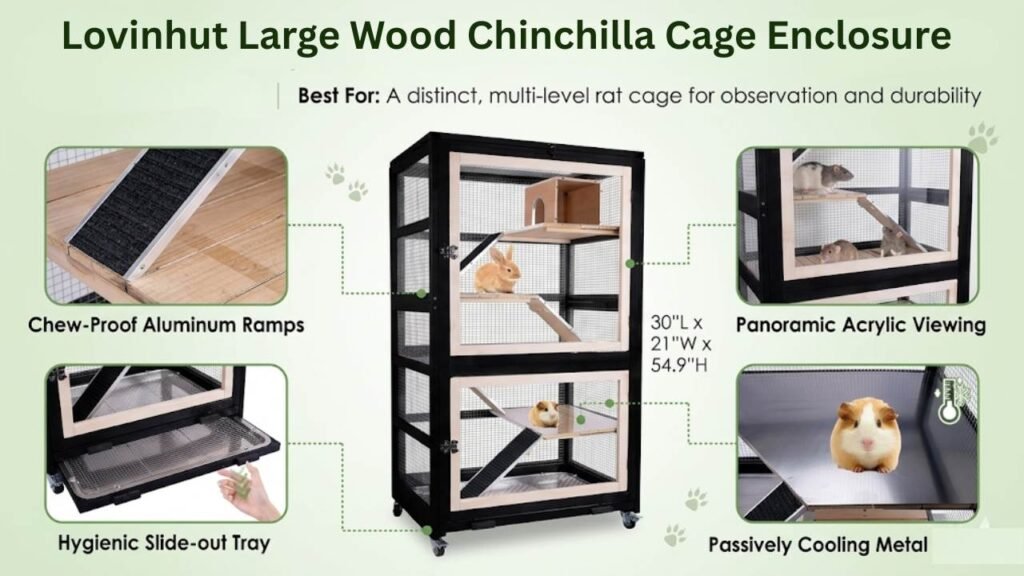
Best For: Rat owners who prioritize a visually distinctive, wood-framed rat cage for multiple rats with chew-proof aluminum ramp edges and panoramic acrylic viewing panels
Why We Recommend It
The Lovinhut enclosure takes the most distinctive structural approach of any rat cage for multiple rats in this review: a wood-framed structure with acrylic panoramic viewing panels, aluminum-edged ramps, and a slide-out stainless steel tray. The aluminum ramp edges solve a specific problem — rats chew wood ramp surfaces relentlessly, degrading structural integrity within weeks.
Aluminum edges resist this damage and protect the underlying ramp structure. The acrylic panels provide full visibility of rat activity without the visual fragmentation of wire bars — useful for behavioral observation and for keeping the cage aesthetically integrated in living spaces.
The temperature note in the product listing is worth taking seriously for rat owners specifically: the cooling metal surfaces mentioned for chinchillas in hot climates apply to rats as well. Rats are sensitive to temperatures above 77°F (25°C) and experience heat stress above 80°F — a cage with metal contact surfaces that dissipate heat provides a passive cooling benefit in warmer environments.
Key Features
- Dimensions: 30″L x 21″W x 54.9″H
- Material: Wood frame with metal components
- Ramps: Chew-proof aluminum-edged ramps with textured surface
- Viewing: Panoramic acrylic panel windows
- Cleaning: Slide-out stainless steel tray + detachable PVC-coated surfaces
- Design: Modular ramp converts to dual play zones
- Access: Large front doors
- Special Feature: Environmentally friendly materials stated
Pros
- Aluminum ramp edges prevent chewing degradation — significantly longer ramp lifespan than wood-only alternatives
- Panoramic acrylic panels allow unobstructed behavioral observation
- Stainless steel slide-out tray is more hygienic than plastic trays that develop permanent odor scratching
- 54.9-inch height provides meaningful vertical enrichment space for climbing behavior
- Modular ramp design allows zone separation — useful in multi-rat setups to reduce territorial tension
- Wood frame aesthetic integrates better into home environments than all-wire designs
Cons
- Wood frame will absorb urine odor over extended use — requires more aggressive cleaning protocols than all-metal
- Bar spacing not explicitly specified — requires pre-purchase verification
- Higher price point for a relatively unvalidated product
- Wood components will eventually show chewing damage despite aluminum ramp edge protection
- No rolling casters — difficult to reposition at 54.9 inches height when loaded
Best For: Rat owners who want a visually distinctive, wood-framed rat cage for multiple rats with durable aluminum ramp protection and panoramic visibility — accepting limited community review data
6. Mcage Large Double Unit 4-Tier Rolling Cage
Best For: Rat owners who need a 4-tier rat cage for multiple rats with rolling casters, included hammock, water bottle, and food bowl for a complete out-of-box setup
Why We Recommend It
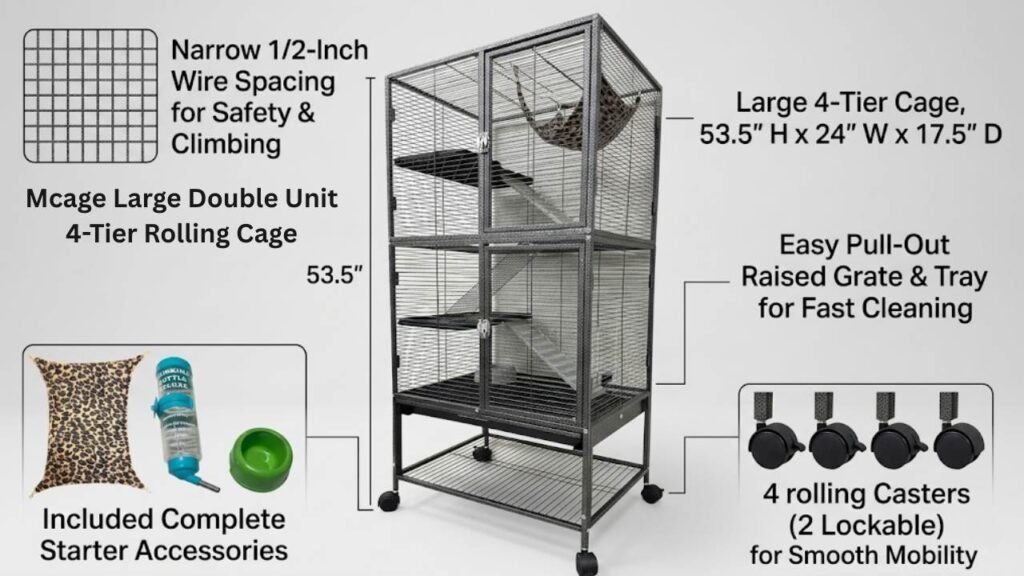
The Mcage Double Unit 4-Tier cage offers the most complete out-of-box setup for a rat cage for multiple rats in this review. The included hammock, water bottle, and food bowl mean the cage is functionally ready for rat occupation immediately — without requiring additional accessory purchases before first use. For owners setting up a rat cage for multiple rats for the first time, this reduces both cost and the research burden of identifying compatible accessories separately.
The 1/2-inch horizontal wire spacing safely contains adult rats, and the horizontal bar orientation on the walls allows rats to climb all four sides — a behavioral enrichment opportunity that vertical-bar cages cannot provide. Four rolling casters (two lockable) on a 53.5-inch cage make repositioning genuinely practical rather than theoretical.
Key Features
- Dimensions: 24″L x 17.5″W x 53.5″H (on rolling stand)
- Bar Spacing: 1/2 inch horizontal — climb-capable walls
- Levels: 4 tiers — two full stories, double unit
- Doors: Large hinged front doors (15″ x 18″) + top hook door (8″ x 9″)
- Locking: Improved safety lock on front doors
- Cleaning: Pull-out platforms, grate, and bottom tray
- Mobility: 4 rolling casters (2 lockable)
- Included: Hammock, water bottle, food bowl, 2 solid platforms, 2 anti-slip ramps
- Storage: Bottom storage shelf for supplies
Pros
- Most complete out-of-box setup — hammock, water bottle, food bowl, platforms all included
- Horizontal 1/2-inch wire spacing allows wall climbing on all four sides
- 4 rolling casters with 2 lockable — genuine practical mobility for a 53.5-inch cage
- Top hook door provides additional access point for feeding and enrichment without opening full front doors
- Bottom storage shelf keeps rat supplies organized at cage location
- 2 solid platforms and 2 anti-slip ramps included — immediate bumblefoot protection
Cons
- 24″ x 17.5″ floor area is modest for a 4-rat colony by welfare space standards
- 1/2-inch spacing is not safe for juvenile rats — requires temporary mesh lining during juvenile stage
- Included accessories (hammock, water bottle) are starter quality — likely to be upgraded with better alternatives
- Wrought iron frame is heavy — meaningful weight even before bedding and rat population
Best For: First-time rat owners setting up a rat cage for multiple rats who want a complete, immediately functional 4-tier setup with accessories included
7. PawHut Large Hamster Cage with Tempered Glass Bottom
Best For: Rat or gerbil owners who want a rat cage for multiple rats with a deep tempered glass base for burrowing substrate, combining wire ventilation with glass containment

Why We Recommend It
The PawHut cage with tempered glass bottom occupies a unique category in this review: it is the only rat cage for multiple rats that combines a deep tempered glass base — suitable for adding several inches of burrowing substrate — with a wire-frame top section for ventilation. For rat owners who want to provide a more naturalistic, burrowing-capable environment rather than a traditional wire-floor platform setup, this hybrid design is functionally irreplaceable among the products reviewed here. Rats are burrowing animals by instinct, and a glass-bottomed enclosure with deep paper substrate allows this behavioral expression that raised wire platforms cannot.
The 0.4-inch bar spacing is the tightest of any cage in this review — safe for juvenile rats, adult rats, smaller gerbils, and dwarf species simultaneously. The front door and top opening provide two independent access points without requiring full cage disassembly.
Key Features
- Dimensions: 30.1″L x 19″W x 21.5″H
- Bar Spacing: 0.4 inches — tightest spacing in this review
- Base: Tempered glass — deep substrate compatible
- Levels: 3 tiers with 2 platforms and 2 ramps
- Material: Alloy steel + tempered glass
- Access: Front door + top opening — dual access
- Cleaning: Frame clips to glass bottom for quick disassembly
- Included: Running wheel, hut, food bowl, water bottle
- Foot Protection: Plastic foot pads + shock-reducing KT board base
Pros
- Tempered glass base allows deep burrowing substrate — unique behavioral enrichment in this review
- 0.4-inch bar spacing is the safest for juvenile rats and smaller species of any cage reviewed
- Running wheel, hut, food bowl, and water bottle included — complete initial setup
- Frame clips to glass base allow fast disassembly for cleaning without tools
- Dual access (front door + top opening) improves daily feeding and enrichment management
- Shock-reducing KT board base protects flooring from vibration during rat activity
Cons
- 21.5-inch total height is the lowest in this review — minimal vertical climbing space for active rat colonies
- Glass base is significantly heavier than plastic tray alternatives — difficult to reposition
- No rolling casters — mobility is very limited at this weight
- Best suited for 1–2 rats by floor space welfare standards — limited colony capacity
- Glass base requires careful handling during cleaning — breakage risk if dropped
- Not appropriate as the primary rat cage for multiple rats in colonies of 3+ animals
Best For: Owners of 1–2 rats, gerbils, and hamster who want to provide deep burrowing substrate in a hybrid glass-base wire-top rat cage for multiple rats, prioritizing naturalistic enrichment over vertical colony space
8. Kaytee My First Home Multi-Level Exotics Habitat
Best For: Budget-conscious rat owners who need a chew-proof-locked, 1/2-inch bar spacing rat cage for multiple rats from a recognized pet brand

Why We Recommend It
The Kaytee My First Home Multi-Level cage delivers reliable baseline performance for a rat cage for multiple rats at a price point accessible to first-time owners who are not yet ready to invest in premium alternatives. The chew-proof locks on the doors are a meaningful safety feature that distinguishes this cage from budget competitors using simple clip closures — rats that learn to manipulate clips will not defeat the Kaytee locking mechanism.
The 1/2-inch wire spacing is appropriate for adult rats, the deep base prevents bedding scatter, and the Kaytee brand’s 150+ years of pet product history provides baseline quality confidence that unbranded alternatives cannot.
The 30″ x 18″ footprint and 30.5″ height provide adequate living volume for 2–4 adult rats as a primary rat cage for multiple rats, with multiple climbing levels that make the vertical space productive.
Key Features
- Dimensions: 30″L x 18″W x 30.5″H
- Bar Spacing: 1/2 inch (12.7mm) — standard adult-rat safe
- Levels: Multiple levels
- Material: Metal
- Locks: Chew-proof locks on doors and wires
- Cleaning: Deep base prevents mess escape + easy assembly for cleaning
- Brand: Kaytee — 150+ years pet product heritage
Pros
- Chew-proof locking mechanisms prevent escape by dexterous problem-solving rats
- 1/2-inch bar spacing is appropriate for adult rat containment
- Deep base significantly reduces bedding scatter onto surrounding floors
- Kaytee brand provides recognized quality baseline and customer support
- 924 reviews with solid 4.3-star rating — reliable community validation
- Easy disassembly for cleaning without complete structural breakdown
Cons
- 30.5-inch height is relatively modest — less vertical enrichment space than taller competitors
- 1/2-inch spacing is not safe for juvenile rats — supplemental mesh required during early stages
- No rolling casters — repositioning the cage for floor cleaning requires lifting
- Does not include hammock, water bottle, or food bowl — additional purchases needed
- 30″ x 18″ floor area is adequate for 2–3 rats but limiting for 4+ animal colonies
Best For: First-time rat owners who want a recognized-brand rat cage for multiple rats with chew-proof locks and reliable 1/2-inch bar spacing at a budget-friendly entry price
Comparison Table: Best Rat Cages for Multiple Rats
| Cage | Dimensions | Bar Spacing | Levels | Pull-Out Tray | Rat Colony Size | Rolling Casters | Best For |
|---|---|---|---|---|---|---|---|
| Critter Nation Double | 36″x24″x63″ | 0.5″ | 2 full levels | Yes (2 pans) | 4–8 rats | No | Large colonies |
| HABUTWAY 60″ Rolling | 36.5″x23″x60″ | Not specified | Multi-level | Yes | 3–6 rats | Yes (4 wheels) | Furniture-style setup |
| Homey Pet 3-Level | 24.8″x16.5″x37.8″ | 0.7″ | 3 levels | Yes | 2–3 rats | Yes | Small colonies |
| Mcage 3-Level Foldable | 30″x18″x24″ | 3/8″ (9.5mm) | 3 levels | Yes | 2–4 rats | No | Travel + juvenile rats |
| Lovinhut Wood Enclosure | 30″x21″x54.9″ | Not specified | Multi-level | Yes (steel tray) | 2–4 rats | No | Aesthetic setups |
| Mcage Double Unit 4-Tier | 24″x17.5″x53.5″ | 0.5″ | 4 tiers | Yes | 3–5 rats | Yes (4 casters) | Vertical colony setups |
| PawHut Glass Bottom | 30.1″x19″x21.5″ | 0.4″ | 3 tiers | No (glass base) | 1–2 rats | No | Single/pair with burrowing |
| Kaytee My First Home | 30″x18″x30.5″ | 0.5″ | Multi-level | Yes | 2–4 rats | No | Budget multi-rat setup |
This YouTube video below explains the best cages for rats, highlighting cage size, bar spacing, ventilation, and enrichment needs. It shows what makes a safe and comfortable rat habitat. Understanding this helps you choose the right cage setup.
How Much Space Do Multiple Rats Actually Need?
Space calculation for a rat cage for multiple rats is one of the most frequently misunderstood aspects of rat welfare. The numbers that matter are cubic feet of usable volume — not just floor dimensions.
The 2 Cubic Feet Rule
The widely cited welfare standard for domestic rats is a minimum of 2 cubic feet of usable space per animal. “Usable” excludes space occupied by cage walls, inaccessible corners, and the volume beneath the lowest platform if it is unreachable.
Practical calculations for selecting a rat cage for multiple rats:
| Number of Rats | Minimum Cubic Feet | Recommended Cage Size |
|---|---|---|
| 2 rats | 4 cubic feet | 24″ x 24″ x 24″ |
| 3 rats | 6 cubic feet | 30″ x 18″ x 30″ |
| 4 rats | 8 cubic feet | 36″ x 24″ x 30″ or 24″ x 17″ x 53″ |
| 5–6 rats | 10–12 cubic feet | 36″ x 24″ x 63″ (Critter Nation Double) |
| 6+ rats | 12+ cubic feet | Double unit cages or multiple connected units |
These are minimums. More space always improves welfare outcomes in a rat cage for multiple rats — reduced territorial stress, more environmental enrichment opportunities, and lower ammonia concentration from distributed waste.
Wire Bar Cages vs. Glass Enclosure Cages for Multiple Rats
The choice between wire bar and glass enclosure formats for a rat cage for multiple rats involves real trade-offs that depend on your specific priorities.
Wire Bar Rat Cages for Multiple Rats
Wire bar cages provide the best ventilation of any rat cage for multiple rats format — essential in multi-animal setups where ammonia accumulation is a real respiratory health concern. Horizontal bars allow wall climbing, which is a significant behavioral enrichment outlet for rats.
Cleaning is straightforward: platforms and trays remove independently, and wire surfaces are easy to scrub. The limitation is bedding containment — without a sufficiently deep base or urine guard, loose substrate escapes through the base gaps onto surrounding floors.
Glass-Base Hybrid Cages (PawHut Style)
Glass-bottom enclosures allow deep burrowing substrate that wire-floor cages cannot accommodate. Rats are natural burrowers, and access to several inches of paper or soil substrate provides behavioral enrichment that platforms and hammocks alone cannot replicate.
The limitation is height — glass bases add weight and structural complexity that limit how tall these rat cages for multiple rats can practically be built. Ventilation is also reduced compared to full wire-wall designs, which matters most in colonies of 3+ animals.
The Practical Recommendation
For a rat cage for multiple rats housing 3 or more animals, a wire bar cage with a deep-enough base pan to contain 3–4 inches of substrate is the most reliable welfare choice. The superior ventilation, cleaning accessibility, and vertical volume of wire bar designs outweigh the burrowing substrate advantage of glass-base alternatives at colony scale.
Essential Accessories for a Rat Cage for Multiple Rats

A properly equipped rat cage for multiple rats needs more than the cage structure itself. These are the additions that most significantly impact rat welfare in a multi-animal setup.
Hammocks and Fabric Shelving
Rats sleep in elevated positions in the wild and show strong preference for hammock-style resting spots in captivity. A rat cage for multiple rats housing 4 animals should have at least 3–4 hammock positions at different heights — providing resting choice without territorial competition over a single preferred spot.
Food Stations
Multiple feeding stations reduce competition stress in a rat cage for multiple rats. Place at least one food dish per 2 rats — ideally at different cage levels — so dominant animals cannot monopolize all food access.
Water Bottles
A single water bottle is inadequate for a rat cage for multiple rats housing 3+ animals. Two bottle positions ensure access is never fully blocked by one animal. Check sipper tubes daily — rats frequently clog or damage sipper mechanisms during normal use.
Burrowing Substrate
At least 3 inches of paper substrate at the cage base allows rats to practice natural burrowing behavior. Carefresh, paper pellets, or hemp bedding all work well — avoid cedar and pine shavings, which release aromatic oils that cause respiratory irritation in enclosed rat cage for multiple rats environments.
Enrichment Items
Rats in a cage for multiple rats require mental stimulation to prevent stress behaviors. Rotating enrichment — cardboard tubes, wooden chews, foraging boxes, dig boxes — keeps the environment novel and reduces boredom-driven cage bar chewing.
How to Clean a Rat Cage for Multiple Rats
Cleaning frequency and thoroughness directly impact both ammonia levels and the long-term health of animals in a rat cage for multiple rats.
- Daily Spot Cleaning
Remove soiled substrate from obvious toilet corners, replace any damp bedding immediately, and check water bottles for blockage. Daily spot cleaning in a rat cage for multiple rats extends the interval between full cleans while maintaining acceptable ammonia levels.
- Twice-Weekly Full Tray Cleaning
Pull out the waste tray, discard all substrate, wipe the tray with a pet-safe unscented cleaner, allow to dry fully, and replace with fresh substrate. In a rat cage for multiple rats housing 4+ animals, twice-weekly tray cleaning is the minimum that maintains acceptable hygiene.
- Monthly Deep Clean
Remove all platforms, ramps, and accessories. Scrub all wire surfaces with a diluted white vinegar solution (1:1 with water) or pet-safe cage cleaner. Rinse thoroughly — residual cleaner causes paw irritation on contact surfaces. Allow all components to dry completely before reassembly. Replace any fabric hammocks that have absorbed permanent odor despite washing.
Frequently Asked Questions About Rat Cages for Multiple Rats
How many rats can comfortably live in one rat cage for multiple rats?
Use 2 cubic feet of usable space per rat as the baseline. The Critter Nation Double accommodates 4–8 adult rats. The Kaytee My First Home and Mcage 4-Tier are appropriate for 2–4 adult animals.
What is the safest bar spacing in a rat cage for multiple rats?
3/8 inch for juvenile rats and smaller females. 1/2 inch for standard adult rats. Never use a rat cage for multiple rats with 1-inch or wider bar spacing for domestic rats at any age.
Can male and female rats be kept together in one cage?
Only if all animals are neutered or the same sex. An unneutered male and female in the same rat cage for multiple rats will produce a litter every 21–23 days — planning accordingly is essential.
How often should a rat cage for multiple rats be fully cleaned?
Daily spot cleaning plus twice-weekly tray changes are the practical minimum for 3+ rats. Monthly deep cleaning of all cage surfaces maintains long-term hygiene and odor control.
Do rats need a solid floor or is wire flooring acceptable in a rat cage for multiple rats?
Wire floors require solid platform covers or fabric shelf liners to prevent bumblefoot. A rat cage for multiple rats should have solid-surface resting areas covering at least 60% of available platform space — wire floors as the only surface option are not appropriate.
What temperature should a room be for a rat cage for multiple rats?
Rats are comfortable between 65–75°F (18–24°C). Temperatures above 80°F (27°C) cause rapid heat stress in rats housed in a cage for multiple rats, where body heat from multiple animals compounds ambient temperature. Ensure adequate room ventilation and keep the rat cage for multiple rats away from direct sunlight, heating vents, and radiators.
Final Thoughts on Choosing the Right Rat Cage for Multiple Rats
The rat cage for multiple rats that works best depends on the size of your colony, your available floor space, your cleaning routine, and how much you are willing to invest in long-term welfare infrastructure.
For most rat owners housing 4 or more adult animals, the Critter Nation Double Unit remains the most comprehensively validated rat cage for multiple rats available — its full-width doors, independent level cleaning, and massive living volume address the welfare needs of a rat colony more completely than any other cage in this review. For smaller colonies of 2–3 rats on tighter budgets, the Kaytee My First Home provides chew-proof locks and recognized brand quality at an accessible entry point. For owners who need juvenile-safe 3/8-inch bar spacing, the Mcage 3-Level foldable cage is the only option in this review that delivers it throughout the entire structure.
What every rat cage for multiple rats in this guide shares — and what no budget or aesthetic consideration should override — is the requirement for adequate ventilation, safe bar spacing, and cleaning accessibility that owners will actually sustain week after week. A rat cage for multiple rats that is difficult to clean will not be cleaned adequately. A cage that is too small will produce territorial stress that affects every rat inside it. And a cage with inadequate bar spacing will not safely contain the animals it is supposed to protect. Get these three fundamentals right, and the specific product matters far less than the care system built around it.
